
Balanced agency growth means adding clients only as fast as you add the hours to serve them well. The rule behind it is simple: sell into capacity you can prove you have, and start hiring before the team is full, not after your best people burn out.
Most agencies do it the other way around. A big win lands and the team absorbs it with late nights. Quality slips on the accounts nobody’s watching, a client leaves, and the owner sells harder to replace the lost revenue. Then the cycle starts again with a thinner margin.
That loop is the capacity death spiral. And it almost always starts with good news.
This guide gives you six steps to break it. Each step ends with a gate, a condition you meet before moving on, so your growth plan runs on the state of your team instead of dates on a calendar. You’ll also get the benchmarks that show whether your growth is healthy, and a way to take the daily monitoring load off your account managers.
What Is the Capacity Death Spiral?
The capacity death spiral is the loop where revenue grows faster than delivery capacity, quality drops, clients churn, and the agency sells harder at lower prices to refill the gap. Each lap leaves less margin to hire the people who would have stopped it.
It runs in six beats:
- You win work the current team can’t absorb.
- People stretch to cover it, and the unbilled work that keeps clients happy gets skipped first.
- Missed issues pile up on the quieter accounts.
- A client leaves or cuts scope.
- You chase replacement revenue fast, usually with discounts or work outside your core.
- Margin shrinks, so the next hire gets pushed back again.
Look at where the damage starts. Not at beat four, when the client leaves. At beat two, when proactive account checks quietly disappear from everyone’s day. That’s why the churn in beat four feels sudden. It isn’t.
What Does Healthy Agency Growth Look Like in Numbers?
Healthy growth shows up as stable margins, workloads with slack in them, and no single client big enough to sink you. Growth rate alone tells you very little. An agency growing 40% a year on 5% margins is closer to trouble than one growing 10% on 18%.
Real benchmarks matter here, because most “healthy range” numbers passed around agency circles are guesses. Promethean Research’s 2026 State of Digital Services report, a survey of 119 agency leaders, put the average digital agency’s after-tax net margin at 13% for 2025, down from 14% the year before. Across Promethean’s data going back to 2015, the long-run average sits around 15%, and a typical agency lands somewhere between 10% and 20%.
The same research shows exactly where growth eats profit. Among agencies that track it, average project margin was 35%. The drop from 35% on the work to 13% on the business is overhead, underpriced scope and hours nobody billed. The death spiral lives in that gap.
If you track only one number from this table, make it capacity coverage. Margin tells you what already went wrong. Coverage tells you what’s about to.
Which of these numbers could you pull up right now without asking anyone?
How to Balance Agency Growth With the Capacity Gates Method
The Capacity Gates method breaks balanced growth into six steps, and each one ends in a gate you must pass before the next step is worth doing. You move forward when the gate is passed, not when a date arrives, and you loop back to the first step every time you add a meaningful chunk of new work.
Calendars are the wrong unit for growth plans. “Hire next quarter” means nothing if the pipeline closes early or never closes at all. Gates tie every decision to what’s actually happening inside your team.
1. Measure the Capacity You Actually Have
Real capacity is the billable hours your team can deliver once leave, holidays and non-billable work come out. Most owners estimate it from headcount, and headcount overstates it by a third or more.
Work it out per role, looking four weeks ahead:
- Start with contracted hours per person.
- Subtract planned leave and public holidays.
- Subtract non-billable time, such as internal meetings, admin, training, sales support and client calls you don’t bill.
- What’s left is available capacity. Divide committed client hours by it to get your capacity coverage ratio.
Say you run six delivery people at 40 hours each. That’s 240 hours a week on paper. Take out roughly 8% for leave and holidays, then another 25% of what remains for non-billable work, and you’re down to about 165 hours. If clients already have 150 of those hours committed, your coverage ratio is 0.91.
You’re full. The org chart just doesn’t show it.
Logged hours turn this from a guess into a number. If your team already tracks time in one of the best time tracking apps like Toggl, Swydo’s Toggl integration brings billable time, non-billable time and hourly rate into the same place as your client performance data. Capacity and results finally sit side by side.
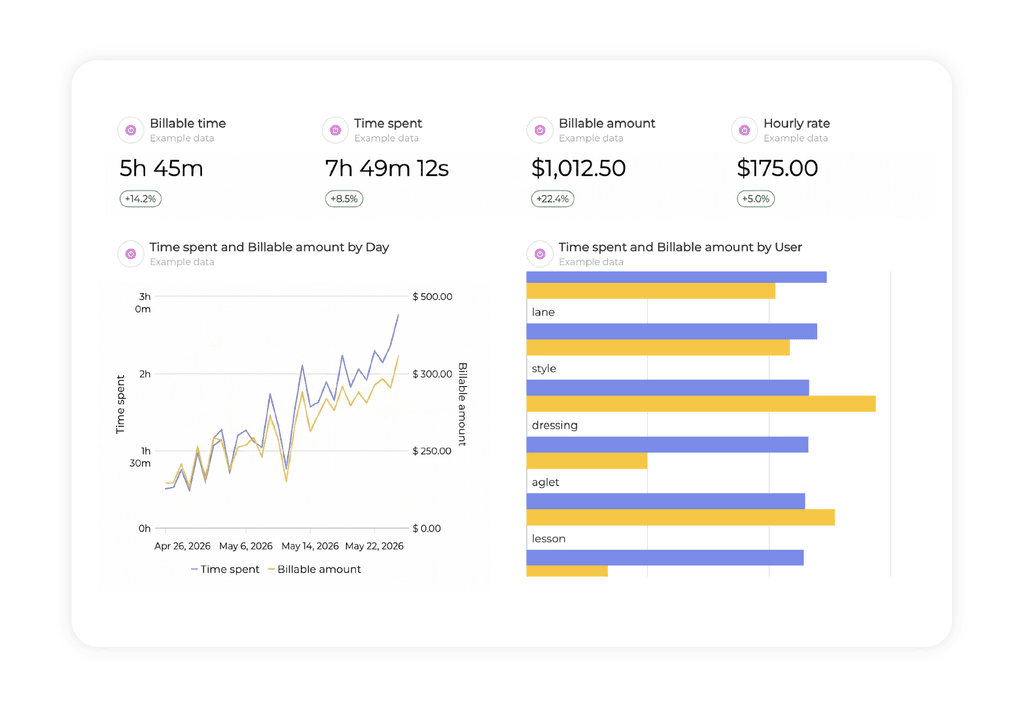
Gate: you can state the coverage ratio for each role for the next four weeks, from data rather than memory.
2. Take the Morning Check Off Your Account Managers
Daily account monitoring is the biggest hidden capacity cost in a growing agency, because it grows in a straight line with every client you sign. It’s also the first task dropped in a crunch, which is exactly when it matters most.
Run the math on your own team. If an account manager spends 12 minutes per client each morning opening ad accounts, checking spend pacing and looking for broken tracking, 25 clients cost five hours a day. That’s 25 hours a week. In the six-person example above, it’s close to one full person’s billable week, spent just looking.
Add ten more clients and you need another hire only to keep watching.
The fix is to flip the check around. The system tells you which clients need attention, and people only open those. In Swydo, four pieces handle it together:
- Metrics Overview shows up to six key metrics across every client on one screen, so the morning scan takes minutes. Build extra views for different services if six metrics isn’t enough for all of them.
- Goals set a target per client, like monthly spend or conversions, and mark each as On Track, Off Track or Achieved.
- Alerts check any metric daily and notify you by email or Slack when it moves out of bounds.
- Data Health Check watches every connection for expired tokens and broken permissions, then emails the connection owner a link to fix it before a report goes out with gaps.
Setup takes a few minutes per rule. Open Monitoring → Alerts → +New Alert, pick the client, data source and metric, then set the trigger condition and a trigger period of 1, 7, 30 or 90 days. Copy the alert across clients that run the same kind of account instead of rebuilding it each time.
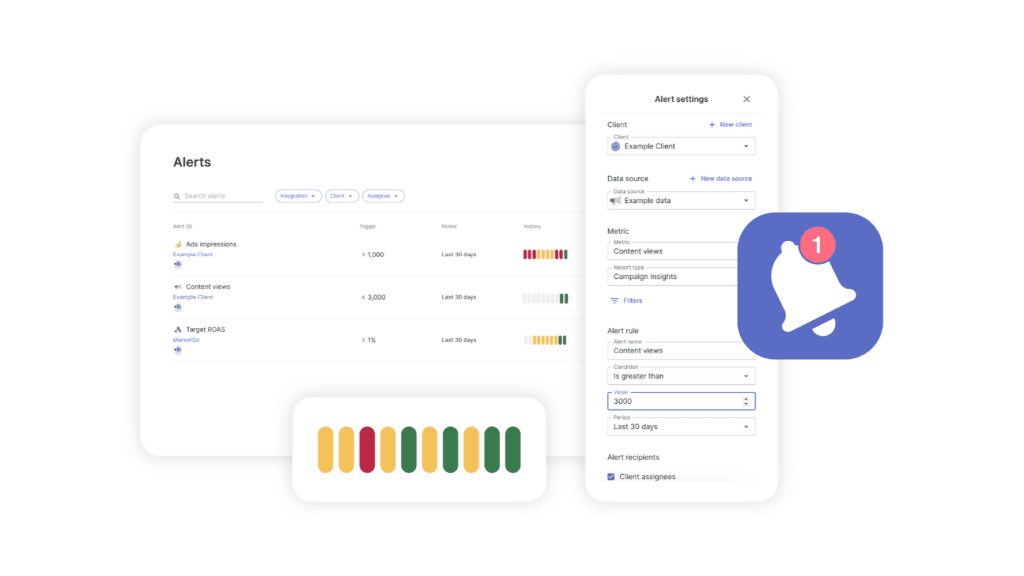
One honest limit. Alerts run on a daily check, so they won’t catch a problem within the hour. For most agency accounts that’s fine, but if a client spends heavily on flash sales, keep a human eye on launch days.
Gate: nobody opens an ad account just to confirm it’s fine. People open accounts because something flagged them.
3. Set Your Sell, Hire and Pause Triggers
Growth decisions go wrong when they’re made in the moment, with a signed proposal sitting on the desk. Decide in advance what your coverage ratio has to be before you sell, before you hire and before you stop selling.
The four bands work like this:
| Coverage ratio | What it means | What to do |
|---|---|---|
| Under 0.75 | Real slack in the team | Sell freely to clients who fit your core services |
| 0.75 to 0.85 | Healthy but filling | Sell into roles with spare hours and line up freelancers for overflow |
| Over 0.85 for two weeks running | Full | Start recruiting now |
| Over 0.95, or quality slipping | Past full | Stop new sales, raise prices on new work or push start dates |
The hiring trigger sits lower than most owners expect, and lead time is the reason. If recruiting takes six weeks and a new hire needs another six before carrying a full load, the person you start looking for today helps in about three months. Wait until the team hits 100% and you’ll run above it for all three.
Freelancers bridge the gap, but watch the pattern. If you’ve paid the same freelancer for the same overflow three months running, you’ve found your next full-time role.
Your project management software or resource scheduler holds the committed hours. The triggers tell you what to do with them.
Gate: leadership has agreed the trigger bands in writing, and the next role’s job description is ready before coverage reaches 0.85.
4. Standardize Delivery Before New Clients Land
Every new client either follows a documented process or invents one, and invented processes live in the founder’s head. Standardize while you still have slack, because nobody writes documentation at 0.95 coverage.
Start with the work that repeats for every client:
- A written client onboarding sequence covering access requests, the kickoff agenda and first-month deliverables.
- Quality checklists for each core deliverable, owned by a named person.
- Client reports built once and reused.
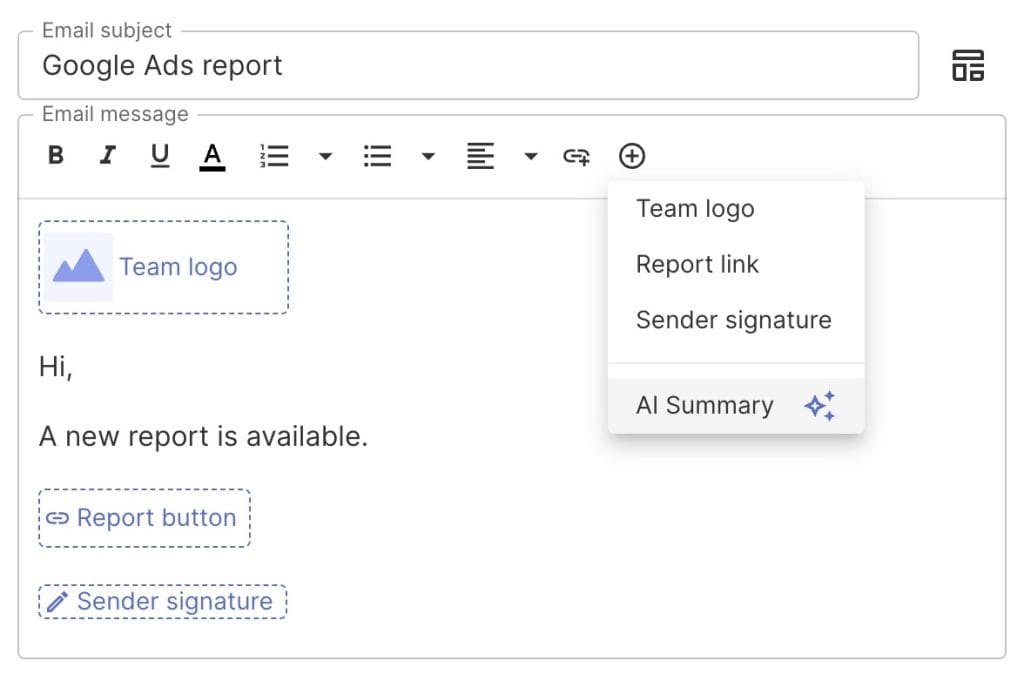
Standardized reporting pays back fastest, because it repeats every month for every client. Build one main report template per service line in Swydo and link client reports to it, so a change to that template updates every linked report at once. Then open the email editor for your scheduled reports, click + and add the AI summary block. Every future send includes a written summary of the period without anyone drafting it.
Which process would break first if five new clients signed tomorrow?
Gate: someone hired last month can onboard a new client from your documentation without pulling in the founder.
5. Protect Margin Before You Add Volume
Growth at thin margins buys you more of the spiral, not less. Before you chase volume, make sure new revenue actually funds the next hire.
Narrow the service mix first. In Promethean’s research, agencies that cut services grew fastest, at 13% on average, compared with 9.8% for agencies that added services and 5.7% for those that held steady. The narrowing group also posted 30% net margins. Fewer services means fewer handoffs, fewer niche specialists to keep busy and less context switching for everyone.
Price for the work you really do. Scope creep is unbilled capacity. If revisions, extra calls and “quick favors” eat a tenth of an account’s hours, that account earns less than its invoice suggests. Our guide to agency pricing covers how to structure retainers so scope has edges.
And don’t switch pricing models in the middle of a growth push. Promethean found the share of agencies using value-based pricing fell from 31% to 18%, and those still using it grew more slowly on average. Change one variable at a time.
Cap client concentration too. Keep your largest client under about 20% of revenue. Above that, one budget cut can force layoffs, and fear of losing that client quietly shapes every decision you make. The wider set of levers lives in our breakdown of agency profitability.
Gate: you know project margin per client, and no client sits above your concentration cap without a plan to dilute it.
6. Grow Existing Accounts Before Chasing New Logos
A bigger scope from a current client costs less capacity than landing a new one. There’s no onboarding, no new access requests and no learning a business from scratch. Once the first five gates are passed, look at your roster before your pipeline.
Test any new service with two or three existing clients before you launch it to everyone, and hire the specialist once demand is proven. Strong client retention also feeds the referrals that most agencies depend on for new business.
When coverage drops under 0.75, go after new logos that fit your narrowed services. Our guide to lead generation for agencies covers the channels worth your time.
Gate: every new commitment, from a small upsell to a new logo, passes a coverage check before anyone says yes. Then go back to the first step and measure again.
The Growth Mistakes That Trigger the Spiral
Four patterns show up again and again when agencies stall mid-growth. Each one feels reasonable in the moment, which is exactly why it’s hard to catch.
Work Outside Your Core
A big project in an adjacent discipline looks like growth. More often it’s a capacity sink. Your team learns on the client’s budget, estimates run long, and you pay contractors at a loss to finish. Before accepting, ask one question. What would you have to turn down to do this well?
The Founder Bottleneck
If every approval, pitch and difficult email runs through you, your calendar is the agency’s capacity ceiling. Set approval thresholds so account managers sign off routine content and budget shifts within agreed limits, and you only see exceptions. The goal isn’t less involvement. It’s involvement where your judgment actually changes the outcome.
Quality That Slips Quietly
Quality rarely fails in one visible moment. It erodes on the accounts nobody’s looking at, so automated monitoring matters far more at 30 clients than at 10. Pick a short list of non-negotiable standards per deliverable and hold them, even when it means pushing a start date.
Fast Hires With Slow Onboarding
Several hires at once, with no real onboarding, splits the team into people who know how things work and people who guess. Write down how decisions get made and how work moves between people. Make that document the first week for every new hire.
Is Hiring Always the Answer?
No. A hire is the right move when demand is proven and the work genuinely needs a person. It’s the wrong move when the team is busy with work a system should be doing.
Before any hire, audit where the hours go. Manual reporting, status checks and copying numbers between tools are capacity problems dressed up as headcount problems. Hire to solve them and you add a salary to a broken process. Our breakdown of scaling agency reporting shows where those hours usually hide.
Automation and AI change the math, but not always in your favor. If you free up hours and immediately fill them with more work at the same rates, you’ve grown busier without growing healthier. So here’s the stance this whole method rests on. Automation in a growing agency shouldn’t cram more clients into the same hours. It should keep coverage under 0.85 while you grow, so your people spend their time on the work only people can do.
Final Thoughts
Balanced growth isn’t a slower version of fast growth. It’s growth that doesn’t have to be rebuilt every time a client leaves.
Three habits carry most of the weight. Measure real capacity by role, not headcount. Take the work that grows with every client, especially daily account checks, off your team. And make sell, hire and pause decisions against written triggers instead of gut feel on the day a proposal gets signed.
Pass one gate at a time. When all six are clear, add work and start again from the first one. If you’re still building the fundamentals, our guide on how to grow a digital marketing agency is a good place to begin.
Stop guessing if your agency growth is sustainable. Track the metrics that matter for balanced scaling.
Start Your Free Trial Today