
The best AI SEO tool depends on the job you need done. For most teams, that means one platform for search data, one for writing and optimizing content, and one for tracking whether AI assistants like ChatGPT and Google’s AI Mode mention your brand.
That third job is new, and it’s why so many “best tool” lists feel off. Google’s AI Overviews now reach more than 2.5 billion people a month and AI Mode over 1 billion, according to figures Google shared at I/O 2026 and on Alphabet’s Q2 2026 earnings call. Ranking on page one is no longer the whole game. Getting named inside the answer matters too.
Below you’ll find a quick answer, a plain explanation of what these tools actually do, honest reviews of the strongest options, real costs, and the mistakes that waste the most money.
The Best AI SEO Tool for Each Job at a Glance
If you only have a minute, start here. Each pick wins a specific job, and the right choice for you comes down to which job is your bottleneck.
| Your main need | Best pick | Starting price | Why it wins |
|---|---|---|---|
| One platform for everything | Semrush One | $199/mo | Keyword, backlink, audit, and AI visibility data in one login |
| Deepest link and keyword data | Ahrefs | $129/mo (Lite) | Best-in-class backlink index and realistic keyword difficulty |
| Budget all-in-one for agencies | SE Ranking | Just over $100/mo | White-label reports and accurate rank tracking at a lower price |
| Writing content that ranks | Surfer | $49/mo (billed yearly) | Live content score inside your editor |
| Best value for content plus AI visibility | Frase | $49/mo | Briefs, writing, and a GEO score in one tool |
| Teams with non-SEO writers | Clearscope | $129/mo | Simplest interface, unlimited users |
| Fixing on-page issues automatically | Search Atlas | $99/mo | OTTO deploys title, meta, schema, and link fixes for you |
| Tracking whether AI recommends you | Otterly.AI, Peec AI, or Profound | From $29/mo | Dedicated AI visibility tracking from budget to enterprise |
| Reporting AI SEO results to clients | Swydo | $69/mo | SEO and AI traffic data in one branded report |
| Free starting point | Google Search Console + ChatGPT, Claude, or Gemini | $0 | Real performance data plus a capable AI assistant |
Pricing in this category changes often, so confirm current plans before you buy.
What an AI SEO Tool Actually Does (and Why One Analogy Isn’t Quite Enough)
An AI SEO tool uses machine learning and large language models to speed up the research, writing, and measurement work that search visibility depends on. A simple analogy gets you most of the way there, but a few details under the hood decide whether a tool is worth paying for.
Think of It Like a GPS for Search
A good GPS does three things: it holds the map, it gives you turn-by-turn directions, and it warns you about live traffic. AI SEO tools split the same way.
- The map is search data: keywords, backlinks, rankings, and competitors. Suites like Semrush and Ahrefs own this layer.
- The directions are content guidance: what to cover, which questions to answer, and how your draft compares to pages already ranking. Surfer, Frase, and Clearscope live here.
- The traffic report is AI visibility: whether ChatGPT, Gemini, Perplexity, or Google’s AI answers mention you, cite you, or recommend a competitor instead. Trackers like Peec AI, Otterly.AI, and Profound watch this.
No single tool does all three equally well. That’s the core reason “the best AI SEO tool” has more than one right answer.
Where the Analogy Breaks Down
A GPS map is objective. AI answers aren’t. Ask ChatGPT the same question twice and you can get two different lists of recommended brands, so a single screenshot of an AI answer tells you very little.
That’s why serious AI visibility tools run the same prompts repeatedly, often daily, across several engines, then report averages like mention rate and share of voice. Surfer’s own documentation openly notes that the same prompt can return different answers each time. When you compare trackers, how often they sample and which engines they check matter as much as the dashboard.
What the “AI” Part Really Means in Each Tool
The label covers very different technology, so it helps to know what you’re buying.
- In content optimizers, AI analyzes the top-ranking pages for a query and maps the topics, entities, and questions they cover. Many also draft text with an LLM, which still needs a human edit.
- In SEO suites, AI mostly summarizes data, suggests keywords, and powers assistants that answer questions about your site.
- In visibility trackers, the tool sends prompts to AI engines, records the answers, and logs which brands and source URLs appear.
- In reporting platforms, AI turns the numbers into summaries and can build a full client report from one prompt, as Swydo’s AI Report Builder does.
General assistants like ChatGPT, Claude, and Gemini can do much of the writing and brainstorming for free. What they lack is live search data, so they can’t tell you search volume, ranking difficulty, or who links to your competitors.
Which Type of AI SEO Tool Do You Actually Need?
Most wasted tool spend comes from buying the wrong category, not the wrong brand. Match the tool to your real bottleneck using the signals below.
Choose an All-in-One Suite When Research Is Your Bottleneck
You need a suite if you can’t confidently answer “which keywords should we target, and who’s beating us?” Suites are also the right first purchase when one person handles SEO end to end. Most now include some AI visibility tracking, which can save you a second subscription.
Choose a Content Optimizer When Publishing Is Your Bottleneck
If you already know your target keywords but your articles stall on page two, a content optimizer is the fix. It shows what top pages cover that yours doesn’t and keeps writers on track without an SEO reviewing every draft. Teams publishing four or more articles a month usually feel the payoff fastest.
Choose an Automation Tool When Implementation Is Your Bottleneck
Some teams know exactly what’s wrong and still can’t fix it, because every title change or internal link waits in a developer queue. Automation tools like Search Atlas OTTO apply on-page fixes directly through a script on your site. They pay off fastest for agencies managing many small sites, as long as someone reviews the changes before they go live.
Choose an AI Visibility Tracker When You Need Proof From AI Search
A dedicated tracker makes sense once leadership asks, “Does ChatGPT recommend us?” and you need a number, not a guess. It’s also essential for brands in categories where buyers ask AI for shortlists, such as software, finance, and travel. If you’re early stage, the AI module inside your suite is usually enough to start. When you’re ready to compare trackers, our guide to the best AI rank tracking tools goes deep on accuracy, pricing, and setup.
Where Free AI Assistants Fit In
ChatGPT, Claude, and Gemini are excellent for outlines, rewrites, schema markup, and summarizing research. Pair one with Google Search Console, which is free and shows your real queries and clicks, and you have a surprisingly capable $0 setup. If your marketing data already lives in Swydo, the Swydo MCP connector lets you ask ChatGPT or Claude questions about it directly.
You’ll outgrow a free setup when you need competitor data or want to track AI mentions at scale.
AI SEO Tools Compared Side by Side
This table shows what separates the leading tools once you look past the feature lists: who each one is built for, how it handles teams, and the trade-off you accept by choosing it.
| Tool | Category | Team seats | Standout strength | Biggest drawback |
|---|---|---|---|---|
| Semrush One | All-in-one + AI visibility | Extra users cost more, plus $99/user for AI Visibility access | Broadest data and AI tracking in one place | Costs climb quickly with seats and add-ons |
| Ahrefs | All-in-one | Paid per user | Backlink and keyword data many SEOs treat as the benchmark | Full AI tracking (Brand Radar) is a separate, sizable add-on |
| SE Ranking | Budget all-in-one | Seats by plan | Strong value and white-label reports for agencies | Smaller data set than Semrush or Ahrefs |
| Surfer | Content optimizer + AI tracking | Workspaces by plan | Real-time content scoring in Google Docs and WordPress | Score measures topic coverage, not ranking certainty |
| Frase | Content optimizer + GEO | 3 seats on Professional, extra seats $29 | Lowest price for briefs, writing, and an AI visibility score | Thin keyword research |
| Clearscope | Content optimizer | Unlimited users | Easiest for writers who aren’t SEOs | No keyword database |
| Search Atlas | Suite + automation (OTTO) | By plan | Automatically deploys on-page fixes | Mixed reviews on billing and cancellation |
| Swydo | Client reporting + AI insights | Unlimited users | SEO and AI traffic data in one branded, automated report | Reports on the data your SEO tools collect rather than tracking prompts itself |
The Best AI SEO Tools, Reviewed
Each review covers who the tool suits, what its AI features actually do, what you’ll really pay, and when you should skip it. The order follows the three jobs: suites first, then content optimizers, then a short roundup of dedicated AI visibility trackers, an on-page automation platform, and finally the reporting platform that shows the results to clients.
Semrush One Is the Best All-in-One AI SEO Platform
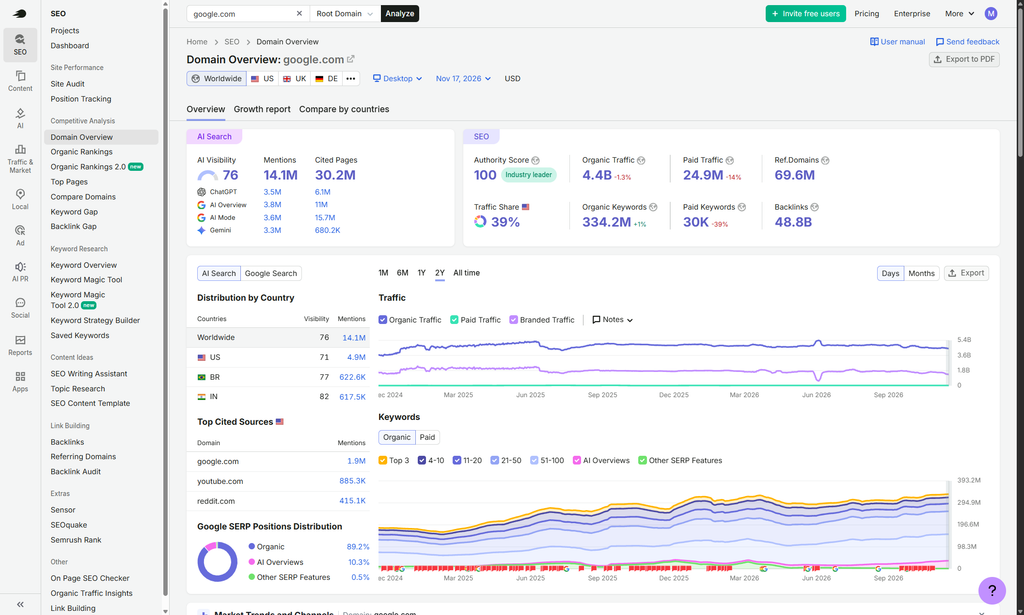
Semrush One earns the top all-in-one spot because it covers the full SEO workflow in one login, then layers AI search on top. Keyword research, site audits, rank tracking, backlink analysis, and competitor research all run from the same project, so a small team doesn’t need a separate tool for each job or an afternoon spent stitching exports together.
The AI features sit inside that workflow rather than beside it. Keyword research flags which queries trigger AI Overviews, so you can spot where a page-one ranking now earns fewer clicks and decide whether that keyword still deserves budget. The Content Toolkit turns keyword data into briefs and drafts, and Semrush’s AI assistant suggests fixes based on your own audit and ranking data. Every Semrush One plan also includes AI visibility tracking, which our guide to the best AI rank tracking tools compares against dedicated trackers. Semrush is now owned by Adobe, which completed the purchase in April 2026 for $1.87 billion, according to Adobe’s quarterly SEC filing.
Pricing: Starter is $199/mo ($165.17/mo billed annually) with 500 tracked keywords and 50 AI prompts. Pro+ is $299/mo and Advanced is $549/mo. Each additional user needs $99/mo for AI Visibility access on top of the normal seat fee.
What users say: Reviewers praise the breadth and ease of use. The steady complaint is cost once add-ons and extra seats stack up.
Skip it if you’re a solo writer who mainly needs content guidance. A content optimizer covers that for a quarter of the price.
Ahrefs Is Best for Backlink and Keyword Data Depth
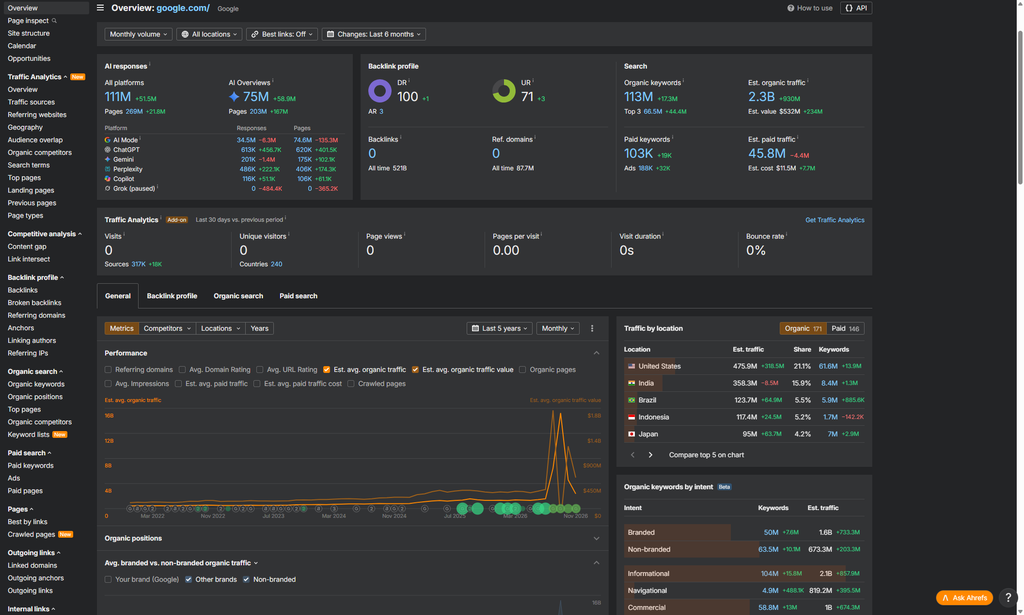
Ahrefs makes the list because its data sits underneath the strategy everything else depends on. Its backlink index is the one many SEOs treat as the benchmark, and when a page stalls on page two, Ahrefs usually explains why: who links to the pages above you and which keywords they actually rank for.
That depth shows up in everyday decisions. Keyword difficulty reflects the links top-ranking pages actually have, so you can tell a realistic target from a wishful one. Content Gap lists the keywords competitors rank for and you don’t, which turns into a content plan in minutes. The AI Content Helper then drafts around that research instead of writing from a blank prompt. Brand Radar adds AI visibility research as a paid add-on, and our AI rank tracking guide covers how it compares with dedicated trackers.
Pricing: Lite starts at $129/mo, Standard at $249/mo, and Advanced at $449/mo, with a limited $29 Starter plan. Full Brand Radar coverage costs $199/mo per AI platform or $699/mo for all of them.
What users say: Data quality earns consistent praise. The usage-credit system frustrates people who run lots of reports.
Skip it if AI visibility is your main goal and your budget is tight. A dedicated tracker costs far less than Brand Radar’s full bundle.
SE Ranking Is the Best Budget All-in-One for Agencies
SE Ranking makes the list because it gives agencies most of what Semrush or Ahrefs does at a price that still works when you multiply it across a client roster. Keyword research, accurate daily rank tracking, site audits, backlink data, and competitor research live in one account, and white-label reports go out under your agency’s own brand.
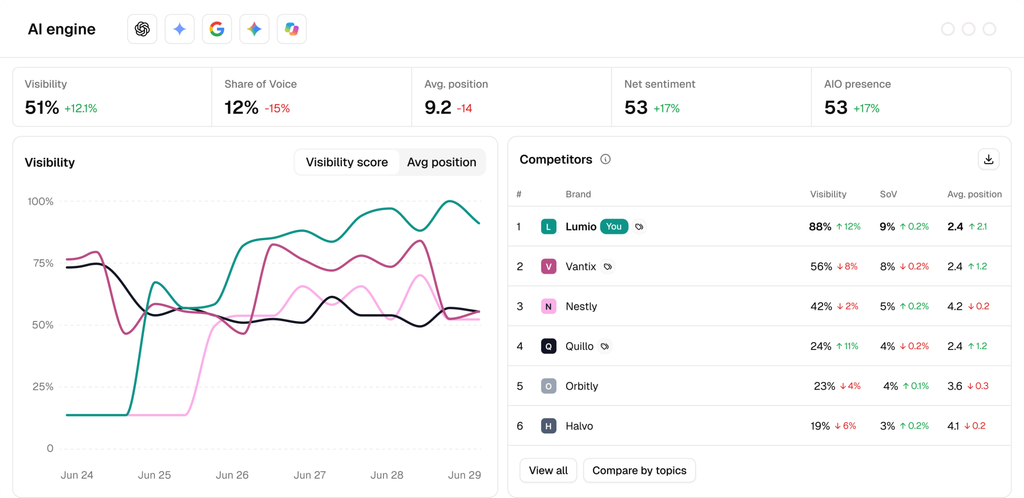
Its AI features lean toward agency workflows. Content and on-page tools score each client page against the competitors outranking it, which gives account managers a clear fix list for every monthly call. An AI search add-on tracks how often Google AI Overviews, ChatGPT, Gemini, and Perplexity mention each client, so you can answer the question clients now ask most without buying a second platform. SE Ranking data also flows into branded client reports through Swydo’s SE Ranking integration.
Pricing: Core plans start just over $100/mo. The AI search add-on starts at $89/mo for 200 checks, with 20% off on annual billing.
What users say: Agencies praise the value and the rank-tracking accuracy. Its database is smaller than the two market leaders.
Skip it if you work in very large or international markets where data depth decides strategy.
Surfer Is the Best AI Content Optimizer for SEO-Led Teams
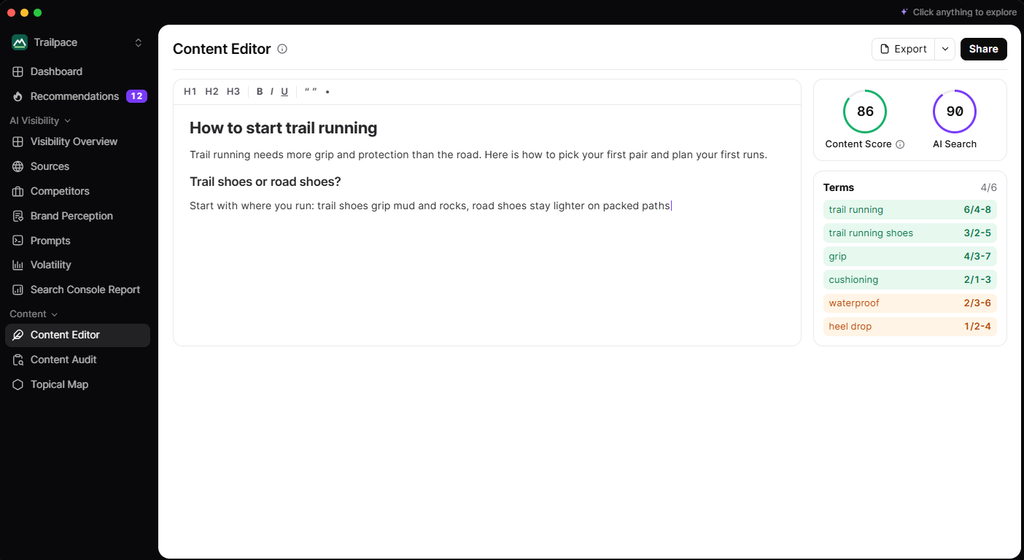
Surfer earns its spot because it closes the loop between finding a gap and fixing it. Most tools stop at telling you something is wrong; Surfer shows you the exact page to rewrite and guides the rewrite in the same place.
Its Content Editor scores your draft against the pages already ranking and updates as you type in Google Docs or WordPress, so writers fix missing topics before an editor ever sees the draft. An AI Search tab adds the facts, entities, and claims a page should include to be cited in AI answers. The AI Tracker then monitors ChatGPT, Perplexity, Gemini, AI Overviews, and AI Mode daily. When a prompt names your competitor instead of you, Surfer links the underperforming page straight back into the Content Editor, which turns AI visibility from a report into a to-do list.
Pricing: Plans start at $49/mo billed yearly, with Standard at $99/mo and Pro at $182/mo (both yearly). Pro adds daily tracking of 50 AI prompts. AI Search Analytics also sells on its own from $95/mo for 50 daily prompts.
What users say: The live content score is the feature people keep paying for. AI-generated drafts usually need heavy editing to sound human.
Skip it if your writers chase the score instead of the reader. A 90+ score on a generic article still loses to a 70 with real expertise.
Frase Offers the Best Value for Content Plus AI Visibility
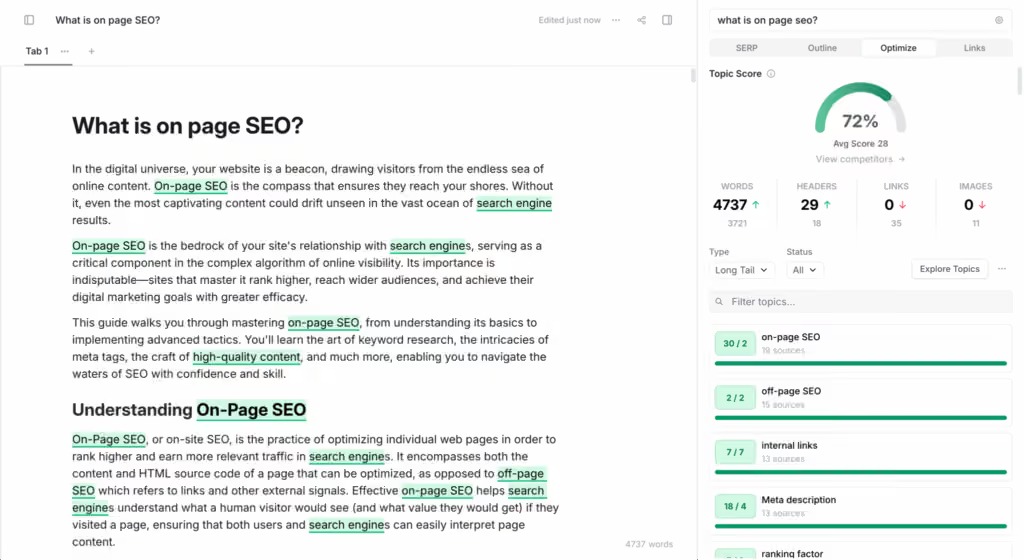
Frase makes the list because it covers the most ground per dollar. For under $50 a month, a solo SEO gets research briefs, an AI writer, an optimization score, and basic AI visibility tracking in one tool, which would otherwise take two or three subscriptions.
The brief builder is where it saves the most time. Enter a keyword and Frase pulls the top results, their headings, and the questions people ask, so a writer starts with a structure in minutes instead of an hour of tab-hopping. Alongside the SEO score, a GEO score estimates how likely the page is to be cited by AI engines, which nudges writers toward the clear, direct answers AI tools tend to quote.
Pricing: Starter is $49/mo ($39 billed yearly), Professional is $129/mo ($103 yearly) with 3 seats, and Scale is $299/mo ($239 yearly). Starter tracks ChatGPT and Google’s AI, Professional adds Perplexity, and Scale adds Claude and Gemini. Use the 7-day free trial fully, since Frase’s terms treat paid fees as final.
What users say: Setup is quick and the briefs save real time. Keyword research is limited, so most users pair it with a suite.
Skip it if you need keyword volume and difficulty data in the same tool.
Clearscope Is Best for Teams With Non-SEO Writers
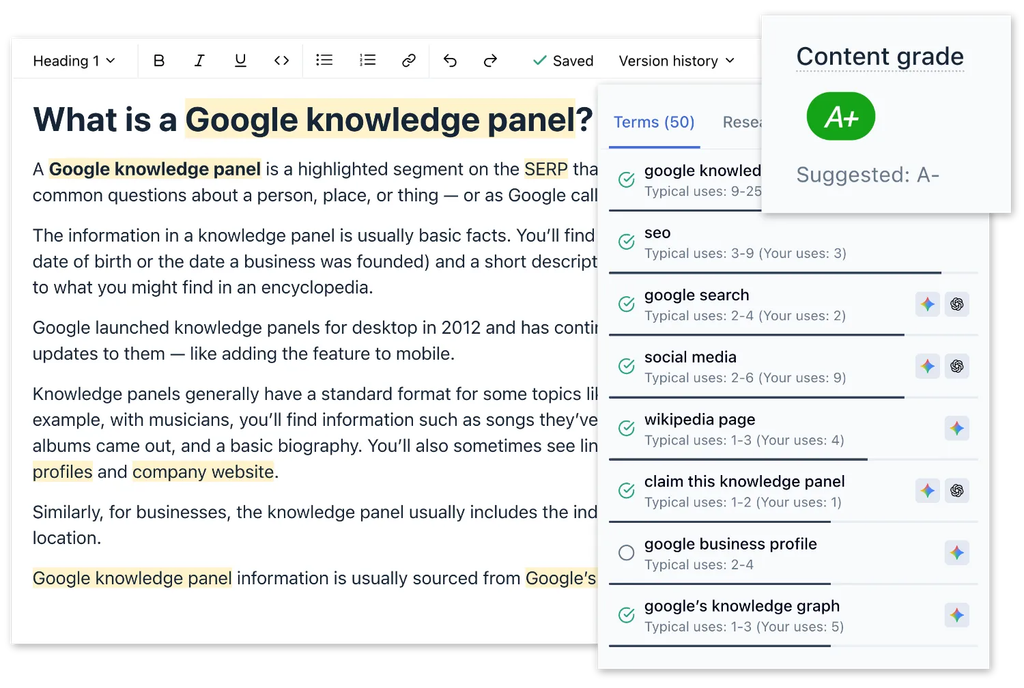
Clearscope earns its place by solving a people problem rather than a data problem. When freelancers, subject matter experts, or product marketers write your content, the hardest part is getting them to follow SEO guidance at all. Clearscope’s editor is simple enough that they actually do.
Writers see a short list of topics to cover and a letter grade, right inside Google Docs or WordPress, with no dashboards to learn. The tool has also moved into AI search: it now shows the questions buyers ask AI tools and which brands get recommended instead of yours, then turns those gaps into writing guidance. Because every plan includes unlimited users, it becomes cheaper per writer the larger your team gets, which is the opposite of most tools on this list.
Pricing: Essentials is $129/mo and Business is $399/mo, with enterprise plans on request. Older reviews quoting $170 or more are out of date.
What users say: On G2’s head-to-head comparison, users rate Clearscope ahead of Surfer on ease of use and support.
Skip it if you also need keyword research and rank tracking. Clearscope focuses on content and pairs best with a suite.
Dedicated AI Visibility Trackers Show Whether AI Recommends You
The tracking built into Semrush One, Ahrefs, Surfer, and SE Ranking covers the basics. A dedicated tracker earns its cost once AI visibility becomes a number someone reports on every month, or once you need engines your suite doesn’t cover. That second point matters more each quarter: ChatGPT’s share of generative AI web traffic fell from about 76% to about 53% between mid-2025 and May 2026 while Gemini climbed to roughly 27%, according to Similarweb.
Four trackers cover most needs:
- Otterly.AI is the cheapest way to start, at $29/mo for 15 prompts. It separates brand mentions from website citations, which tells you whether to fix your reputation or your pages.
- Peec AI suits marketing teams, from $95/mo with daily tracking and unlimited seats. Its sources view shows which sites AI engines trust in your category.
- SE Visible suits agencies, from $89/mo with unlimited seats and coverage of ChatGPT, AI Overviews, AI Mode, Gemini, and Copilot.
- Profound suits enterprises, with custom pricing, AI crawler analytics, and checks for AI answers that get your facts wrong.
For hands-on reviews, accuracy testing, and prompt setup advice, see our full guide to the best AI rank tracking tools.
Search Atlas Is Best for Automated On-Page Fixes
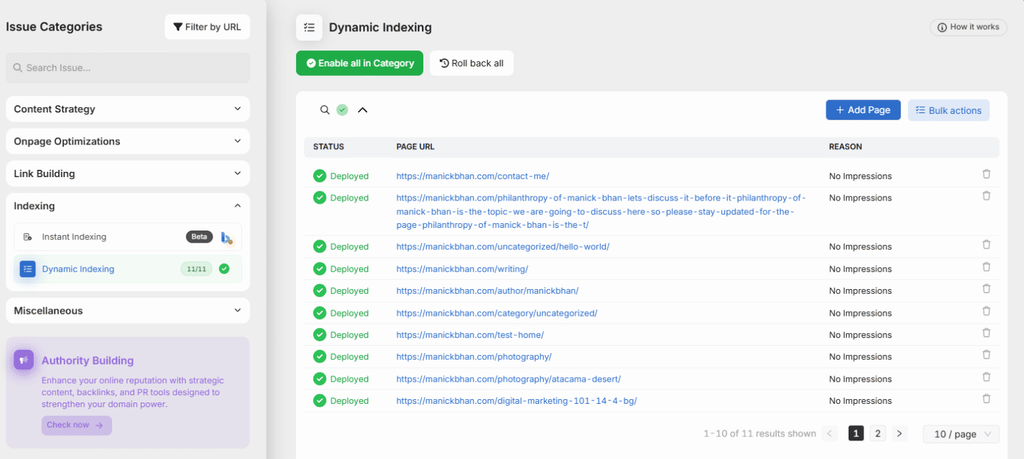
Search Atlas makes the list for teams whose real bottleneck is implementation, not insight. Most SEO tools hand you a list of 200 fixes and leave the work to you or a developer queue. Search Atlas pairs a full SEO suite with OTTO, an agent that makes many of those fixes itself.
Once a small script is added to your site, OTTO can rewrite weak titles and meta descriptions, add internal links, fix schema markup, and help pages get indexed, then grades how your site improves over time. For an agency managing dozens of small client sites with no developer support, that can clear months of backlog in days. The Growth plan adds LLM visibility tracking, so the same platform shows whether those fixes help in AI answers too.
Pricing: Starter is $99/mo and Growth is $199/mo, with lower rates for annual billing and a 7-day free trial.
What users say: Reviews are split. Many praise the automation, but its Shopify App Store listing includes complaints about unexpected charges, so watch your billing settings.
Skip it if you want full manual control over every change on your site, or you can’t review automated edits before they go live.
Swydo Is Best for Reporting AI SEO Results to Clients
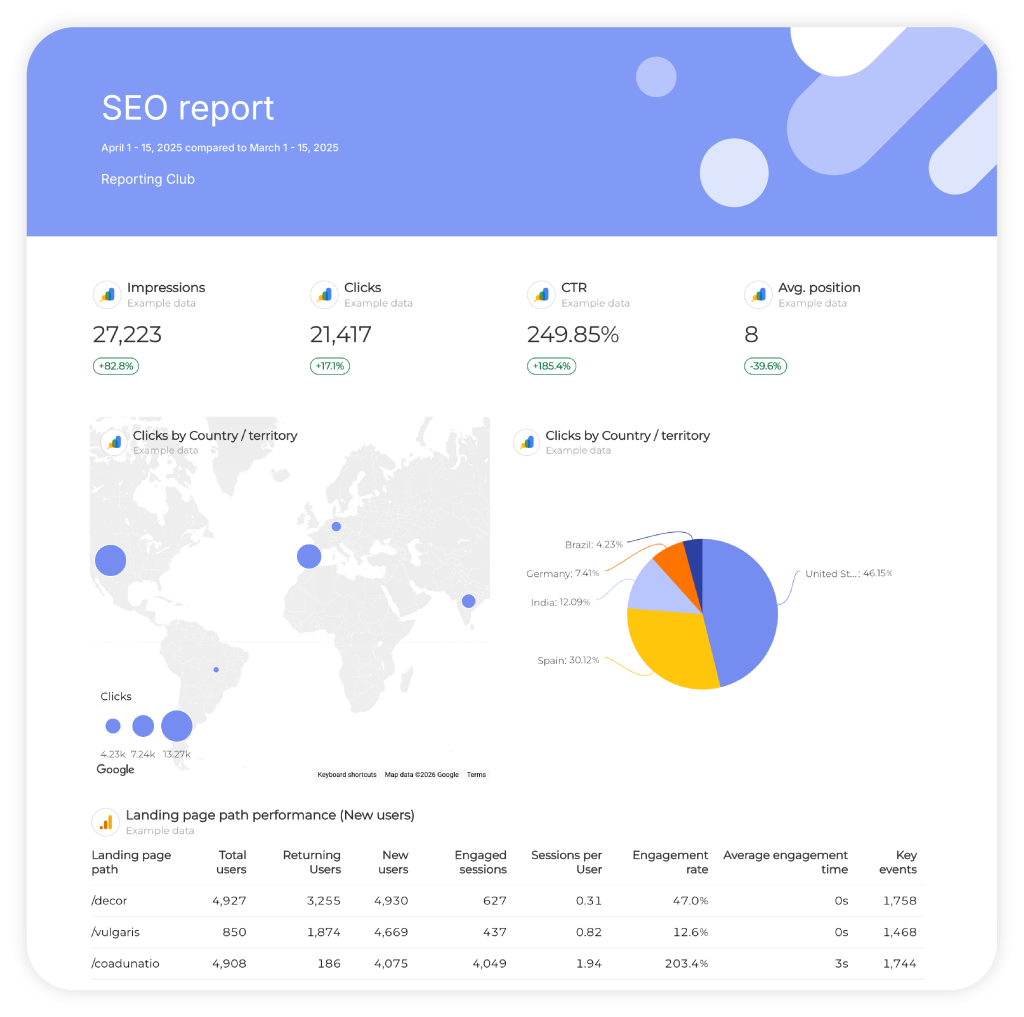
Swydo turns what your other tools find into a report a client or executive will actually read. It pulls Google Search Console, GA4, Semrush, and SE Ranking data into one branded report. Its AI Traffic GA4 report template separates visits and conversions from ChatGPT, Gemini, Perplexity, and other AI assistants.
The AI features speed up the reporting itself. The AI Report Builder creates a full report from a one-line prompt, AI summaries explain what changed, and the Swydo MCP connector lets you ask ChatGPT or Claude about client data directly. Monitoring and alerts flag drops across every client before the monthly report goes out.
Pricing: $69/mo (about $62/mo billed annually) includes 10 data sources, with unlimited clients, users, and reports. Pricing scales by data source rather than by client, and there’s a 14-day free trial with no credit card required.
What users say: Agencies credit the hours saved on recurring client reports and the unlimited-user setup.
Pair it with a suite or AI visibility tracker from this list. Those tools produce the results, and Swydo shows them to the people paying for the work.
What AI SEO Tools Really Cost at Every Budget
The sticker price is rarely what you pay. Seats, extra domains, extra AI engines, and prompt limits are where bills quietly double, so it pays to price the whole stack before committing.
Hidden Costs to Price In Before You Buy
A few examples show how fast the math changes:
- Seats: On Semrush One, two extra teammates need $198/mo for AI Visibility access alone, before standard seat fees.
- AI add-ons: Ahrefs Lite plus full Brand Radar coverage comes to $828/mo, more than six times the Lite price on its own.
- Engines: On Otterly.AI, Gemini, AI Mode, and Claude cost extra. On Peec AI, you get 3 models before add-ons.
- Prompts: Most trackers price by prompt volume. Fifteen prompts covers one product line; a real category usually needs 50 to 100.
- Billing terms: The lowest advertised prices usually require annual billing, which locks you in while these products change quickly.
Recommended Tool Stacks by Monthly Budget
These combinations cover research, content, and AI visibility without paying twice for the same feature.
| Budget | Recommended stack | Approximate monthly cost | Best for |
|---|---|---|---|
| $0 | Google Search Console, GA4, a free AI assistant, free Semrush or Ahrefs accounts | $0 | Learning the ropes, very small sites |
| Under $100 | Frase Starter (yearly) + Otterly.AI Lite | About $68 | Solo creators and bloggers |
| $100 to $300 | Semrush One Starter, used for both SEO and AI tracking | $165 to $199 | Small businesses with one marketer |
| $100 to $300 (alternative) | Ahrefs Lite + Frase Starter (yearly) + Otterly.AI Lite | About $197 | Link-focused sites that publish often |
| $300 to $600 | Semrush One Pro+ + Clearscope Essentials | About $428 | In-house teams with several writers |
| $300 to $600 (agency) | SE Ranking + SE Visible Core + Clearscope Essentials | About $420 | Agencies needing white-label reports and unlimited seats |
| Enterprise | Semrush or Ahrefs enterprise + Profound + Clearscope Business | Custom | Large brands with dedicated SEO and content teams |
One rule saves the most money: if your suite already tracks AI visibility, don’t add a separate tracker until you’ve outgrown its prompt limit.
How to Build a $0 AI SEO Setup That Actually Works
You can cover a surprising amount of ground before paying for anything. This setup suits new sites, side projects, and anyone testing whether SEO deserves a budget:
- Google Search Console shows the queries you already appear for, your clicks, and pages Google struggles to index. It’s the only source of Google’s own data about your site.
- GA4’s AI Assistant channel shows visits from ChatGPT, Gemini, and Perplexity. Our guide to tracking AI traffic in GA4 walks through the setup.
- Ahrefs Webmaster Tools is free for sites you verify and gives you backlink and site audit data for your own domain.
- A free AI assistant like ChatGPT, Claude, or Gemini handles outlines, title rewrites, FAQ drafts, and schema markup. Feed it your Search Console queries instead of guessing what people search for.
- A monthly manual AI check means asking ChatGPT, Gemini, and Perplexity your five most important buyer questions and noting which brands get named.
You’ll outgrow this once you need competitor keyword data, want to track more than a handful of AI questions, or report results to someone else every month.
The Best AI SEO Tool for Your Situation
The same tool can be a bargain for one team and dead weight for another. Here’s how the picks shift depending on who you are and what you sell.
For Beginners: Start Free, Then Add One Tool
Spend your first month in Google Search Console learning which queries already bring you clicks. Then add one paid tool that matches your gap: Frase if writing is the hard part, Semrush One if you don’t know what to write about. Buying three tools on day one usually means using none of them well.
For Freelancers and Solo Consultants: Prioritize Value and Flexibility
Frase or Surfer covers client content work at a low monthly cost, and Otterly.AI Lite lets you show clients their AI visibility for $29. Choose monthly billing while your client roster is still changing.
For Agencies: Look for Unlimited Seats and White-Label Reporting
Per-seat pricing punishes agencies as they grow. SE Ranking with SE Visible, Peec AI, and Clearscope all avoid per-user fees, and SE Ranking adds white-label reports clients can see under your brand.
The bigger agency challenge is showing clients results from several tools at once. Swydo pulls Search Console, GA4, Semrush, and SE Ranking data into one branded report on a schedule, and our roundup of the best SEO reporting software for agencies compares the other platforms that do this.
For Ecommerce Sites: Focus on Scale and Product Pages
Online stores need tools that handle thousands of product and category pages. A suite like Semrush or Ahrefs handles audits and keyword mapping, while automation tools like Search Atlas can roll out title and meta fixes in bulk. Be careful with AI-written product descriptions at scale, since templated, thin pages are exactly what Google’s spam policies target.
For Local Businesses: Keep It Simple
Most local businesses need Google Business Profile management, review generation, and local rank tracking more than an enterprise suite. A free AI assistant plus a local-focused SEO tool usually delivers more than a $200/mo all-in-one subscription.
For Enterprise Teams: Invest in Governance and Depth
Large brands need user permissions, API access, and engine coverage across many markets. Pair an enterprise suite with Profound or Scrunch for AI visibility, and set a review process so AI-drafted content never publishes without an expert sign-off.
Head-to-Head Matchups People Ask About Most
These three comparisons come up in nearly every buying conversation. Each verdict depends on how your team works, so here’s the deciding factor for each.
Semrush vs. Ahrefs for AI SEO
Semrush is the better pick if AI visibility is a priority, because tracking is built into Semrush One from $199/mo. Ahrefs wins on backlink data, but matching Semrush’s AI coverage means adding Brand Radar, which can push a Lite plan past $800/mo. Choose Ahrefs when link building drives your strategy and AI tracking can wait or live in a cheaper tool.
Surfer vs. Clearscope vs. Frase
All three improve content, but they suit different teams:
- Surfer fits SEO-led teams that want detailed scoring, internal linking help, and AI tracking in the same tool.
- Clearscope fits teams where writers aren’t SEOs. It’s the easiest to learn and includes unlimited users.
- Frase fits solo operators and small budgets that want briefs, drafts, and a GEO score for the least money.
If you’re still unsure, think about who will use it daily. The tool your writers actually open beats the tool with the longest feature list.
Semrush One vs. SE Ranking for Agencies
Semrush One is the stronger choice when data depth and built-in AI tracking matter most, starting at $199/mo. SE Ranking wins when you need white-label reports and lower costs across many clients, starting just over $100/mo with an optional AI search add-on. Agencies with large international clients usually justify Semrush; agencies running many small local and SMB accounts usually get more from SE Ranking.
How to Use AI SEO Tools Without Risking a Google Penalty
Google doesn’t penalize content for being AI-assisted. It penalizes content that’s unhelpful or mass-produced to game rankings, and the line between the two comes down to how you use your tools.
What Google’s Policies Actually Say
Google’s guidance on AI-generated content says it rewards helpful, high-quality content however it’s produced. The risk sits in its scaled content abuse policy, which targets pages generated in bulk primarily to manipulate rankings, regardless of whether a person or a machine wrote them.
Google has also tightened its expectations around review. Its guidance updated in early October 2026 stresses manually fact-checking AI-generated content before publishing, including titles, meta descriptions, and structured data, as Delante’s breakdown of the changes explains.
A Safe Workflow for AI-Assisted Content
Use AI where it’s strong and keep people where judgment matters:
- Research with AI: Let your tools pull keywords, questions, and competitor gaps.
- Outline with a human: Decide the angle and what you know that competitors don’t.
- Draft with AI if you like: Treat the output as a rough first pass, not a finished page.
- Add real expertise: Include first-hand experience, original data, examples, and opinions.
- Fact-check every claim: Verify statistics, prices, and product details against original sources.
- Publish at a pace you can review: If no one can read every page before it goes live, you’re publishing too fast.
How to Tell If Your AI SEO Tools Are Paying Off
Clicks alone no longer tell the full story, because AI answers satisfy many searches before anyone visits a website. You need a few new measurements alongside rankings and traffic.
Why Rankings and Clicks Aren’t Enough Anymore
When an AI Overview appears, the top organic result gets 58% fewer clicks, according to an Ahrefs study of 300,000 keywords. Pew Research Center found the same pattern from the user side: people clicked a result in 8% of searches with an AI summary versus 15% without one.
There’s good news inside that data. Pages cited in AI Overviews earn more than twice the click-through rate of uncited pages, about 2.1% versus 0.9%, based on Seer Interactive’s analysis reported by Search Engine Land. Being the cited source is now one of the best ways to protect your traffic.
Track AI Signals Alongside Your Usual SEO Numbers
Keep rankings and organic traffic in your report, then add AI referral visits and branded search growth. GA4 added a dedicated AI Assistant channel in May 2026, as PPC Land reported, so you no longer need custom filters to see visits from ChatGPT, Gemini, and Perplexity. People who see you in AI answers often search for you by name later, which shows up as branded search growth in Search Console.
Keep expectations realistic. AI platforms sent about 0.32% of total website traffic across more than 100,000 sites, and 60% of those visits landed on homepages, according to SE Ranking’s research. Make sure your homepage clearly explains what you do and where to go next.
Show AI SEO Results to Clients in One Report
Most AI SEO tools keep their numbers inside their own dashboards, so clients and executives end up juggling logins and screenshots. Swydo pulls Google Search Console, Semrush, and SE Ranking data into one branded report, and its AI Traffic GA4 report template breaks out visits and conversions from AI assistants. For a step-by-step walkthrough, see our guide to creating SEO reports for clients.
Common Mistakes When Choosing and Using AI SEO Tools
Most disappointment with AI SEO tools traces back to a handful of avoidable decisions. Watch for these before you sign up and again a few months in.
- Buying a writer when you need a strategist. AI drafts built without search data and a clear angle produce pages that look like everyone else’s.
- Treating the content score as a ranking guarantee. Scores measure topic coverage, not authority, originality, or links.
- Judging AI visibility from one screenshot. AI answers change from one run to the next. Trust trends from repeated sampling, not a single check.
- Paying twice for the same feature. Semrush One, Surfer Pro, and a standalone tracker can all monitor the same prompts.
- Ignoring per-seat and per-engine pricing. The plan price is a starting point, not the total.
- Locking into annual plans too early. Try monthly first, then switch once the tool proves itself.
- Letting automation run unchecked. If a tool changes titles or links on your live site, review its changes and know what happens to them if you cancel.
- Trusting old reviews and listicles. Pricing and features in this category change every few months, so always confirm on the vendor’s own site.
- Measuring only clicks. You’ll undervalue AI visibility unless you also track mentions, citations, and branded search.
Frequently Asked Questions About AI SEO Tools
These are the questions buyers ask most often, answered directly.
What Is the Best AI SEO Tool Overall?
Semrush One is the best all-around choice for most teams because it combines keyword research, site audits, and AI visibility tracking in one platform, starting at $199/mo. If your main need is writing better content, Surfer or Frase is the better buy.
What Is the Best Free AI SEO Tool?
The most useful free setup is Google Search Console paired with a free AI assistant like ChatGPT, Claude, or Gemini. Search Console shows your real search performance, and the assistant helps with outlines, rewrites, and schema. Semrush and Ahrefs also offer limited free accounts.
Is Surfer SEO Worth It?
Surfer is worth it if you publish content regularly and want writers guided by data while they write. It’s less worth it if you publish rarely or need keyword research, since it works best alongside a suite.
What Is the Best Tool to Track Brand Mentions in ChatGPT?
Otterly.AI and Peec AI are the most accessible dedicated options, starting at $29/mo and $95/mo. If you already pay for Semrush One or Surfer Pro, start with their built-in AI tracking before adding another tool. Our guide to the best AI rank tracking tools compares every major option.
Can AI SEO Tools Replace an SEO Specialist?
No. They speed up research, drafting, and reporting, but they can’t set strategy, judge what your audience needs, or add the first-hand expertise that helps content rank and get cited.
Does Google Penalize Content Written With AI Tools?
Google doesn’t penalize content for being AI-assisted. It acts against low-value pages produced at scale to manipulate rankings, so human review and original insight are what keep AI-assisted content safe.
What Is the Difference Between SEO, GEO, and AEO?
SEO focuses on ranking in traditional search results. GEO (generative engine optimization) and AEO (answer engine optimization) focus on being mentioned and cited inside AI-generated answers. The good news is that the same foundations, like clear answers, strong sources, and real expertise, support all three.
How Much Should I Spend on AI SEO Tools?
Solo creators can cover the essentials for under $100/mo, small businesses for about $200/mo, and in-house teams usually land between $300 and $600/mo. Spend more only when a specific limit, like prompts or seats, is holding you back.
Pick the Tool That Fixes Your Biggest Gap
The best AI SEO tool is the one that removes your current bottleneck. If you don’t know what to target, start with Semrush One or Ahrefs. If your content isn’t ranking, add Surfer, Frase, or Clearscope. If you need proof that AI assistants recommend you, add Otterly.AI, Peec AI, or SE Visible, or use the tracking already built into your suite.
Whichever you choose, the tools only multiply what you bring to them. Clear answers, original expertise, and pages worth citing are what win in both Google and AI search, and every tool on this list works best when it helps you deliver more of exactly that.
AI SEO Tools FAQ
Direct answers to the questions people ask Google and AI assistants about AI SEO tools
Semrush One is the best AI SEO tool for most teams because it combines keyword research, site audits, rank tracking, backlinks, and AI visibility tracking in one platform. If your keywords are already set and your pages just won’t rank, a content optimizer like Surfer, Frase, or Clearscope will help more than another suite.
Frase is the best paid AI SEO tool for beginners because it bundles research briefs, writing help, and optimization at the lowest price. Before paying for anything, spend a month in Google Search Console, which is free and shows the searches you already appear for.
SE Ranking is the best AI SEO tool for most agencies because it offers strong research, accurate rank tracking, and white-label reports at a lower price than Semrush or Ahrefs. Pair it with a reporting platform like Swydo so clients see SEO and AI traffic results in one branded report. Our roundup of the best SEO reporting software for agencies compares the options.
Semrush is better if you want AI visibility tracking included in your plan, while Ahrefs is better if backlink data drives your strategy. Semrush One includes AI tracking from $199 a month. Matching that coverage in Ahrefs means adding its Brand Radar add-on, which can cost more than the base plan.
Surfer is the best AI tool for writing SEO content when an SEO team leads the work, and Clearscope is best when writers aren’t SEO specialists. Both score drafts against the pages already ranking. General assistants like ChatGPT write well but can’t see search data, so they can’t tell you what top-ranking pages cover.
Search Atlas is the best AI tool for technical SEO when the problem is getting fixes live, because its OTTO agent applies title, meta, schema, and internal link changes for you. If you only need to find issues, the site audits in Semrush, Ahrefs, or SE Ranking are enough. Always review automated changes before they go live.
Google Search Console paired with a free AI assistant like ChatGPT, Claude, or Gemini is the best free AI SEO setup. Search Console shows your real queries and clicks, and the assistant turns them into outlines, titles, and schema. Add Ahrefs Webmaster Tools, which is free for sites you verify, for backlink data on your own domain.
AI SEO tools cost between $0 and several hundred dollars a month, and most teams spend under $600. Typical budgets look like this:
| Who you are | Typical monthly spend | What it usually covers |
|---|---|---|
| Solo creator or blogger | Under $100 | A content optimizer plus a low-cost AI tracker |
| Small business | About $200 | One all-in-one suite with built-in AI tracking |
| In-house content team | $300 to $600 | A suite plus a content optimizer |
| Agency | $400 and up | A budget suite, AI tracking, content tools, and client reporting |
Extra seats, domains, AI engines, and prompt limits are where bills quietly double, so price the full setup before you commit.
Surfer is worth it if you publish content every week and want writers guided by search data as they write. It’s not worth it if you publish rarely or need keyword research, since Surfer works best alongside a suite. Treat its content score as a checklist, not a ranking guarantee.
Most AI SEO tools offer a free trial of 7 to 14 days, but not all of them refund paid months. Frase and Search Atlas offer 7-day trials, SE Ranking offers 14 days, and Semrush’s standalone AI Visibility Toolkit has no trial. Test with your own keywords and prompts during the trial, and check the refund terms before upgrading.
AI SEO means two things: using AI tools to do SEO work faster, and optimizing your brand to appear in AI-generated answers. The first covers research, briefs, drafting, and audits. The second covers getting mentioned and cited by ChatGPT, Gemini, Perplexity, and Google’s AI Overviews.
ChatGPT can handle parts of SEO, like outlines, rewrites, meta descriptions, and schema markup, but it can’t replace an SEO tool. It has no live access to search volume, keyword difficulty, rankings, or backlinks, and it may confidently invent those numbers. Use it with data from Google Search Console or an SEO suite, not instead of them.
No, Google doesn’t penalize content for being written with AI. Google’s guidance on AI-generated content rewards helpful content however it’s made. It does act against scaled content abuse, meaning pages mass-produced to manipulate rankings, so review and fact-check everything before publishing.
No, AI content detectors don’t affect your rankings, because Google judges content on helpfulness rather than how it was produced. A human-sounding score from a detector won’t save a thin page, and an AI-assisted page with real expertise can still rank well. Spend that time adding original insight and checking facts instead.
No, AI SEO tools speed up the work but can’t replace the judgment of an SEO specialist. They can’t set strategy, decide which opportunities are worth the effort, or add the first-hand expertise that helps content rank and get cited. The best results come from pairing a specialist with tools that remove repetitive work.
SEO is about ranking in search results, while GEO (generative engine optimization) and AEO (answer engine optimization) are about being mentioned and cited in AI answers. The same foundations help all three: clear answers, trustworthy sources, crawlable pages, and real expertise. The biggest difference is measurement, since AI visibility is tracked by mentions and citations rather than positions.
Get your brand mentioned on the sites AI engines already trust, such as review sites, industry publications, Reddit, and YouTube. Ahrefs’ study of 75,000 brands found YouTube mentions were the strongest signal of AI visibility, as Ahrefs reported via Business Wire. On your own site, answer buyer questions plainly and make sure AI crawlers can reach your pages.
Rank well for the query and answer it directly near the top of your page. AI Overviews usually cite pages Google already trusts for that search, so traditional SEO still does most of the work. Short, specific answers, clear headings, and up-to-date facts make your page easier to quote.
Not at first, because Semrush One, Ahrefs, Surfer, and SE Ranking already include some AI visibility tracking. Add a dedicated tracker like Otterly.AI, Peec AI, SE Visible, or Profound once AI visibility becomes a monthly reported metric or you need more AI engines. Our guide to the best AI rank tracking tools compares them in depth.
AI engines generate each answer fresh, so the same prompt can name different brands from one run to the next. That’s why one screenshot proves very little about your AI visibility. Reliable trackers run the same prompts repeatedly across several engines and report averages, like the share of answers that mention you.
Yes, the top organic result gets 58% fewer clicks when an AI Overview appears, according to an Ahrefs study of 300,000 keywords. Being cited in the Overview softens the hit, since cited pages earn more than twice the click-through rate of uncited ones, based on Seer Interactive’s analysis reported by Search Engine Land.
No, SEO isn’t dead, because search engines still send far more traffic than AI tools. AI platforms sent about 0.32% of total website traffic across more than 100,000 sites, according to SE Ranking’s research. What has changed is that ranking alone isn’t enough, and being cited in AI answers now matters too.
Use the AI Assistant channel in Google Analytics 4, which groups visits from ChatGPT, Gemini, Perplexity, and similar tools. Expect most of those visits to land on your homepage rather than blog posts, so make sure it explains what you do. Our guide to tracking AI traffic in GA4 walks through the setup.
Measure rankings, organic traffic, AI referral visits, AI mentions, and branded search growth together, not clicks alone. AI answers satisfy many searches without a visit, so a brand that gets mentioned often may see branded searches rise before referral traffic does. Compare each number against a baseline you record before switching tools.
Put rankings, organic traffic, and AI referral visits in one report instead of sending screenshots from several dashboards. Swydo’s AI Traffic GA4 report template sits alongside Google Search Console, Semrush, and SE Ranking data in the same branded report. See our guide to creating SEO reports for clients for a full walkthrough.
Turn rankings, AI traffic, and Search Console data into one branded report your clients actually read.
Start Your Free Trial Today