Marketing agency tools are the software platforms agencies use to manage client campaigns, automate workflows, prove ROI, and scale operations across channels like social media, SEO, PPC, email, and creative production. In 2026, the right tech stack is the difference between agencies that thrive and agencies that fall behind—because the landscape has fundamentally shifted.
The numbers tell the story. Forrester forecasts a 15% reduction in agency headcount in 2026, following an average 8% cut in 2025—yet projects agency profits will double this year. That math only works if agencies are doing more with fewer people, and the lever is technology.
Meanwhile, Gartner predicted that traditional search engine volume would drop 25% by 2026 as AI chatbots capture market share. Agencies that can’t explain to clients why their brand doesn’t show up in ChatGPT or Google AI Overviews are watching accounts slip away.
Yet according to Funnel’s 2026 Marketing Intelligence Report, fewer than 30% of marketers use automation for repetitive SEO and optimization tasks, and 55% of agencies say they have mountains of data but struggle to turn it into insights. The problem isn’t access to tools. It’s having the right stack—one that’s reliable, scalable, and built to prove results to clients who expect more than vanity metrics.
This guide covers 75+ tools across every category an agency needs, from social media management and SEO to the new categories defining 2026: AI agents, answer engine optimization, and marketing data intelligence. Every tool includes what it does well, where it falls short, and which type of agency it’s best for. Let’s get into it.
Social Media Management and Reporting Tools
Social media management tools are the operational backbone of most agencies, handling everything from scheduling and engagement to analytics and client reporting across multiple accounts. Here are the platforms that matter in 2026.
Sprout Social – The All-in-One Powerhouse

Sprout Social dominates the social media management space, earning #1 rankings in 59 individual G2 reports in the Spring 2026 cycle and securing trust from tens of thousands of global brands. The platform was also named a top company across six G2 2026 Best Software Award categories for the tenth consecutive year.
Key Strengths:
- Comprehensive analytics with customizable, branded client reports
- AI-powered workflows including the proprietary AI agent Trellis for predictive social intelligence
- Unified Smart Inbox centralizing client engagements across all platforms
- Deep Salesforce integration plus expanded connections with Bluesky, LinkedIn, Meta, and TikTok Listening
- Social listening capabilities positioned as a core differentiator
Sprout Social excels at complex agency requirements while maintaining interface simplicity. The Smart Inbox consolidates all social messages into one manageable stream, allowing teams to prioritize and respond efficiently. Agencies particularly value the reporting tools that create branded client presentations with clear performance metrics. Real results back the platform—Trek Bikes achieved a 1,002% increase in social engagements after implementation.
Considerations: Pricing starts at $199/month per user for the Standard plan, with Professional at $249/user and Advanced at $399/user. A three-person team pays $747–$1,497/month, making it a substantial expense. Social listening is an add-on, not included in base plans. The per-user pricing model means costs scale quickly as teams grow.
Ideal for: Medium to large agencies overseeing multiple client accounts who require robust analytics, social listening, and efficient workflow systems.
Hootsuite – The Veteran Platform with Broad Integration

Hootsuite has been a social media management fixture for over 16 years, offering one of the broadest integration ecosystems in the market with 100+ app connections.
Key Strengths:
- 100+ app integrations creating a centralized social hub
- OwlyWriter AI for content creation included in all plans
- Intuitive dashboard for multi-channel management
- Mass content deployment (350 posts simultaneously)
- Social listening powered by Talkwalker at higher tiers
Hootsuite transforms complicated social operations into streamlined processes. The central dashboard displays all social activities clearly, while advanced scheduling enables months of content planning. The platform’s social listening capabilities—powered by Talkwalker integration—represent its strongest competitive advantage in 2026. The Regional Municipality of Wood Buffalo achieved 500%+ growth across social channels after adopting Hootsuite.
Considerations: The free plan was permanently removed in March 2023. Pricing starts at $99/month per user (annual billing) for the Professional plan, with per-user costs that climb quickly. A three-person team on the Team plan runs about $249/month. Social listening is expensive as an add-on ($7,000+/year). The interface is showing its age compared to newer alternatives.
Ideal for: Agencies managing diverse social campaigns who prioritize system integration and need social listening at the enterprise level.
Later Social – The Visual Content Specialist

Later Social dominates the visual marketing niche as the premier platform for Instagram and TikTok-focused agencies, built around a visual-first approach to content planning.
Key Strengths:
- Visual calendar interface for intuitive drag-and-drop content planning
- Deep Instagram and TikTok platform integration
- Traffic-driving Link in Bio functionality turning posts into shoppable content
- Smart hashtag recommendations powered by AI
- Visual storytelling-optimized user interface
Later Social revolutionizes content planning by letting teams drag and drop images directly onto calendar slots, creating cohesive visual narratives without text-heavy planning documents. The Link in Bio tool delivers exceptional value, transforming standard posts into shoppable content that drives website traffic from Instagram. For agencies managing lifestyle, fashion, food, or any visually-driven brand, this platform feels purpose-built.
Considerations: Primarily supports visual-focused networks with less comprehensive coverage than Sprout or Hootsuite. Analytics continue to improve but remain less robust than full-suite competitors. Free accounts face significant limitations, and team collaboration features need enhancement.
Ideal for: Agencies delivering visual marketing strategies, especially for clients heavily invested in Instagram and TikTok campaigns.
Agorapulse – The Customer Support Champion

Agorapulse distinguishes itself through award-winning support services and precise social media ROI measurement tools, giving agencies concrete numbers to put in front of clients.
Key Strengths:
- Unified social inbox centralizing all platform interactions
- Automated reporting with clear value metrics
- Dedicated social ROI calculation capabilities
- Straightforward interface requiring minimal training
- Responsive, solution-focused customer support team
Agorapulse simplifies complex social processes while maintaining advanced functionality. The shared inbox promotes team efficiency through clear assignment protocols and internal commenting that prevents duplicate work. Reporting functions stand out with customizable metrics that highlight specific client priorities through automated delivery. When something goes wrong, the support team is consistently praised for fast, helpful responses—a genuine differentiator when troubleshooting on deadline.
Considerations: Pricing starts at approximately $79/user/month. Critical features often require higher-tier plans, creating scaling challenges. Platform performance occasionally lags during high-traffic periods.
Ideal for: Agencies valuing responsive customer support and requiring concrete ROI measurements for client presentations.
Buffer – The Streamlined Solution

Buffer delivers streamlined social media management focused on essential functions without feature bloat. With a genuine free plan still available supporting up to three social channels, it remains one of the most accessible entry points in the market.
Key Strengths:
- Clean interface requiring minimal training time
- AI-powered content suggestions for posting consistency
- Free plan available with paid plans starting around $5/month per channel
- Dependable post scheduling with optimal timing recommendations
- Clear, adaptable analytics reports
Buffer excels through calculated simplicity. The platform masters critical functions like content scheduling and performance measurement instead of attempting comprehensive coverage. AI-driven content recommendations suggest optimal types and timing based on historical performance data. For solo operators or small teams, the pricing-to-value ratio is hard to beat—reliable scheduling and solid analytics without paying for enterprise features you’ll never use.
Considerations: Lacks advanced capabilities found in premium alternatives, particularly social listening and collaborative team features. Analytics provide clarity but miss the depth required for sophisticated campaign analysis.
Ideal for: Small agencies, freelancers, and new businesses seeking affordable, straightforward social media management.
Sendible – The White-Label Specialist

Sendible meets the agency need for seamless branding and client-facing professionalism throughout the social media management process, with white-label customization that goes deeper than most competitors.
Key Strengths:
- Complete white-label customization across reports, dashboards, and client portals
- Mass content scheduling with content library for effective repurposing
- Broad platform integration capabilities
- Competitive pricing compared to enterprise alternatives
Sendible delivers exceptional white-label functionality, enabling complete brand customization that creates professional impressions and strengthens client relationships. The content library facilitates effective repurposing of successful content across multiple accounts, saving teams from recreating assets that already perform well. For agencies that want every client touchpoint to carry their own branding, Sendible makes that straightforward.
Considerations: Video scheduling occasionally presents technical challenges, and Instagram capabilities lack the depth found in Later Social. The interface functions well but appears less refined than premium competitors.
Ideal for: Agencies requiring white-label presentation options while seeking affordable comprehensive solutions.
Zoho Social – The CRM Integration Expert

Zoho Social specializes in connecting social media management with the broader Zoho ecosystem, creating particular value through direct CRM integration that tracks leads from first social touch through final conversion.
Key Strengths:
- Direct CRM connectivity for social lead tracking through full conversion journey
- AI-powered content assistant for drafting and optimization
- SmartQ timing optimization for maximum engagement
- Sophisticated analytics and reporting tools
Zoho Social transforms social media into a powerful lead generation tool through its CRM integration. Teams track complete customer journeys from initial social engagement through final conversion, gaining valuable insights into campaign attribution. If your agency already runs on Zoho for CRM, invoicing, or project management, the native integration eliminates data silos that plague agencies using disconnected tools.
Considerations: Entry-level subscriptions restrict channel access, creating challenges for agencies managing varied social presences. Customer support response times occasionally lag behind competitors.
Ideal for: Existing Zoho ecosystem users and agencies prioritizing social-to-sales tracking capabilities.
Sprinklr – The Enterprise Solution

Sprinklr delivers enterprise-grade social media management designed for large-scale operations managing multiple brands, regions, and languages simultaneously.
Key Strengths:
- Deep social listening capabilities across platforms
- AI-driven insights and predictive strategic recommendations
- Competitive intelligence gathering tools
- Team collaboration systems for large organizations
- Enterprise security protocols and compliance features
Sprinklr manages complex social operations that would overwhelm lighter tools. Advanced AI capabilities generate predictive insights and automate responses, enabling efficient management of high-volume social interactions without proportional staff increases. The platform excels when running social for a Fortune 500 client across 15 countries in 8 languages—scenarios where simpler tools break down.
Considerations: Requires significant learning investment and comes with premium pricing that excludes most smaller agencies. Implementation demands substantial resources and often specialized training.
Ideal for: Large agencies serving enterprise clients with multinational, multi-brand social media requirements.
Statusbrew – The Collaboration Specialist

Statusbrew maximizes team efficiency in social media management through specialized collaboration tools designed for distributed workforces and agencies with remote teams across time zones.
Key Strengths:
- Central social inbox unifying all platform engagements
- Role-based permissions and structured approval workflows
- Cross-platform content scheduling tools
- Audience targeting and segmentation capabilities
- Task automation for repetitive processes
Statusbrew creates efficient team environments through role-based permissions, structured approval workflows, and internal communication systems. The unified inbox consolidates messages from all connected networks, ensuring consistent response times and service quality regardless of platform. For agencies where team members are spread across time zones, the permission and workflow structure keeps everyone aligned without constant check-ins.
Considerations: Pricing structure creates confusion with critical features distributed across multiple tiers. Content creation capabilities lack refinement compared to competitors, often requiring additional specialized tools.
Ideal for: Agencies with remote or distributed teams requiring strong collaboration tools and engagement systems.
SEO and Content Marketing Tools
SEO in 2026 is no longer just about Google rankings. With AI Overviews appearing in the majority of searches and zero-click searches making up nearly 60% of U.S. queries, agencies need tools that track both traditional rankings and AI search visibility. Here are the essential platforms.
Ahrefs – The Backlink Analysis Leader
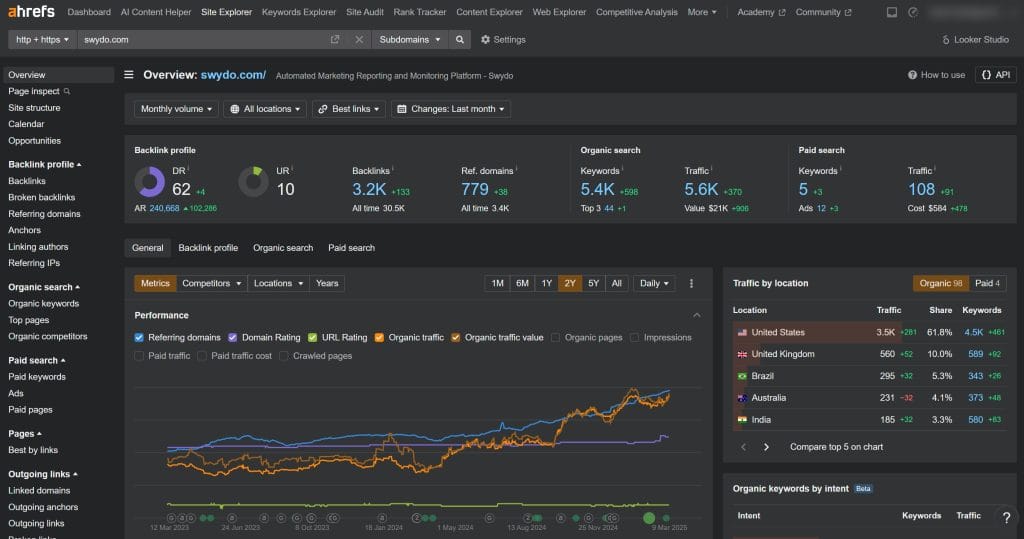
Ahrefs maintains the largest backlink index in the industry with over 35 trillion known links, making it the definitive platform for link profile analysis and competitive research.
Key Strengths:
- Market-leading backlink database and analysis tools
- Extensive keyword database with competition metrics
- Content Explorer identifying top-performing industry content
- Technical SEO audit tools uncovering site issues
- Competitive intelligence revealing traffic sources and strategy
Ahrefs provides unmatched backlink profile visibility, helping teams discover link building opportunities and evaluate competitor approaches. Site Explorer reveals precise traffic acquisition pathways with historical performance visualization. The platform excels at answering the question every SEO agency asks: where are my competitors getting their links, and how do I get better ones?
Considerations: Ahrefs restructured its pricing significantly. The Starter plan begins at $29/month (limited to 500 credits/month), Lite at $129/month, and Standard at $249/month. The credit-based system means heavy users can burn through monthly allotments quickly—a full competitor analysis can consume 150 credits, limiting you to 3–4 deep analyses monthly on the entry plan. The platform requires more learning time than some alternatives.
Ideal for: SEO-focused agencies prioritizing backlink strategies and competitive research. Best pure-SEO value at the Starter tier for budget-conscious teams.
Semrush – The Comprehensive Digital Marketing Platform
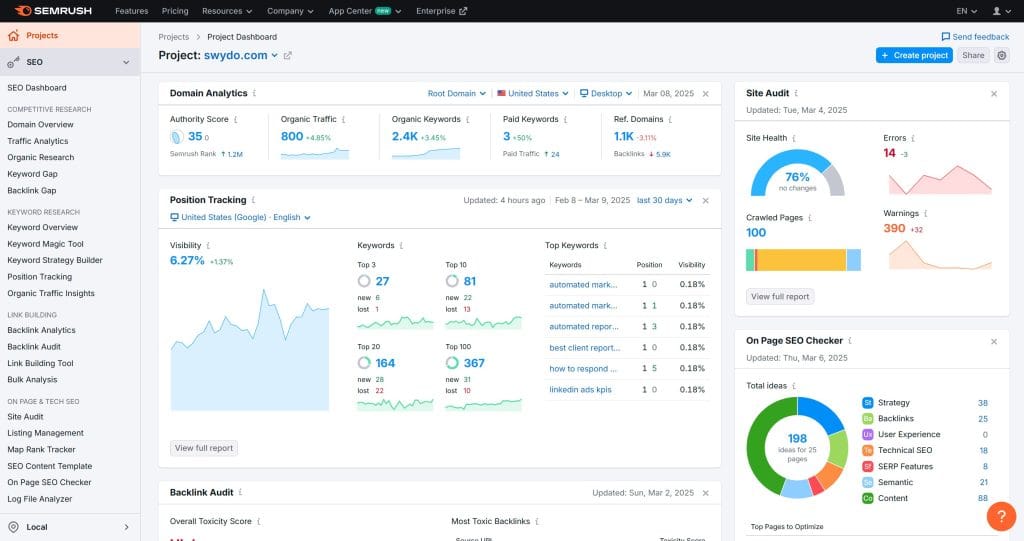
Semrush has evolved well beyond an SEO tool into a comprehensive digital marketing platform. In October 2025, the company launched Semrush One, pairing the core SEO Toolkit with a new AI Visibility Toolkit designed to track brand presence across both traditional search and AI-generated answers.
Key Strengths:
- Keyword database of over 25 billion keywords
- AI Visibility Toolkit tracking brand presence in AI Overviews and generative search
- Multi-dimensional competitive analysis tools
- Content optimization with AI-driven recommendations
- Social media management toolkit included
- Link building resources and technical audit capabilities
Semrush excels at delivering actionable insights across the entire marketing spectrum. The AI Visibility Toolkit is a significant differentiator in 2026, giving agencies the ability to show clients how their brand appears in AI-generated answers—not just traditional blue links. The content marketing toolkit offers topic discovery, writing assistance, and content auditing within a single platform. For agencies that want one subscription to cover SEO, content, PPC research, and now AI visibility, Semrush is the closest thing to an all-in-one.
Considerations: Pro starts at approximately $139.95–$165/month depending on billing cycle, with Guru at $249.95/month. Per-user seat costs add up ($45–$100/month per additional user). The extensive capabilities create initial complexity for new users, and some specialized tools lack the depth of dedicated alternatives.
Ideal for: Full-service agencies offering comprehensive SEO and digital marketing services who need all-in-one research, implementation, AI visibility tracking, and reporting.
SE Ranking – The Budget-Friendly Comprehensive Platform
SE Ranking delivers complete SEO campaign management with exceptional white-label capabilities at a price point significantly below Semrush and Ahrefs, making enterprise-level features accessible to agencies with tighter budgets.
Key Strengths:
- White-label reporting with complete branding customization
- Competitor SEO analysis with gap identification
- Website audit tools and keyword rank tracking with local and mobile options
- Backlink monitoring with acquisition suggestions
- Pricing starting around $89/month, significantly less on annual billing
SE Ranking equips agencies with complete SEO management capabilities under their own branding. The white-label dashboard provides clients with real-time performance metrics that showcase agency expertise, while competitive analysis tools reveal specific optimization opportunities based on competitor weaknesses. The platform’s keyword reporting also integrates seamlessly with reporting tools like AgencyAnalytics, extending its value across the stack.
Considerations: Some advanced features offered by enterprise SEO platforms require workarounds. API access limitations on lower-tier plans restrict custom integration options. The keyword database is roughly 30% the size of Semrush’s, meaning it may miss long-tail keywords in obscure niches.
Ideal for: SEO-focused agencies seeking comprehensive tools with powerful white-label reporting at a fraction of enterprise pricing.
Screaming Frog – The Technical SEO Essential
Screaming Frog’s SEO Spider crawls websites with unmatched thoroughness to identify technical optimization opportunities that other tools miss.
Key Strengths:
- Complete technical SEO auditing covering broken links, redirects, duplicate content, and metadata
- Adaptable crawling parameters for custom analysis
- Google Analytics and Search Console integration
- Free crawling for up to 500 URLs
- Site architecture visualization tools
Screaming Frog identifies technical barriers to SEO success that can tank rankings regardless of how good the content is. The tool offers free crawling for up to 500 URLs, making it accessible to agencies of all sizes, while the premium version removes limitations for larger sites. For agencies that do technical SEO audits as part of their onboarding or monthly deliverables, this tool is non-negotiable.
Considerations: Desktop application with steeper learning curve than web-based alternatives. Utilitarian interface prioritizes functionality over aesthetics. Focuses on technical aspects only, requiring complementary tools for content and link building.
Ideal for: Agencies providing technical SEO services requiring thorough site analysis and issue detection.
Clearscope – The Content Optimization Specialist

Clearscope harnesses AI to analyze high-ranking content and generate optimization recommendations that improve search visibility, bridging the gap between content quality and search performance.
Key Strengths:
- AI-driven content enhancement analyzing top search results for any keyword
- Actionable recommendations for relevant terms, optimal content length, and readability
- Content performance monitoring over time
- Google Docs and WordPress compatibility for seamless workflow integration
Clearscope transforms content creation through data-driven optimization. The platform analyzes top search results and provides specific improvement strategies, telling writers exactly which terms to include, how long the piece should be, and what readability level to target. Writers get a real-time content grade as they work, making optimization part of the drafting process rather than an afterthought.
Considerations: Premium pricing starts at $170+/month. Focused specifically on content optimization, so agencies still need separate tools for technical SEO, link building, and rank tracking. The specialized nature means it’s an addition to your stack, not a replacement for broader platforms.
Ideal for: Content-focused agencies demanding search-optimized deliverables with measurable performance improvements.
Surfer SEO – The On-Page Optimization Tool

Surfer SEO delivers data-driven content optimization based on comprehensive analysis of top-performing search results, with real-time feedback as writers create content.
Key Strengths:
- Live content editing guidance with immediate feedback on keyword usage and structure
- SERP analysis revealing competitive ranking patterns
- Content planning for topic clusters and content strategy
- Keyword research capabilities
- Google Docs integration for in-workflow optimization
Surfer SEO excels in real-time content enhancement. Writers receive immediate feedback on keyword usage, content structure, and other ranking factors while creating client deliverables. This simultaneous editing and optimization approach streamlines production—instead of writing first and optimizing later, teams do both at once. Many agencies now combine Surfer with generative search optimization tools for complete coverage across traditional and AI search.
Considerations: Focuses exclusively on on-page factors, requiring additional tools for comprehensive SEO strategies. Data-driven guidelines sometimes constrain creative approaches to content development. Does not track AI search visibility.
Ideal for: Content production agencies seeking to guarantee search optimization in every client deliverable.
BuzzSumo – The Content Research Powerhouse

BuzzSumo uncovers trending topics, successful content formats, and influential creators in targeted niches, answering the question every content strategist asks: what’s actually resonating right now?
Key Strengths:
- Content trend identification across social and web platforms
- Influencer discovery and outreach tools
- Content performance analysis with engagement metrics
- Backlink and brand mention monitoring
- Question analyzer for content idea generation based on real audience queries
BuzzSumo reveals exactly what content resonates with specific audiences. The content analyzer identifies the most-shared and engaged content across social platforms, while the question analyzer discovers common inquiries related to any topic—ideal for creating highly relevant client content and for informing AEO strategies based on the questions real people actually ask.
Considerations: Specializes in content research and social performance metrics, complementing rather than replacing traditional SEO tools. Data coverage occasionally shows limitations in highly specialized industry sectors.
Ideal for: Content marketing agencies focusing on thought leadership who require data-driven insights for topic selection and format decisions.
Google Search Console – The Essential Free SEO Tool
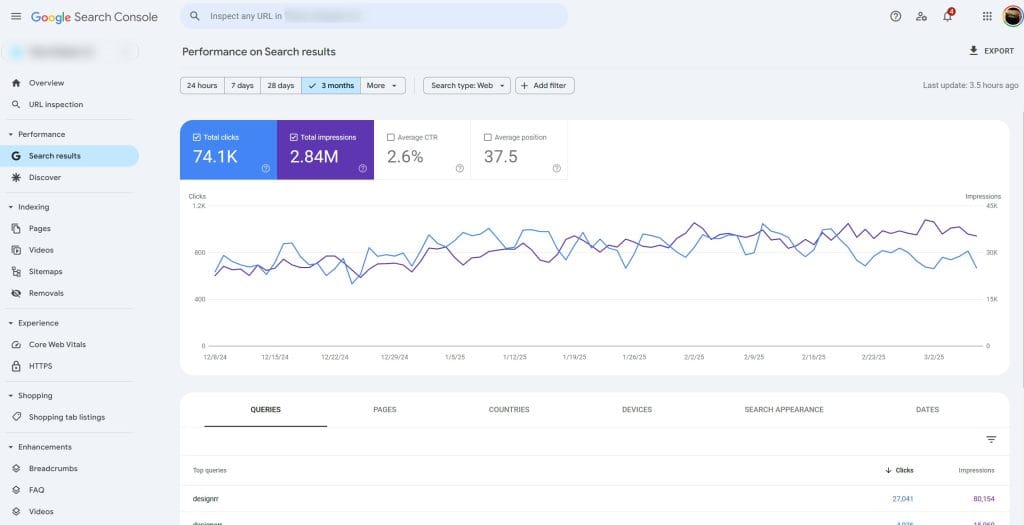
Google Search Console provides direct insights from Google itself into how it evaluates and indexes client websites, making it the single most important free tool in any SEO stack.
Key Strengths:
- Direct Google search data showing exactly which terms drive traffic
- Query and page performance metrics with click-through data
- Technical issue alerts and index coverage notifications
- Mobile usability analysis
- URL inspection and direct indexing submission
Google Search Console delivers critical SEO information that no paid tool can replicate—because it comes directly from Google. The platform flags technical problems affecting search visibility and enables immediate submission of new content for indexing. Every SEO recommendation your agency makes should start with what this tool tells you about current performance.
Considerations: Lacks competitive analysis features found in paid alternatives. Google-exclusive focus requires supplementary tools for comprehensive search engine coverage. Historical data retention is limited compared to paid platforms.
Ideal for: Every agency managing client websites must implement this foundational tool regardless of which other SEO platforms they use.
AccuRanker – The Precision Rank Tracking Specialist
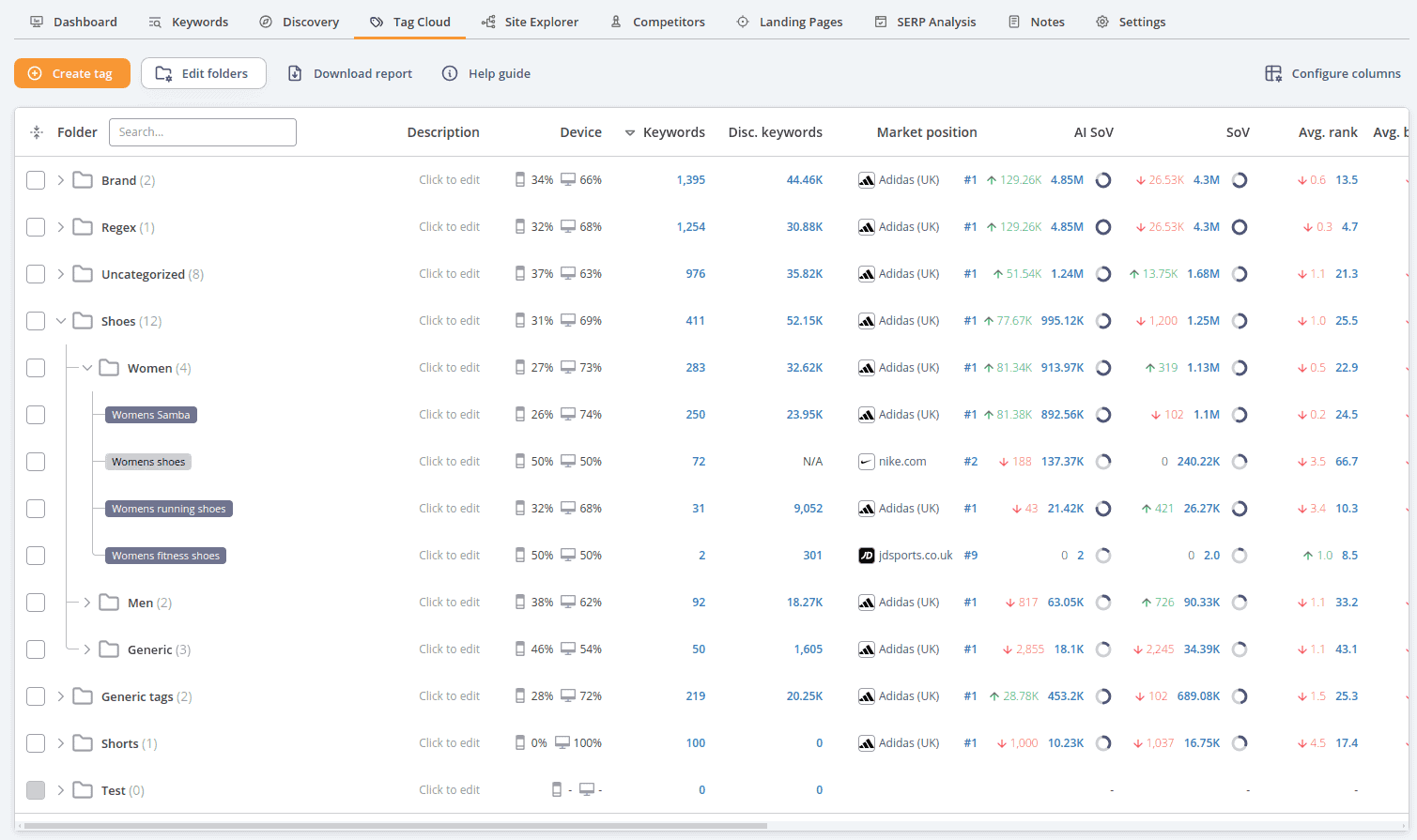
AccuRanker delivers the fastest, most accurate ranking data available with on-demand refresh capability that eliminates waiting periods for actionable insights after optimization efforts.
Key Strengths:
- On-demand ranking updates providing real-time position data
- Exceptional local and mobile rank tracking precision
- Share of voice measurement quantifying market dominance
- Landing page performance correlation with rankings
- Advanced competitor tracking with SERP feature monitoring
AccuRanker provides agencies with ranking data that updates on demand rather than on a schedule. The competitive intelligence tools measure exact market position across all ranking factors, including SERP features and local pack inclusion. For agencies that need to show clients the immediate impact of optimization work, this instant refresh capability eliminates the frustrating wait times other tools impose.
Considerations: Specialized focus means agencies need additional tools for comprehensive SEO management. Higher refresh rates and data volume increase costs compared to general-purpose SEO platforms. Not designed for content optimization or link building.
Ideal for: Data-driven SEO agencies requiring absolute precision in rank tracking with immediate visibility into algorithm-driven position changes.
Check out our full breakdown of the best SEO monitoring and the best SEO reporting tools.
AI Search Visibility and Answer Engine Optimization (AEO) Tools
Answer Engine Optimization is the fastest-growing category in agency marketing for 2026. AEO is the process of ensuring your client’s brand, content, and expertise are surfaced and cited by AI systems—ChatGPT, Perplexity, Google AI Overviews, Gemini, and voice assistants—when users ask questions. Traditional SEO focuses on rankings. AEO focuses on being the answer.
With zero-click searches making up nearly 60% of U.S. queries and AI Overviews appearing in the vast majority of searches, agencies that can’t measure and optimize AI search visibility risk losing ground to competitors who can. These platforms are purpose-built for this new reality.
Semrush AI Visibility Toolkit – The Integrated AEO Solution
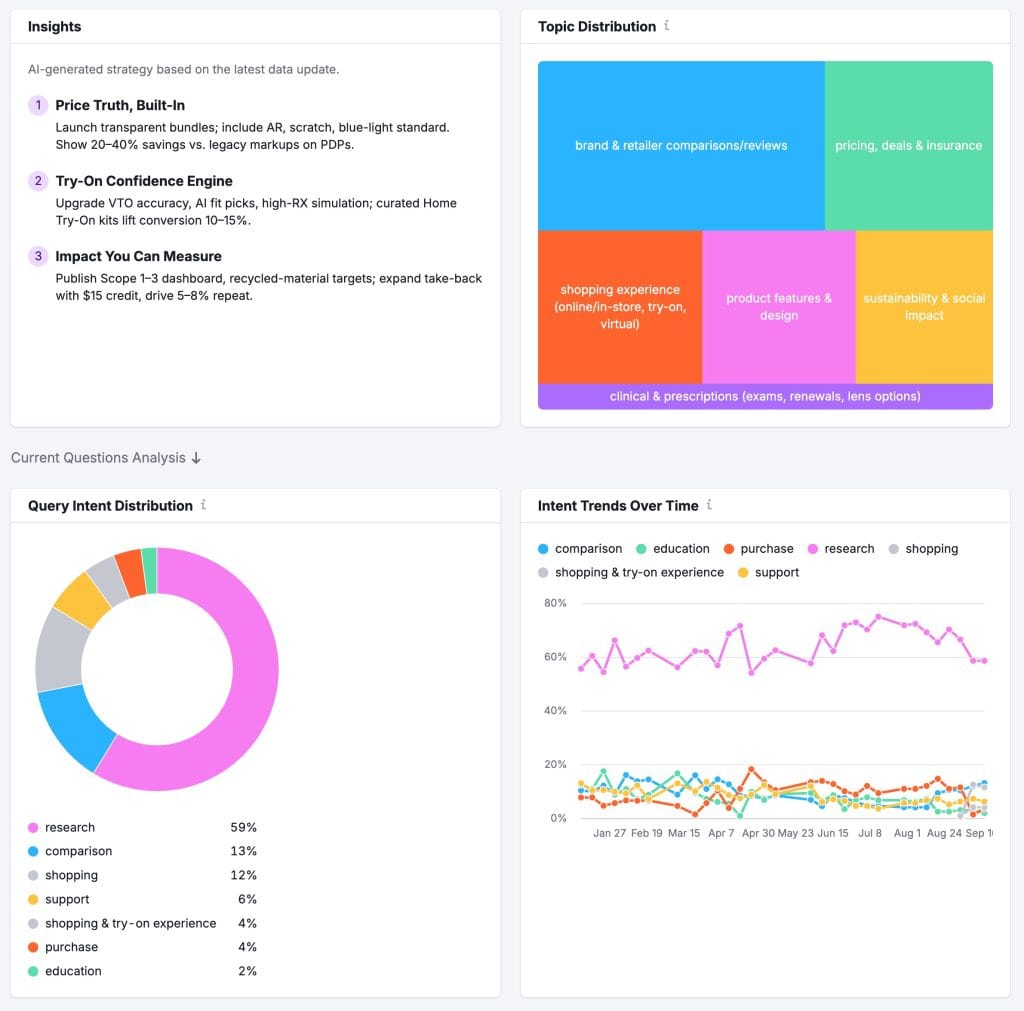
Semrush launched its AI Visibility Toolkit in late 2025 as part of the Semrush One bundle, making it the first major SEO platform to natively integrate AI search tracking alongside traditional rank tracking.
Key Strengths:
- Tracks brand visibility across Google AI Overviews and generative search results
- Integrates with existing SEO workflows—no separate platform needed
- AI search analytics alongside traditional keyword and rank data
- MCP Access on Advanced plans for agent-based workflows
The AI Visibility Toolkit gives agencies a single dashboard view of both traditional rankings and AI search presence. Instead of logging into separate tools to check Google rankings versus AI citations, teams get a unified picture of search visibility. For agencies already paying for Semrush, this is the most cost-effective way to add AEO capability to client reporting.
Considerations: Requires Semrush One subscription. AI visibility features are still maturing compared to dedicated AEO-only platforms. The depth of citation analysis is not yet as granular as specialized tools that only focus on AI search tracking.
Ideal for: Agencies already using Semrush who want to add AI search visibility tracking without adopting a separate platform.
AtomicAGI – The AI Citation Tracking Pioneer
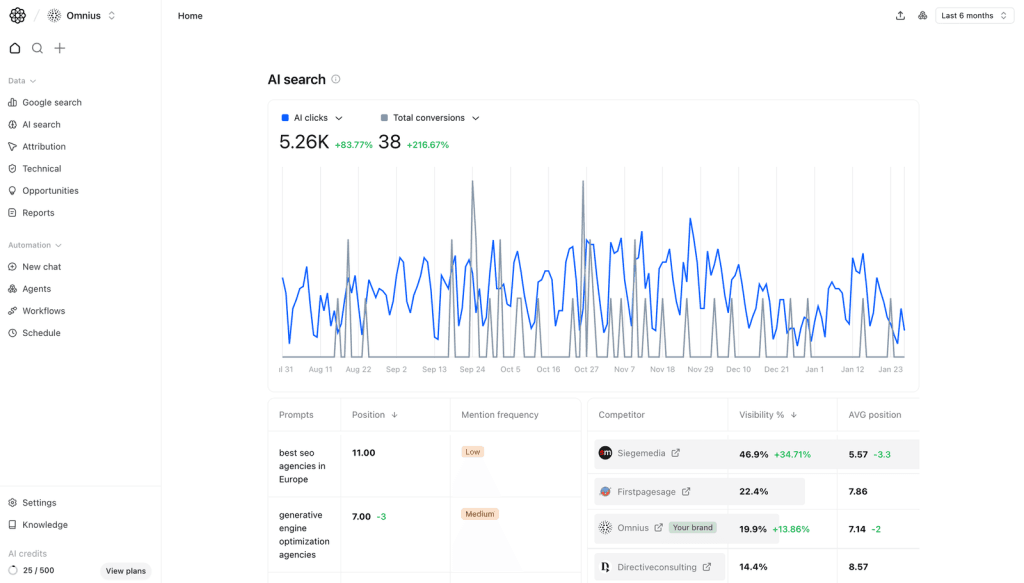
AtomicAGI is designed specifically for tracking how brands appear inside AI-generated answers across ChatGPT, Gemini, Claude, and Perplexity—a capability that traditional SEO tools were never built to offer.
Key Strengths:
- Monitors AI search citations across all major AI platforms
- Analyzes which prompts trigger brand citations and which pages are used as sources
- Includes suite of SEO AI agents that automate optimization workflows
- Generative search visibility reporting for client presentations
AtomicAGI fills the gap that content creation AI tools like ChatGPT and Jasper leave open: they help you create content, but they don’t tell you whether AI systems are actually citing your client’s brand in their answers. AtomicAGI monitors this visibility, showing agencies exactly which prompts surface their clients and which don’t—actionable intelligence for optimization efforts. The built-in AI agents continuously analyze performance data and surface opportunities.
Considerations: Newer platform with a smaller user base than established SEO tools. Best used alongside traditional SEO platforms rather than as a standalone replacement. Pricing and feature set are still evolving as the AEO category matures.
Ideal for: Agencies offering AEO services who need to show clients exactly how their brand appears (or doesn’t) in AI-generated answers.
Birdeye Search AI – The Local AEO Platform
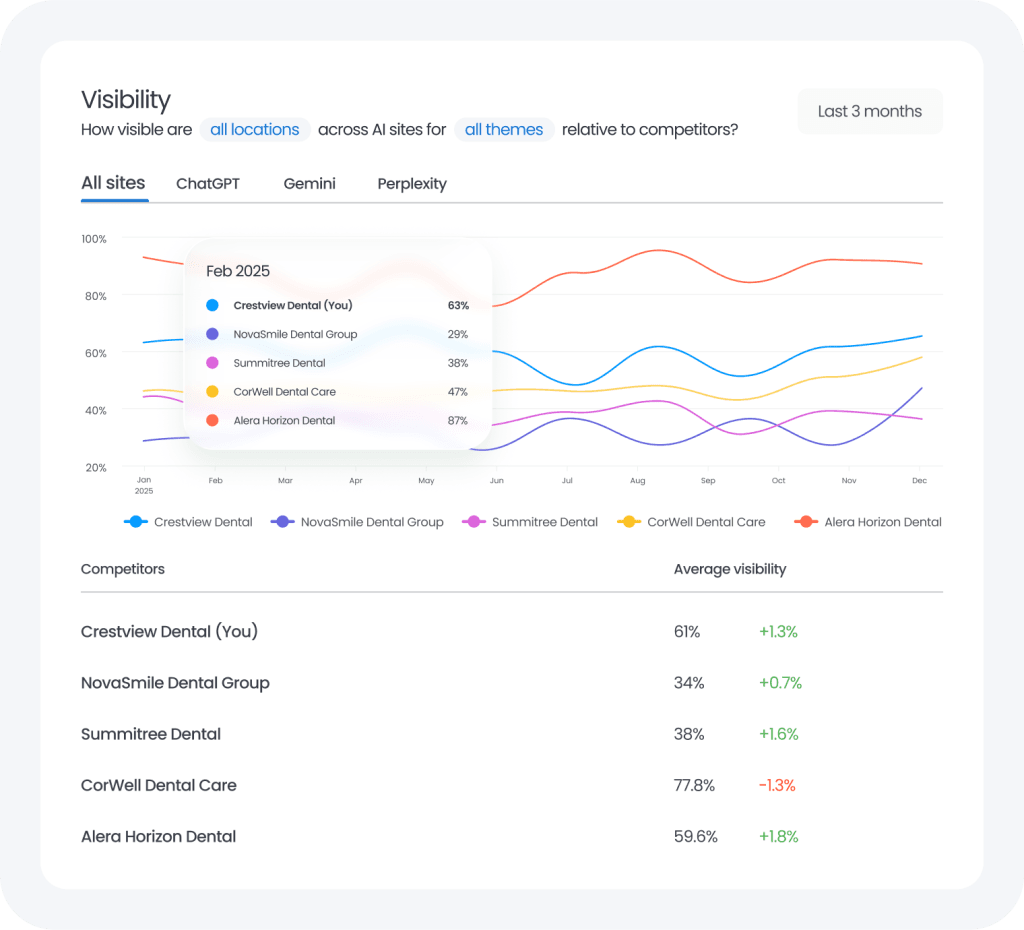
Birdeye Search AI helps businesses optimize content to appear in AI-driven search results, with particular strength in local search and multi-location businesses where “near me” queries and local recommendations dominate AI answers.
Key Strengths:
- AI search visibility tracking and content optimization
- Content recommendations specifically for AI answer eligibility
- Strong local search and multi-location management tools
- Authority signal strengthening across platforms
- Reputation management integration
For agencies managing restaurants, law firms, medical practices, home services, or any business where local discovery matters, Birdeye Search AI addresses a specific problem: AI assistants are increasingly answering “best plumber near me” or “top-rated dentist in [city]” queries directly, and if your clients aren’t optimized for those answers, they’re invisible. The platform combines local SEO fundamentals with AI-specific optimization strategies.
Considerations: Most valuable for businesses with local intent queries. Less relevant for pure e-commerce or SaaS brands without geographic focus. The local emphasis means national or global campaigns need supplementary tools.
Ideal for: Agencies managing local and multi-location businesses who need to win visibility in local-intent AI answers.
Google Trends – The Free Trend Discovery Tool
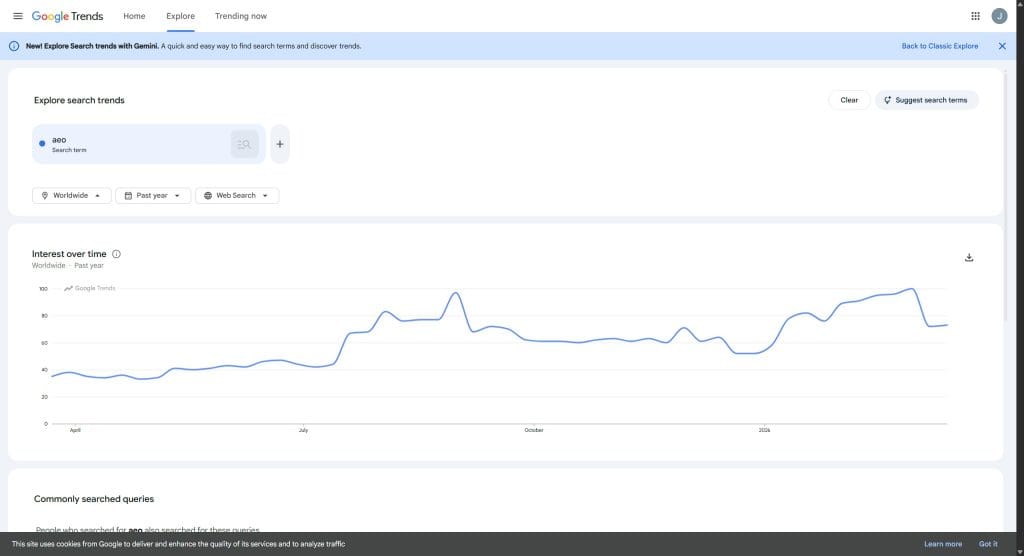
Google Trends shows the real-time popularity of search terms among Google users, helping agencies find trending topics in client niches and gain competitive advantage by identifying what people are actually asking about—insights that directly inform both traditional SEO and AEO content strategies.
Key Strengths:
- Real-time search trend data across topics and keywords
- Geographic and temporal filtering for regional campaigns
- Related queries and rising topics identification
- Comparison tools for evaluating multiple terms side by side
- Free access with no usage limits
Google Trends is deceptively powerful for its $0 price tag. Beyond basic trend identification, it reveals the specific questions and related queries people are searching for—data that directly feeds AEO content strategies. When agencies need to decide which FAQ content to create for AI answer eligibility, Google Trends shows which questions have growing search volume. It’s also invaluable for validating content ideas before investing production time.
Considerations: Shows relative search interest rather than absolute volume—pair with keyword tools for full picture. Doesn’t provide competitive analysis or backlink data. The simplicity that makes it accessible also means it can’t replace dedicated research platforms.
Ideal for: Every agency, regardless of size. A free tool that informs both content strategy and AEO prompt research.
PPC and Paid Media Tools
Effective paid media management requires specialized platforms for campaign optimization, landing page conversion, and performance tracking across an expanding set of ad networks.
Google Ads – The PPC Foundation
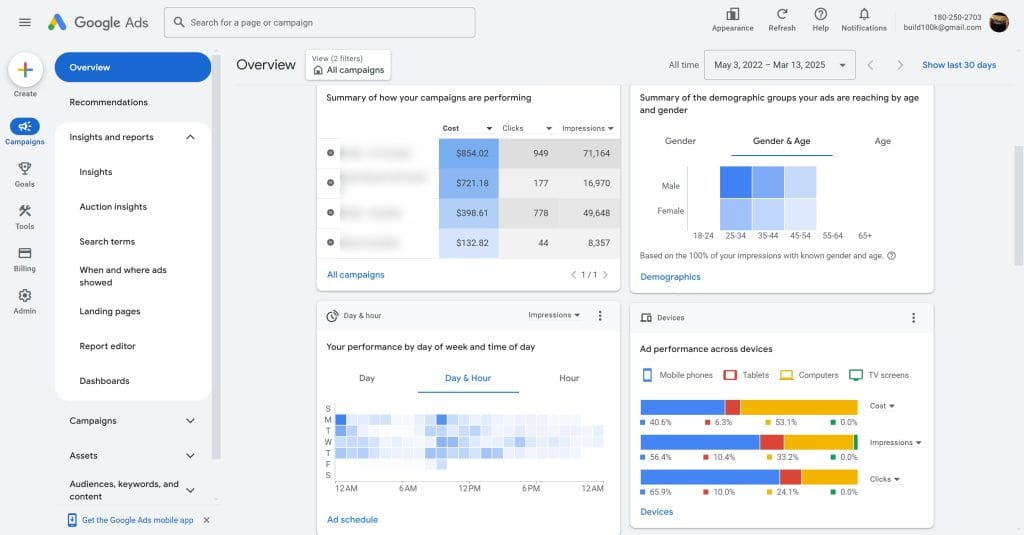
Google Ads provides unmatched reach across search, display, video, and shopping networks, forming the cornerstone of most digital advertising strategies with precise audience targeting and advanced machine learning bidding.
Key Strengths:
- Massive reach across Google’s entire network including Search, Display, YouTube, and Shopping
- Precise audience targeting using demographics, interests, and intent signals
- Advanced machine learning bidding optimization toward business outcomes
- Google Analytics integration for conversion tracking
- Diverse campaign types addressing varied marketing objectives
Google Ads equips agencies with multiple campaign formats to address specific client goals, from immediate lead generation to brand awareness building. The platform’s machine learning capabilities continue evolving, offering automated bidding strategies that optimize toward client business outcomes rather than vanity metrics. Performance Max campaigns now use AI across all Google properties, giving agencies broader reach with less manual optimization.
Considerations: Platform complexity creates learning challenges for newcomers, while increasing competition drives up costs across many industries. Effective management demands continuous education to master frequent feature updates. The shift toward AI-driven campaigns reduces manual control, which frustrates specialists who prefer granular optimization.
Ideal for: Nearly all agencies offering paid media services, as Google Ads forms the foundation of most comprehensive digital advertising strategies.
Google Ads Editor – The Bulk Management Essential
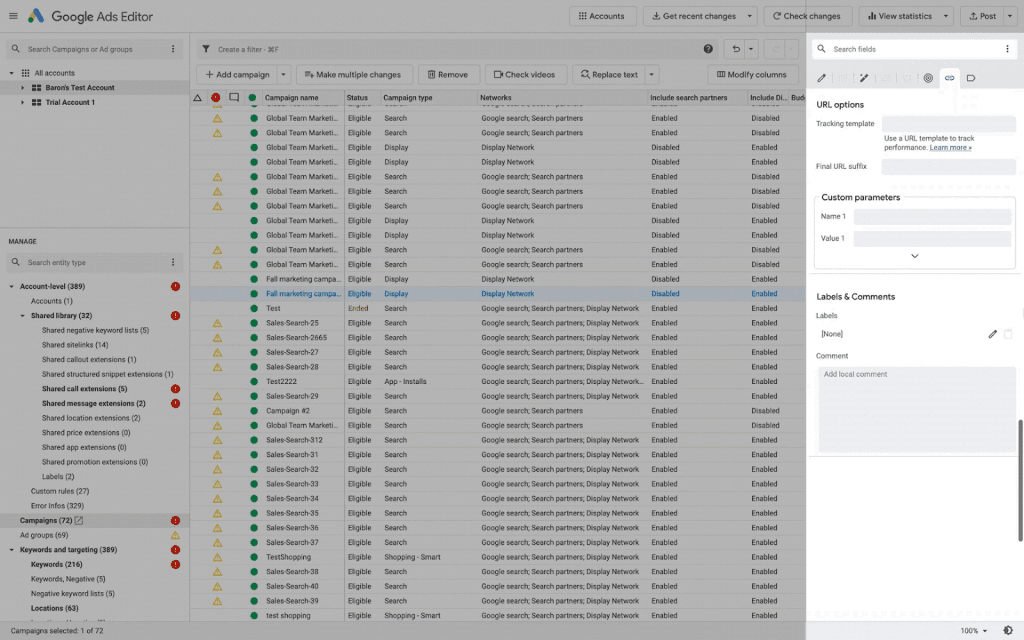
Google Ads Editor provides a desktop application for bulk campaign management and editing without browser limitations, dramatically increasing efficiency for agencies managing multiple accounts.
Key Strengths:
- Offline editing capabilities for campaign assets
- Mass changes across multiple accounts or campaigns simultaneously
- Advanced search and filtering options
- Error detection before publishing changes
- Version history with account snapshots for safety
Google Ads Editor is the behind-the-scenes workhorse of PPC agencies. The ability to make bulk changes across hundreds of ad groups, work offline during travel, and catch errors before they go live saves substantial time. For agencies managing 10+ client accounts, the efficiency gain over the web interface alone justifies making this a standard part of every PPC specialist’s toolkit.
Considerations: Works exclusively with Google Ads, requiring separate solutions for other platforms. Some users find the interface less intuitive than web-based alternatives. Requires periodic updates to stay current with platform changes.
Ideal for: Any agency managing Google Ads campaigns, particularly those handling multiple client accounts or large-scale campaign structures.
Optmyzr – The PPC Automation Platform
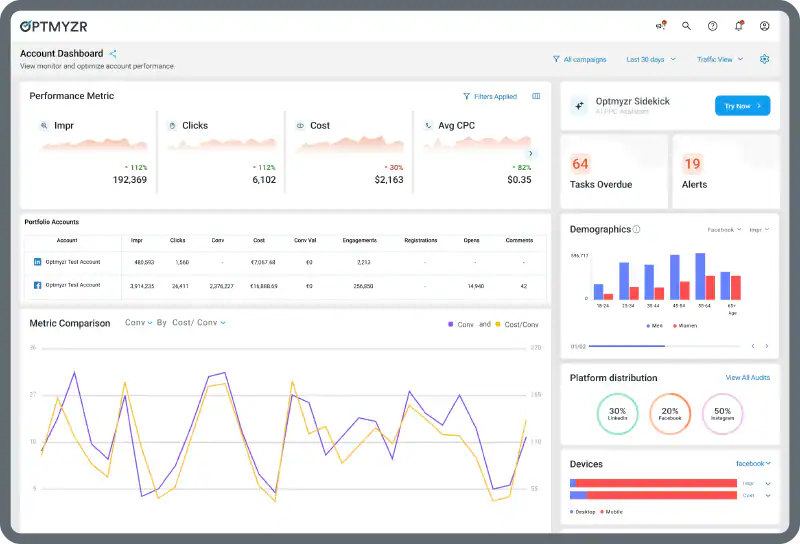
Optmyzr delivers AI-powered optimization and management tools specifically designed for PPC campaign enhancement across Google, Microsoft, and Meta platforms.
Key Strengths:
- Automated optimization recommendations based on real performance data
- Single-click improvements for routine optimization tasks
- Comprehensive reporting with visualization and white-label options
- Multi-platform management from a unified interface
- Custom rule creation for agency-specific optimization logic
Optmyzr identifies optimization opportunities that manual analysis might miss, from bid adjustments to ad copy enhancements. The automation capabilities provide exceptional value for agencies managing multiple accounts, enabling efficient optimization at scale without proportional time investment. Custom rules let agencies codify their optimization playbooks, ensuring consistent strategy execution across team members and client accounts.
Considerations: Adds costs beyond the ad platforms themselves. Certain features require learning investment, though the time savings typically justify this initial effort. Over-reliance on automation can lead to missed nuances that human analysis would catch.
Ideal for: Agencies handling substantial PPC account responsibilities seeking efficiency improvements and performance gains at scale.
Wordstream – The PPC Management Solution

Wordstream simplifies and enhances PPC campaign management across multiple advertising platforms, making complex optimizations accessible to users with varied experience levels.
Key Strengths:
- Performance grader providing quick, actionable account assessment
- Landing page optimization tools increasing conversion rates
- Alert systems for immediate account issue identification
- Multi-platform campaign management capabilities
- Client-friendly reporting templates
Wordstream’s PPC Advisor delivers actionable insights for performance improvement, focusing on making sophisticated optimizations accessible without requiring deep PPC expertise. The landing page tools ensure clicked ads actually convert, improving overall campaign ROI. For agencies with junior team members managing accounts, Wordstream provides guardrails that prevent costly mistakes while building their skills.
Considerations: Advanced PPC specialists sometimes find the simplified approach restrictive for complex strategy implementation. The accessibility focus occasionally sacrifices depth in specialized areas. Not the right fit for agencies that want granular, manual control over every campaign element.
Ideal for: Agencies with diverse PPC expertise levels who need consistent performance across all client accounts.
Unbounce – The Landing Page Optimizer

Unbounce specializes in creating and testing high-converting landing pages, addressing the critical gap between ad click and conversion that determines whether PPC spend turns into revenue.
Key Strengths:
- Intuitive drag-and-drop page builder requiring no coding
- Comprehensive A/B testing capabilities
- Smart Traffic AI that automatically routes visitors to highest-converting variants
- Integration with major marketing and analytics platforms
- Mobile-responsive design capabilities
Unbounce empowers agencies to create conversion-focused landing pages without development resources. The Smart Traffic feature automatically directs visitors to landing page variants most likely to convert based on their characteristics, improving campaign performance without manual intervention. For PPC agencies, the ability to spin up and test landing pages quickly means faster optimization cycles and better results for clients.
Considerations: Adds another cost element to the marketing technology stack. Design flexibility sometimes restricts creative vision compared to custom-coded solutions. The platform focuses on landing pages specifically, not full website building.
Ideal for: Agencies prioritizing conversion rate optimization who need efficient landing page creation and testing capabilities.
Microsoft Advertising – The Underestimated Alternative

Microsoft Advertising provides valuable search traffic beyond Google, reaching users throughout the Microsoft network ecosystem with often superior ROI in specific sectors.
Key Strengths:
- Access to Bing, Yahoo, DuckDuckGo, and Microsoft partner sites
- Reduced competition with lower cost-per-click in many sectors
- Audience demographics skewing toward professionals and higher-income segments
- Google Ads campaign import for efficient cross-platform management
- LinkedIn profile targeting for precision B2B campaign delivery
Microsoft Advertising delivers access to valuable audience segments that complement Google campaigns. The platform often produces superior ROI in industries targeting professional audiences or mature demographics. LinkedIn profile targeting is a unique advantage—no other search advertising platform lets you target by job title, company, or industry with this precision. The Google Ads import feature means setup takes minutes, not hours.
Considerations: Reaches fewer total users than Google, positioning it better as a complementary channel than standalone solution. New features sometimes arrive later than their Google counterparts. Reporting and interface refinement lag behind Google Ads.
Ideal for: Agencies diversifying paid search strategies to access additional qualified traffic at competitive rates, especially for B2B campaigns.
Amazon Advertising – The E-Commerce Essential

Amazon Advertising has emerged as a critical platform for product-focused clients, offering direct access to active shoppers at the point of purchase decision.
Key Strengths:
- Direct connection to customers actively searching for products to buy
- Diverse ad formats including Sponsored Products, Brands, and Display
- Precise targeting based on shopping behavior and product categories
- Sales-focused attribution and analytics tied to actual purchases
- Expanding reach through Amazon’s growing publisher network
Amazon Advertising connects clients directly with consumers at their purchasing decision point. The platform’s focus on shopping intent makes it exceptionally valuable for direct response campaigns—when someone searches on Amazon, they’re usually ready to buy. Attribution is cleaner than most ad platforms because you can tie spend directly to sales on the same platform.
Considerations: Exclusively benefits product-based businesses, particularly those already selling on Amazon. Increased seller adoption has intensified competition, raising costs across popular categories. The learning curve for Amazon’s ad platform is steeper than many agencies expect.
Ideal for: Agencies serving e-commerce clients needing to establish or expand presence on the world’s largest online marketplace.
Meta Ads (Facebook & Instagram) – The Social Advertising Giant

Meta Ads dominates social advertising through precision targeting based on user interests, behaviors, and demographics across the Facebook and Instagram ecosystem.
Key Strengths:
- Precision audience targeting using interests, behaviors, and demographics
- Versatile ad formats from stories to carousels to video and Reels
- Powerful remarketing capabilities for audience nurturing
- Access to Instagram, Facebook, and Marketplace inventory
- Effective for both brand awareness and conversion campaigns
Meta Ads excels at delivering targeted messaging to specific audience segments across its massive user base. The visual-focused platform proves particularly effective for industries requiring product demonstration or lifestyle positioning. Advantage+ campaigns now use AI to automate audience targeting and creative optimization, reducing the manual workload for agencies while often improving performance.
Considerations: Privacy changes, particularly Apple’s iOS updates, have significantly impacted tracking capabilities and attribution accuracy. Creative freshness demands frequent asset updates to combat ad fatigue. The shift toward AI-driven campaigns reduces granular control over targeting.
Ideal for: Agencies managing campaigns for clients with strong visual offerings and defined audience targeting parameters.
LinkedIn Ads – The B2B Specialist
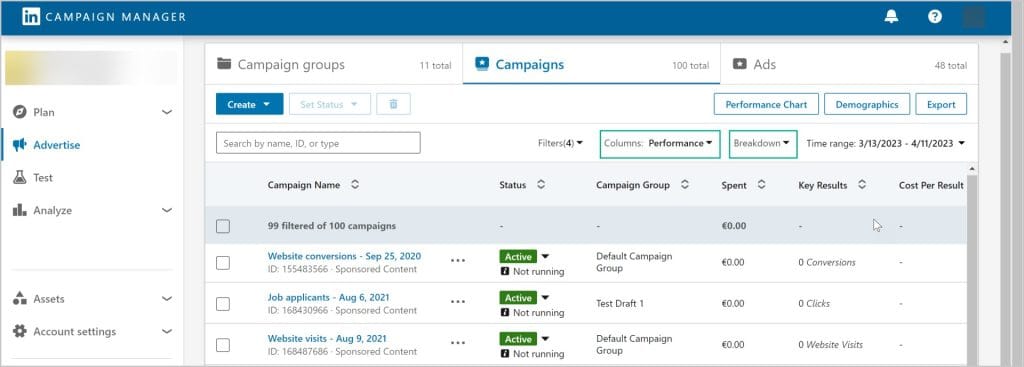
LinkedIn Ads delivers unrivaled B2B targeting capabilities based on professional attributes and company characteristics that no other advertising platform can match.
Key Strengths:
- Targeting by job title, company size, industry, seniority, and skills
- Professional context aligning with B2B messaging and decision-maker mindset
- Multiple format options including Sponsored Content, InMail, and video
- Account-based marketing features for enterprise sales approaches
- Lead generation forms pre-populated with professional profile data
LinkedIn Ads connects campaigns with decision-makers in specific companies and industries. The platform’s professional environment ensures business messages appear where users actively consider professional challenges and solutions. The pre-populated lead gen forms reduce friction dramatically—prospects can submit their info in two taps, and the data quality is high because it pulls directly from their LinkedIn profile.
Considerations: Cost-per-click rates exceed most alternative platforms, requiring careful budget management. The audience focuses more on professional development than immediate purchases, meaning longer conversion timelines. Minimum daily budgets are higher than other social platforms.
Ideal for: Agencies serving B2B clients with higher-value products or services where reaching specific decision-makers justifies premium acquisition costs.
CallRail – The Conversation Intelligence Platform
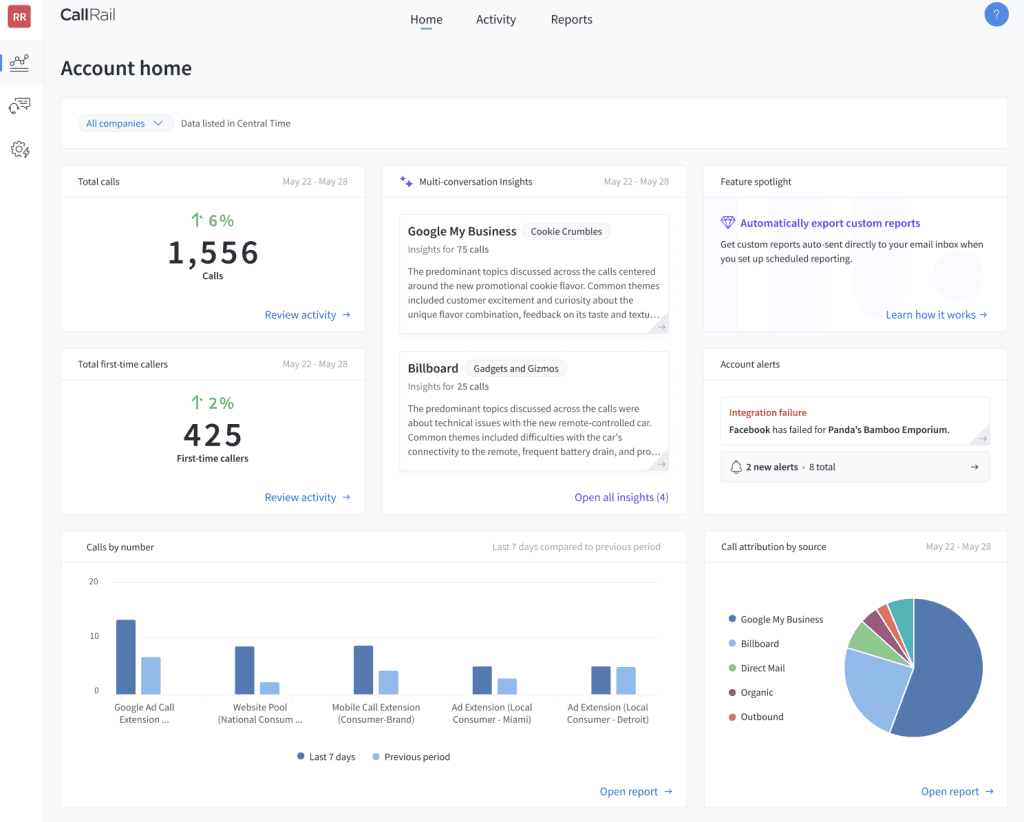
CallRail transforms phone calls into actionable marketing insights, solving the critical attribution challenge of connecting offline conversions to digital marketing efforts.
Key Strengths:
- Precise call attribution across all marketing channels
- Dynamic number insertion for website visitor tracking
- Conversation intelligence with AI-powered call analysis and transcription
- Form tracking integration for complete lead journey mapping
- Multi-location call routing and management
CallRail automatically records, transcribes, and analyzes calls, identifying qualified leads and revealing which marketing tactics drive valuable phone conversations. Custom scoring rules flag high-priority opportunities requiring immediate follow-up. For agencies managing clients in industries where the phone still rings—legal, healthcare, home services, automotive—this platform closes the attribution gap that makes it impossible to prove digital marketing drives real leads.
Considerations: Setup requires technical implementation for maximum value including dynamic number insertion on client websites. Some advanced conversation intelligence features command premium pricing beyond basic call tracking. Call volume-based pricing means costs increase with client success.
Ideal for: Agencies managing clients who rely on phone calls for lead generation and need precise attribution of marketing-driven conversations.
CallTrackingMetrics – The Omnichannel Attribution System
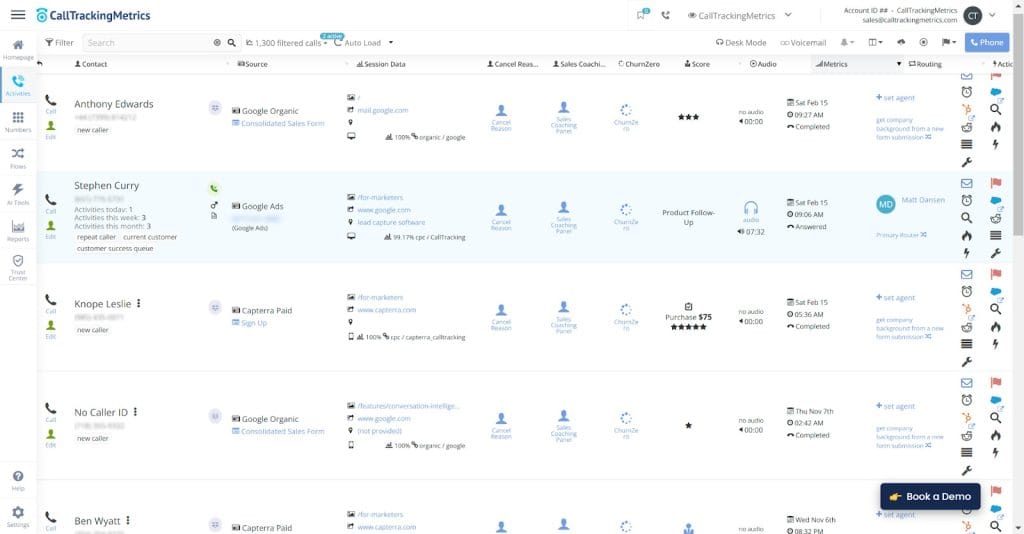
CallTrackingMetrics delivers unified tracking across calls, texts, forms, and chat interactions, providing complete attribution regardless of how prospects choose to communicate.
Key Strengths:
- Cross-channel tracking unifying calls, texts, forms, and chat
- Advanced call routing and distribution logic
- Real-time dashboard with conversion reporting
- Automated tagging based on conversation content analysis
- Integration with major advertising and CRM platforms
CallTrackingMetrics captures every customer touchpoint regardless of communication channel. The platform reveals which campaigns drive actual conversations, automatically scoring and categorizing interactions based on content analysis. For full-service agencies where clients receive leads through phone, text, web form, and chat, this unified view eliminates the blind spots that single-channel tracking tools leave.
Considerations: The comprehensive feature set creates a steeper learning curve than simpler alternatives. Cost increases with call and interaction volume, potentially creating scaling challenges for high-volume clients. Setup complexity increases with each communication channel added.
Ideal for: Full-service agencies needing complete attribution across multiple communication channels beyond just phone calls.
AdRoll – The Retargeting Specialist
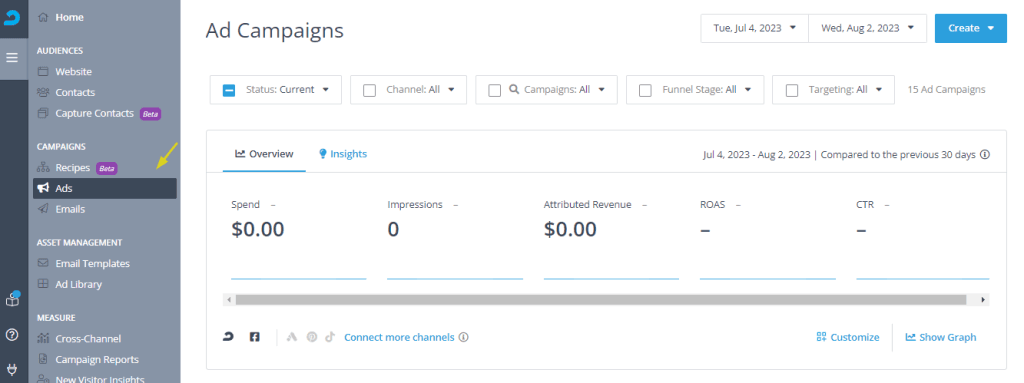
AdRoll specializes in cross-platform retargeting and audience targeting, turning website visitors who didn’t convert into customers through persistent, intelligent remarketing.
Key Strengths:
- Cross-platform ad retargeting across web, social, and email channels
- AI-powered audience segmentation identifying high-potential prospects
- Brand awareness and conversion campaign tools
- Unified dashboard for cross-channel retargeting performance
- Dynamic ad creation generating personalized creative variations at scale
AdRoll transforms website visitors into customers through sophisticated retargeting that follows prospects across channels. The platform’s AI analyzes user behavior to identify high-potential segments and optimal targeting moments, then automatically generates personalized creative variations. For agencies where client conversion rates are the primary KPI, AdRoll’s focused approach to remarketing often delivers measurable lifts that justify the additional spend.
Considerations: Cookie restrictions in modern browsers require adaptation of tracking strategies. Peak performance requires significant historical data, creating ramp-up periods for new accounts. The retargeting focus means it’s an addition to your ad stack, not a replacement for prospecting campaigns.
Ideal for: Performance-focused agencies seeking to improve conversion rates through targeted remarketing and audience segmentation.
Check out our full breakdown of the best PPC reporting tools.
PR Tools – Building Brand Reputation
Modern public relations extends beyond press releases into comprehensive reputation management and digital PR that directly supports both traditional SEO and AEO visibility. Strong PR signals—media mentions, authoritative citations, journalist relationships—are increasingly what AI systems use to determine which brands to reference in generated answers.
BuzzStream – The Outreach Manager

BuzzStream specializes in relationship management for digital PR and link building initiatives, turning chaotic outreach into a structured, trackable process.
Key Strengths:
- Extensive influencer and publisher database
- Email template library with open and response tracking
- Contact relationship history accessible across all team members
- Discovery tools identifying relevant industry contacts
- Link monitoring with performance metrics
BuzzStream streamlines outreach processes, helping teams find appropriate contacts and track engagement throughout campaigns. The relationship management features preserve institutional knowledge even through staff changes, maintaining valuable contact histories that would otherwise walk out the door. For agencies running regular digital PR campaigns, the efficiency gain of structured outreach versus ad-hoc emailing is substantial.
Considerations: Complex campaigns face steeper learning requirements. The interface looks dated compared to newer alternatives, though functionality outweighs aesthetics. The platform works best at scale—for agencies doing only occasional outreach, the investment may not pay off.
Ideal for: Agencies conducting regular outreach campaigns who need scalable relationship management while tracking effectiveness metrics.
Prezly – The Digital Newsroom

Prezly provides a specialized platform for modern press release creation and media resource distribution, replacing static PDF press kits with dynamic digital newsrooms.
Key Strengths:
- Customizable brand newsrooms and digital media centers
- Media relationship CRM built specifically for PR workflows
- Multimedia press release creation with embedded video and images
- Email distribution with engagement analytics
- Coverage monitoring and clipping services
Prezly modernizes press release strategy, creating digital-first content that resonates with today’s journalists who expect multimedia, not plain text. The newsroom features give media contacts self-service access to relevant information, assets, photos, and brand materials, increasing coverage opportunities by reducing friction. Journalists can find what they need without waiting for your team to respond to requests.
Considerations: The digital-first approach works best for agencies already embracing contemporary PR methods. Integration with traditional media databases sometimes requires additional tools. Smaller agencies may find the feature set exceeds their needs.
Ideal for: Forward-thinking PR agencies transitioning beyond standard press release distribution toward compelling digital media hubs.
Muck Rack – The Media Intelligence Platform

Muck Rack combines comprehensive journalist database capabilities with extensive real-time media monitoring functionality, giving agencies deep visibility into who covers what and when.
Key Strengths:
- Comprehensive journalist profiles with detailed beat and specialization data
- Real-time media monitoring across news outlets and social platforms
- Custom alert system for client mentions and competitor coverage
- Relationship tracking throughout outreach campaigns
- PR impact measurement and coverage reporting for client presentations
Muck Rack delivers powerful insights into media coverage patterns and journalist preferences, enabling precise outreach targeting. The monitoring capabilities ensure teams never miss relevant client coverage or time-sensitive opportunities for rapid response. For agencies managing multiple client PR campaigns simultaneously, the platform’s ability to track coverage across all clients from one dashboard prevents things from falling through the cracks.
Considerations: Premium pricing positions this tool at the higher end of PR platform costs. Specialized industries occasionally show less comprehensive journalist coverage than mainstream sectors. The investment makes most sense for agencies with active, ongoing PR programs rather than occasional media outreach.
Ideal for: Larger PR agencies managing multiple client campaigns requiring comprehensive media intelligence and relationship management from a unified platform.
PR.co – The Campaign Manager

PR.co delivers comprehensive tools for managing complete PR campaign lifecycles, from initial strategy through execution, approval, and measurement.
Key Strengths:
- Campaign planning and strategy management tools
- Team collaboration on content creation with version control
- Media contact database with relationship tracking
- Result monitoring and coverage reporting
- Client approval systems with permission controls
PR.co structures the entire PR workflow from initial strategy through execution and measurement. The collaborative features provide exceptional value for agencies whose clients require approval at various campaign stages—building in the review cycles that prevent the embarrassment of publishing unapproved messaging. The structured approach also helps junior team members follow established processes without constant supervision.
Considerations: The smaller user community means fewer templates and shared resources compared to market leaders. Customization options occasionally present limitations for highly specialized campaigns. Less name recognition than competitors may require explanation during client onboarding.
Ideal for: Mid-sized PR agencies seeking structured systems for the entire campaign process from planning to results reporting.
Presspage – The Press Release Specialist

Presspage focuses exclusively on creating and distributing press releases that generate measurable results, transforming traditional text releases into multimedia assets.
Key Strengths:
- Multimedia press release creation tools with rich media embedding
- SEO optimization for press materials to maximize search visibility
- Multi-channel distribution capabilities across wire services and direct outreach
- Performance analytics showing opens, clicks, and pickup rates
- Media contact management system
Presspage transforms traditional text releases into multimedia assets that perform effectively across digital channels. The platform’s analytics provide clear insights into press material performance—which journalists opened releases, which outlets picked up stories, and what drove the most engagement. For agencies billing clients for PR services, these metrics help demonstrate concrete value beyond simply sending releases.
Considerations: The narrow press release focus means agencies need additional tools for comprehensive PR management. Some features duplicate functionality found in broader marketing platforms. The specialist nature makes it hard to justify unless press releases are a significant part of your agency’s service offering.
Ideal for: Agencies heavily invested in press release creation who want to modernize this aspect of their PR strategy with measurable results.
Link Building Tools – SEO’s Critical Component
Quality backlinks remain fundamental to both traditional SEO and AEO success. AI systems use citation signals and link authority when determining which sources to reference in generated answers, making link building more relevant in 2026, not less.
Majestic SEO – The Link Intelligence Tool

Majestic provides detailed metrics and analytical insights focused specifically on backlink quality and patterns, going deeper into link analysis than generalist SEO platforms.
Key Strengths:
- Proprietary Trust Flow and Citation Flow quality measurements
- Comprehensive historical index tracking link profile development over time
- Detailed anchor text distribution analysis
- Competitive backlink comparison tools
- Link context and neighborhood quality assessment
Majestic delivers sophisticated link quality metrics extending far beyond simple quantity counts. The historical data proves particularly valuable for understanding link profile evolution over time and identifying patterns in successful acquisition strategies. Trust Flow and Citation Flow provide a quick quality signal that helps agencies rapidly assess whether a link prospect is worth pursuing or a competitor’s link profile is vulnerable.
Considerations: The interface lacks the modern design of newer alternatives. The proprietary metrics require initial learning investment to interpret correctly. Focused exclusively on links—you’ll need separate tools for keyword research, content optimization, and technical SEO.
Ideal for: SEO agencies specializing in technical link analysis who need detailed quality metrics beyond standard SEO platform capabilities.
Pitchbox – The Outreach Automation Platform

Pitchbox transforms link building outreach into a scalable, repeatable process through automation and workflow management, turning what was once a manual grind into a structured operation.
Key Strengths:
- Automated prospect identification and contact discovery
- Personalized outreach sequence creation with merge fields
- Intelligent follow-up scheduling and management
- Team collaboration with task assignment and pipeline views
- Performance tracking with conversion analytics showing reply and placement rates
Pitchbox converts link building into a structured, measurable process. The automation features dramatically increase efficiency, enabling agencies to scale outreach efforts without corresponding time increases while maintaining personalization quality. Pipeline views show exactly where each prospect stands in the outreach sequence, and conversion analytics reveal which templates and approaches generate the best results.
Considerations: The efficiency focus requires careful management to avoid sacrificing relationship quality through over-automation. The platform represents a significant investment specialized exclusively for link acquisition. Teams need to balance automation with genuine relationship building.
Ideal for: Agencies with dedicated link building teams needing to scale outreach operations efficiently while maintaining personalization and quality standards.
Check out our full breakdown of the best link building tools.
Project Management and Client Collaboration Tools
Efficient agency operations demand robust project management. The right platform reduces missed handoffs, scattered feedback, and the approval bottlenecks that kill agency margins. A clear system for tasks, owners, deadlines, and approvals is the foundation that makes every other tool in your stack work better.
ClickUp – The Versatile Project Management Solution

ClickUp offers a highly customizable project management platform that adapts to diverse agency workflows and team structures, from agile marketing campaigns to traditional client retainers.
Key Strengths:
- Fully customizable workflows and information views (list, board, calendar, Gantt, timeline)
- Integrated time tracking and resource allocation
- Collaborative document creation and editing
- Client portal options for transparent progress sharing
- Extensive integration ecosystem connecting essential tools
ClickUp adapts to virtually any agency work style through its exceptional flexibility. The platform accommodates everything from agile marketing sprints to traditional client retainers, with customizable views allowing team members to access information in their preferred formats. The built-in docs, whiteboards, and goal tracking reduce the need for separate collaboration tools, consolidating more agency operations into a single platform.
Considerations: The extensive customization options require meaningful initial setup investment—plan for a week of configuration to get it right. The mobile experience provides less functionality than the desktop version. The sheer number of features can overwhelm teams during onboarding.
Ideal for: Agencies seeking a central platform unifying project management, documentation, and team collaboration under a single system.
Asana – The Workflow Specialist

Asana delivers structured project management with exceptional workflow clarity and accountability tracking, excelling at making project status immediately visible to everyone involved.
Key Strengths:
- Intuitive interface requiring minimal onboarding time
- Advanced workflow automation reducing manual handoffs between team members
- Team workload visualization preventing burnout and capacity issues
- Goal tracking connecting individual projects to strategic objectives
- Comprehensive reporting dashboards measuring progress and productivity
Asana excels at making project status immediately visible, helping agencies prevent missed deadlines and overlooked deliverables. The workflow automation features eliminate manual task transitions between team members—when a designer finishes an asset, the copywriter automatically gets notified to write the caption. Workload visualization helps managers maintain balanced team capacity and catch overallocation before it becomes burnout.
Considerations: The commenting and notification system sometimes creates information overload for busy team members. The structured approach provides less flexibility for non-standard project types. Advanced features like portfolios and goals tracking require premium plans.
Ideal for: Agencies with established processes seeking reliable systems for task management and team coordination.
Monday.com – The Visual Project Management Platform

Monday.com offers a visually oriented approach to project management that makes status and progress immediately apparent through color-coding, status indicators, and customizable board structures.
Key Strengths:
- Highly visual interface with color-coded status tracking
- Customizable board structures adaptable to any workflow
- Automation capabilities reducing manual status updates
- Client-facing dashboards for transparent progress sharing
- Comprehensive app marketplace extending functionality
Monday.com’s visual approach makes it particularly effective for agencies managing multiple projects simultaneously. Color-coding and status indicators provide at-a-glance updates on project health across your entire client portfolio. The customizable structure adapts to various workflow types—one board can track social media campaigns while another manages website redesign milestones—all with consistent visual clarity.
Considerations: Per-user pricing can get expensive as teams grow. The extensive customization options require initial investment to optimize for specific agency needs. Some users report the platform can feel slow with very large, complex boards.
Ideal for: Visually oriented agencies who value clear status indicators and customizable workflows across multiple concurrent projects.
Teamwork.com – The Agency-Built Platform
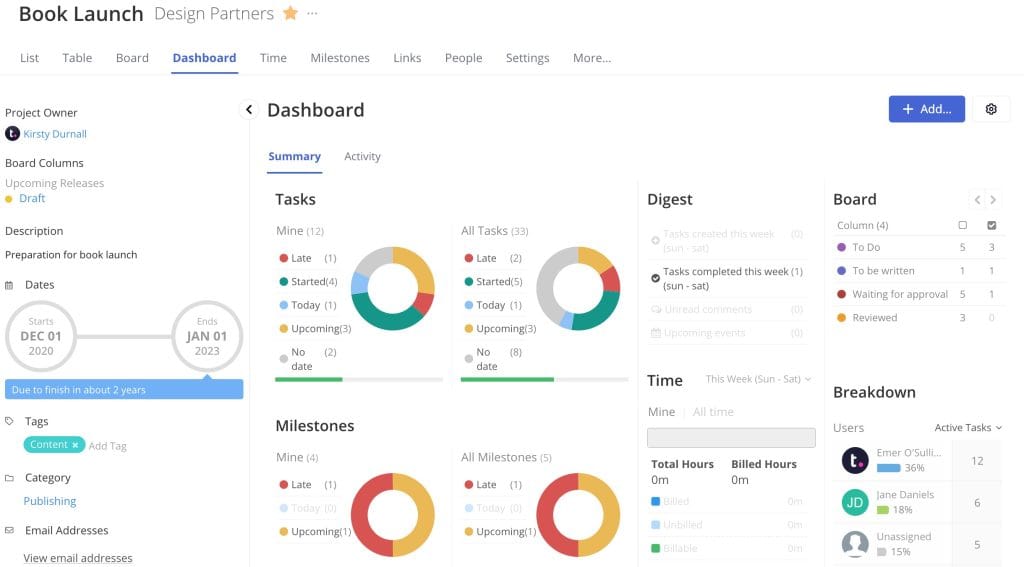
Teamwork.com was started by its founders as an agency before transforming into software trusted by more than 6,000 agencies worldwide, which means it was designed by people who understood agency pain points firsthand.
Key Strengths:
- Native time tracking with billable vs. non-billable hour categorization
- Resource and workload management for capacity planning and long-term forecasting
- Budgeting tools tied to project scopes and retainers
- Advanced collaboration features keeping teams and clients aligned
- Integrations with Slack, HubSpot, Jira, and dozens of other tools
Teamwork.com is the closest an agency can get to a complete all-in-one platform for managing, planning, and collaborating across all projects. The time logging and billable hours tracking—features that general project management tools treat as afterthoughts—are built into the core experience. Resource management shows exactly who has bandwidth and who’s overbooked, preventing the capacity crises that lead to missed deadlines and burned-out staff. And the pricing won’t blow the budget compared to enterprise alternatives.
Considerations: The platform is purpose-built for agencies, which means non-agency teams may find some features irrelevant. The interface, while functional, can feel dense when managing very large numbers of concurrent projects. Some users report a learning curve for advanced resource management features.
Ideal for: Agencies that need time logging, resource management, and budgeting alongside project management—the full operational picture, not just task tracking.
Notion – The All-in-One Workspace

Notion combines note-taking, project management, and knowledge base capabilities in a single platform, with powerful databases and Notion AI for intelligent assistance across internal operations.
Key Strengths:
- Flexible structure combining documents, databases, wikis, and project tracking
- Powerful relational databases for custom workflows
- Knowledge base and documentation features for SOPs and playbooks
- Collaborative real-time editing across team members
- Notion AI for drafting, summarizing, and organizing content
- Customizable templates for repeatable processes
Notion’s flexibility makes it particularly valuable for agencies that want to consolidate multiple tools into a single platform. The ability to create custom databases, documentation, and project trackers within the same workspace reduces context switching and improves information accessibility. Agency SOPs, client onboarding playbooks, content calendars, and meeting notes all live in one searchable, organized space. Notion AI adds intelligent assistance for drafting documents and finding information quickly.
Considerations: The open-ended nature means it requires more setup than purpose-built project management tools—you’re building your own system, not adopting a pre-built one. Some users report performance issues with very large workspaces. Time tracking and resource management require third-party integrations.
Ideal for: Agencies looking to reduce tool sprawl by combining project management, documentation, and knowledge sharing in a single platform.
Slack – The Team Communication Hub

Slack has established itself as the standard for team communication, replacing email for internal collaboration with organized, searchable, real-time messaging.
Key Strengths:
- Channel-based communication for topic and client organization
- Extensive integration capabilities connecting to virtually every agency tool
- Searchable message history preserving institutional knowledge
- Huddle feature for quick voice conversations without scheduling meetings
- Thread support for focused discussions that don’t clutter main channels
Slack excels at reducing email overload while keeping team communication organized and searchable. The channel structure allows for both team-wide updates and specialized discussions—one channel per client, one for each department, one for water-cooler chat. Search ensures information remains accessible over time, and the integration ecosystem means notifications from project management tools, CRM updates, and social media alerts all flow into one place.
Considerations: Can become a source of distraction without careful channel management and notification settings. The conversation-based nature makes it less suitable for structured documentation—important decisions made in Slack need to be captured elsewhere. The free plan’s message history limits can be frustrating for growing teams.
Ideal for: Agencies of all sizes looking to improve team communication and reduce email dependence.
For more options, check out our full breakdown of the best project management software for agencies.
CRM and Client Relationship Tools
Managing client relationships at scale requires purpose-built platforms that track the full lifecycle from initial lead through ongoing service delivery. The right CRM prevents opportunities from falling through cracks and gives agency leadership visibility into pipeline health.
HubSpot – The Integrated Marketing and CRM Platform

HubSpot offers a comprehensive CRM platform with marketing, sales, and service capabilities unified around a single customer record, making it the most popular all-in-one platform for mid-market agencies.
Key Strengths:
- Unified customer data across marketing, sales, and service interactions
- Marketing automation with email, social, and content management
- Client portal options for transparent project communication
- Email marketing integration tied to CRM contact data
- Comprehensive reporting connecting marketing activity to revenue
HubSpot stands out for its ability to track the entire client journey, from the first website visit through signed contract and ongoing retainer. The platform’s marketing tools are particularly valuable for agencies, with email marketing, social media, and content management capabilities built alongside the CRM. For agencies that also do business development, the sales pipeline tools help track prospects without needing a separate sales platform.
Considerations: The full suite represents a significant investment, with costs increasing substantially as features are added beyond the free CRM tier. Some specialized features lack the depth of dedicated tools—the social media management won’t replace Sprout Social, and the SEO tools won’t replace Semrush. The sheer breadth of the platform creates a long onboarding period.
Ideal for: Full-service agencies looking to align marketing, sales, and client service around a central platform with a strong free starting point.
Salesforce – The Enterprise Relationship Platform
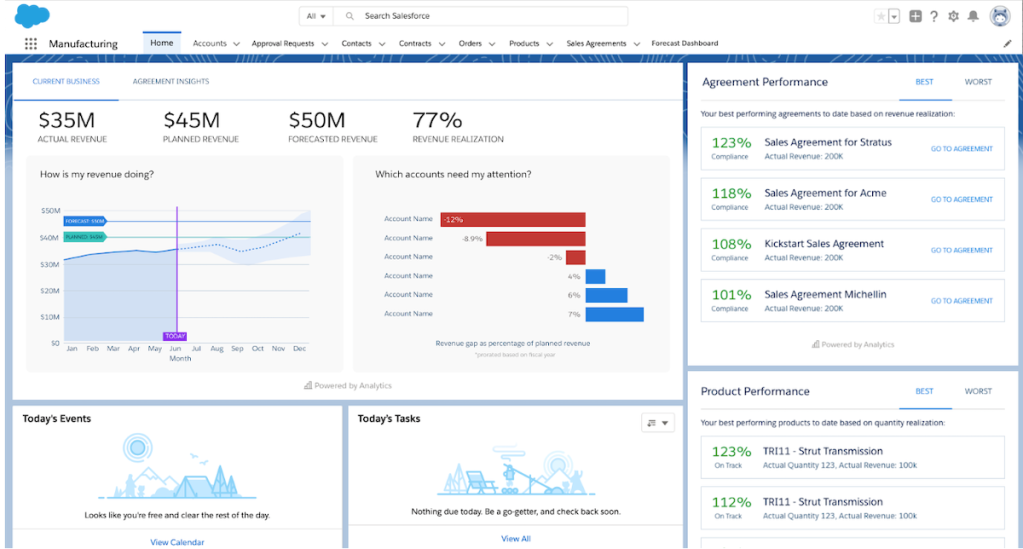
Salesforce provides the most comprehensive client relationship management ecosystem available, designed for complex agency-client engagements with deep customization and AI-powered insights through Einstein and Agentforce.
Key Strengths:
- End-to-end client lifecycle management from lead to long-term retention
- Customizable workflow automation for complex agency processes
- Advanced opportunity tracking, forecasting, and pipeline analytics
- Deep analytics with AI-powered insights through Einstein and Agentforce
- Extensive integration capabilities with virtually every marketing tool
Salesforce creates a unified client view from initial contact through ongoing service delivery. The platform enables sophisticated automation of complex agency processes while providing granular visibility into team performance and client status. Custom dashboards deliver executive-level insights alongside operational metrics for complete agency intelligence. Agentforce adds AI-driven customer operations capabilities that are especially valuable for agencies managing high-touch client relationships.
Considerations: Implementation requires significant configuration and possible customization—budget for setup time and potentially consultant fees. The extensive feature set demands dedicated administration resources to maximize value. Cost per user is high and increases with each cloud and add-on.
Ideal for: Larger agencies with complex client relationships seeking an enterprise-grade platform for complete business operations management.
Pipedrive – The Agency Sales CRM
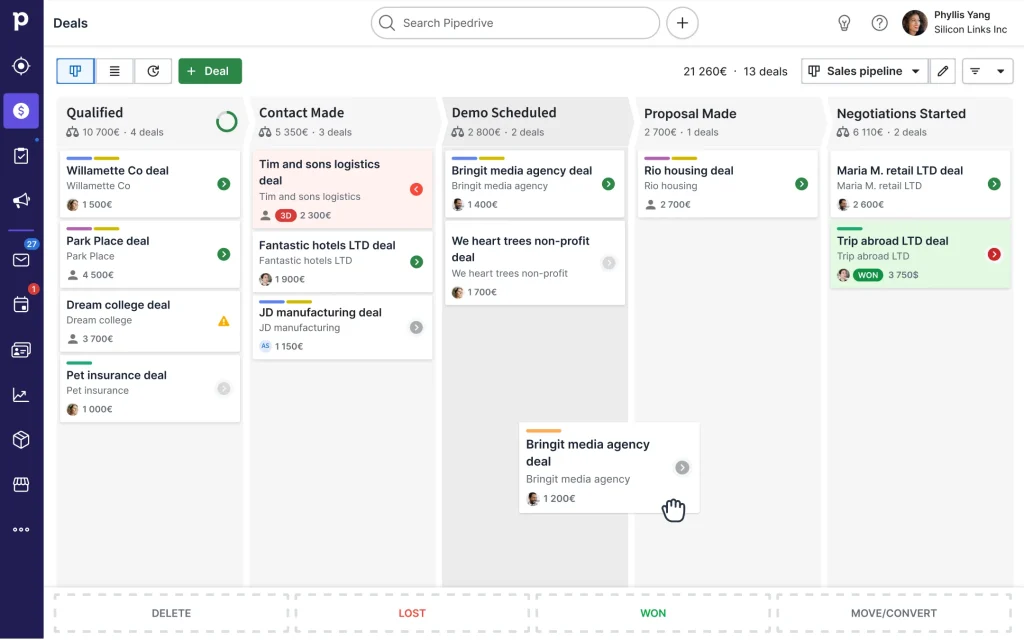
Pipedrive delivers a sales-focused CRM designed specifically for visualizing and optimizing the client acquisition process, making it the go-to pipeline tool for agencies focused on growth.
Key Strengths:
- Visual sales pipeline with drag-and-drop deal management
- Automated activity tracking and follow-up reminders
- Email integration with open and response tracking
- Sales forecasting and goal setting tools
- Mobile app for on-the-go prospect management
Pipedrive transforms chaotic agency sales processes into structured, measurable workflows. The visual pipeline shows exactly where each prospect stands, while automation ensures consistent follow-up without manual tracking. The platform highlights which actions move deals forward, enabling teams to replicate successful patterns. For agencies where business development is a core function, this clarity into the sales pipeline prevents the feast-or-famine cycle that plagues agencies without structured sales processes.
Considerations: Focuses exclusively on sales rather than marketing or service delivery—it won’t replace your project management tool. Some advanced automation features require higher-tier subscriptions. Reporting is solid but not as deep as enterprise CRM platforms.
Ideal for: Agencies seeking a dedicated sales management tool with clear pipeline visibility and structured follow-up processes.
Data Infrastructure and Marketing Attribution Tools
This is the category most agencies underinvest in—and it shows. According to Funnel’s 2026 research, agencies score just 81% on client satisfaction for intelligence delivery, suggesting significant room to differentiate through better data infrastructure. Clients don’t just want dashboards. They want intelligence—the ability to understand what’s working, why it’s working, and what to do next.
Funnel.io – The Marketing Data Hub
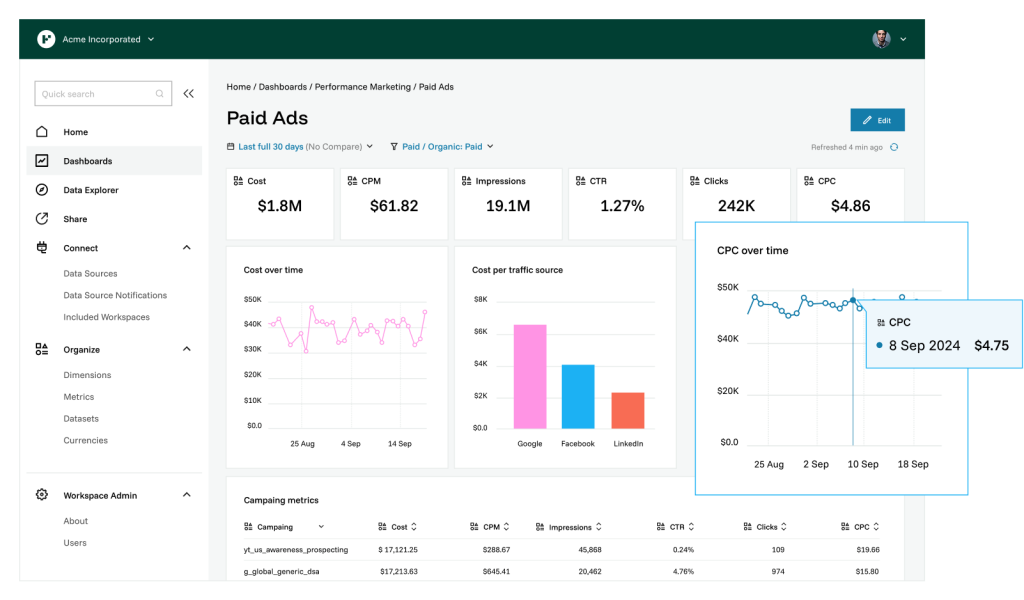
Funnel ingests marketing data from hundreds of sources, cleans and normalizes it, and delivers analysis-ready data for client dashboards and reporting platforms.
Key Strengths:
- Connects to hundreds of marketing data sources automatically
- Cleans and normalizes messy cross-platform data into consistent formats
- Delivers analysis-ready data to any BI tool, warehouse, or spreadsheet
- Eliminates manual data wrangling, CSV exports, and copy-paste reporting
- Cross-channel performance comparison with confidence in data accuracy
Funnel.io solves the foundational problem that undermines everything else in your reporting stack: dirty, inconsistent data. When Facebook calls it “impressions” and Google calls it “views” and LinkedIn calls it something else, Funnel normalizes it all so your cross-channel reports actually compare apples to apples. The platform’s value compounds—the more channels your clients run, the more time you save and the more trustworthy your reporting becomes.
Considerations: Funnel is a data infrastructure tool, not a visualization or reporting tool—you still need Looker Studio, Tableau, or a similar platform for the presentation layer. The pricing reflects enterprise positioning and may be steep for smaller agencies. Initial setup requires mapping data sources to your desired schema.
Ideal for: Agencies managing multiple channels who need trustworthy, unified data as the foundation of all client reporting.
Fospha – The Cross-Channel Attribution Platform
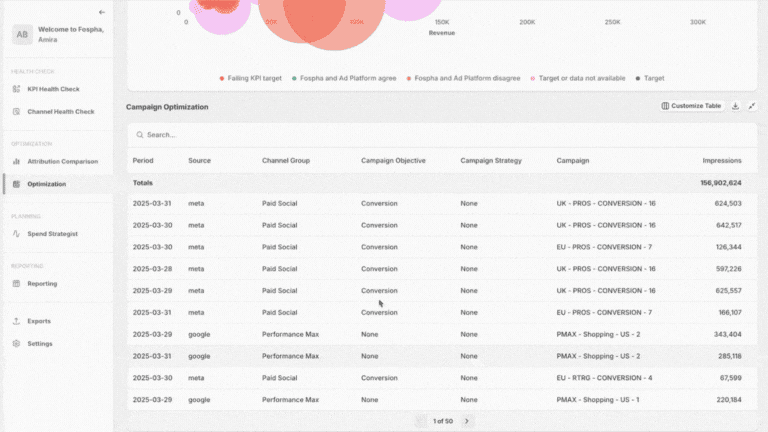
Fospha helps agencies show how upper-funnel activity drives sales across DTC, Amazon, and marketplaces like TikTok Shop, solving the attribution problem that plagues agencies trying to prove the value of awareness campaigns.
Key Strengths:
- Cross-channel attribution connecting awareness spend to actual sales
- Incremental forecasting identifying profitable growth opportunities
- Diminishing returns analysis preventing overspending
- DTC, Amazon, and marketplace attribution in one platform
- Media mix modeling for budget optimization across channels
Fospha addresses the question that keeps agency-client relationships tense: “Is our top-of-funnel spend actually driving sales?” The platform’s incremental forecasting helps teams identify exactly where profitable growth opportunities exist and where additional spend would hit diminishing returns. For e-commerce agencies, the ability to connect brand awareness campaigns on Meta or TikTok to actual sales on Amazon or Shopify provides the attribution story that justifies continued investment.
Considerations: Most valuable for e-commerce and DTC brands—less applicable for service businesses or B2B. Requires sufficient data volume for accurate modeling. The attribution methodology is probabilistic, not deterministic, which some clients may question.
Ideal for: E-commerce-focused agencies needing to prove the value of full-funnel marketing investment across multiple sales channels.
Supermetrics – The Marketing Data Pipeline

Supermetrics automates the extraction of marketing data from ad platforms, analytics tools, and social networks into the destinations where agencies actually build reports and do analysis.
Key Strengths:
- Automated data extraction from all major ad and analytics platforms
- Direct delivery to Google Sheets, Excel, Looker Studio, BigQuery, and more
- Scheduled data refreshes eliminating manual export routines
- Custom query building for specific metrics and dimensions
- Multi-client management for agencies handling numerous accounts
Supermetrics reduces the manual reporting burden that eats agency hours every week. Instead of logging into six platforms, exporting CSVs, reformatting data, and pasting into spreadsheets, Supermetrics automates the entire pipeline. Scheduled refreshes mean client reports update themselves overnight, and custom queries ensure you’re pulling exactly the metrics each client cares about. The platform supports direct delivery to whatever tool you build reports in.
Considerations: Primarily a data extraction tool—doesn’t clean, normalize, or visualize data like Funnel.io or Looker Studio. Pricing is based on data sources and destinations, which can add up for agencies with diverse client tech stacks. Some connectors have data freshness limitations.
Ideal for: Agencies building custom reporting workflows who need reliable, automated data pipelines from ad platforms to reporting tools.
Triple Whale – The E-Commerce Intelligence Platform
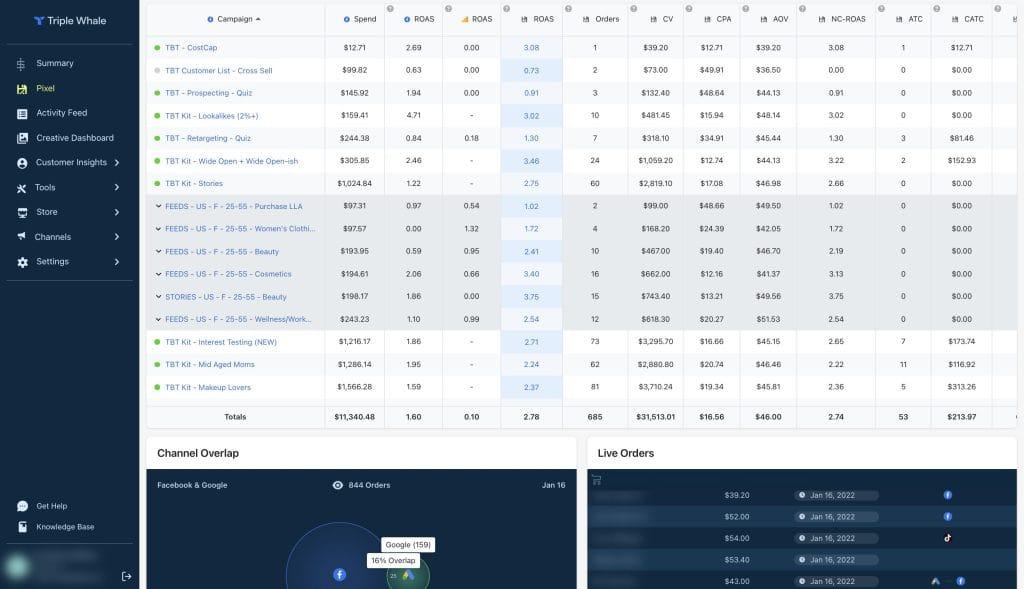
Triple Whale provides e-commerce attribution, customer journey analytics, and creative performance tracking, giving agencies serving Shopify and DTC brands a single source of truth that platform-reported metrics can’t provide.
Key Strengths:
- First-party data attribution independent of ad platform reporting
- Customer journey analytics showing full path to purchase
- Creative performance tracking identifying which ads drive revenue
- Real-time dashboard with blended ROAS across all channels
- Shopify and DTC platform deep integration
Triple Whale exists because every e-commerce agency knows the problem: Facebook says it drove $50K in revenue, Google says it drove $50K, and the client only made $60K total. Platform-reported attribution double-counts, and agencies need a source of truth. Triple Whale provides that through first-party data tracking, giving agencies clean attribution data they can confidently present to clients. The creative performance tracking also shows which specific ads drive revenue, informing creative strategy decisions.
Considerations: Focused primarily on Shopify and DTC e-commerce—less useful for B2B, service businesses, or non-Shopify retailers. Requires the Triple Whale pixel installation on client stores. The attribution model is one approach among several, and clients with strong analytics opinions may want to compare methodologies.
Ideal for: Agencies managing Shopify and DTC e-commerce brands who need attribution data they can trust beyond platform-reported metrics.
Analytics and Reporting Tools
Demonstrating value to clients requires robust analytics platforms that translate data into compelling stories. These tools form the visualization and analysis layer that sits on top of your data infrastructure.
Google Analytics 4 – The Essential Analytics Platform
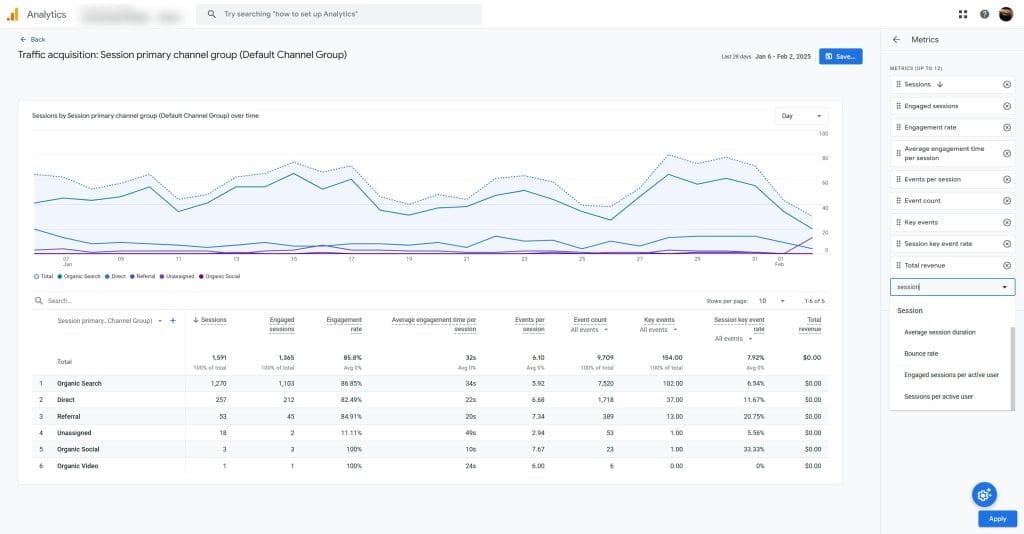
GA4 provides the foundation for website and app performance analysis, with a fundamentally different approach than its predecessor—focusing on user journeys across platforms rather than isolated page-by-page sessions.
Key Strengths:
- Cross-platform tracking unifying web and app user behavior
- Event-based data model providing flexible interaction tracking
- AI-powered insights surfacing anomalies and opportunities automatically
- Enhanced privacy features designed for a cookieless future
- Deep integration with Google’s marketing ecosystem including Ads and Search Console
GA4 represents a significant evolution in analytics. The event-based model provides more flexibility in tracking user interactions, while AI capabilities surface insights that might otherwise be buried in data. For agencies, the ability to create custom exploration reports and share them with clients provides a powerful storytelling tool that goes beyond standard dashboards.
Considerations: The transition from Universal Analytics involved a significant learning curve, and many agencies are still adapting to the new data model and interface. Some reports that were simple in UA require more setup in GA4. Historical data from UA did not migrate, creating a break in trend analysis for long-running clients.
Ideal for: All agencies involved in digital marketing. GA4 provides the foundational understanding of online performance that informs every other marketing decision.
Looker Studio – The Free Visualization Tool
Looker Studio (formerly Google Data Studio) transforms raw data into visual reports and interactive dashboards by connecting to multiple data sources—and it’s completely free, making it one of the easiest wins in an agency reporting stack.
Key Strengths:
- Visual report and dashboard creation without coding or design skills
- Connection to multiple data sources including Google products and third-party connectors
- Interactive dashboard capabilities with filters and date range selectors
- Sharing and collaboration with live links that stay current
- Extensive community template library for rapid report creation
Looker Studio excels at making data accessible and understandable. The ability to combine data from multiple sources allows agencies to create comprehensive client dashboards that showcase performance across channels. The shareable live links mean clients can check performance anytime without asking you to export another report—reducing the back-and-forth that eats into account management time. Build one solid reporting template, then duplicate it per client and swap the data source.
Considerations: Advanced customization can require workarounds and calculated fields that get complex quickly. Some data sources require third-party connectors (Supermetrics, Funnel.io) that add cost. Performance can lag with very large datasets or complex reports with many data sources.
Ideal for: Agencies of all sizes looking to create visually compelling, shareable reports and dashboards for client presentations.
Tableau – The Advanced Data Analysis Platform
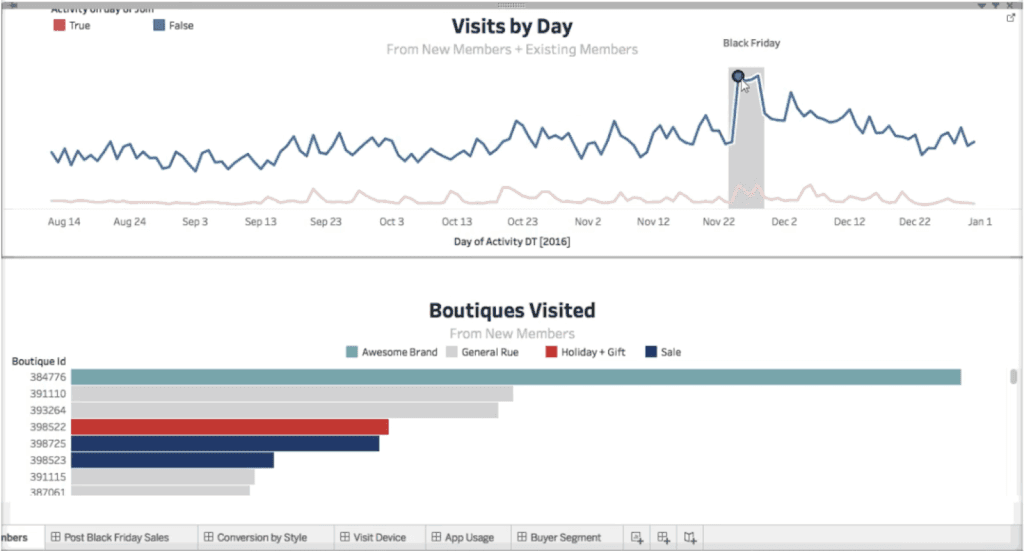
Tableau offers the most powerful data visualization and analysis capabilities available, designed for agencies with complex reporting needs and data specialists who want to tell sophisticated data stories.
Key Strengths:
- Advanced data visualization options far beyond standard charts
- Complex data analysis with calculated fields, parameters, and statistical functions
- Interactive dashboard features with drill-down capabilities
- Enterprise-grade security and governance
- Desktop and cloud deployment options
Tableau excels at handling complex data analysis requirements, making it particularly valuable for agencies working with large datasets or sophisticated analysis needs. The visualization capabilities go beyond standard charts, allowing for compelling data storytelling that impresses clients accustomed to seeing the same bar graphs every month. For agencies competing on analytical sophistication, Tableau signals that you take data seriously.
Considerations: Steeper learning curve than alternatives—expect dedicated training time. Desktop licenses start at $70+/month per user, making it a significant investment. The platform’s power comes with complexity that can be overwhelming for basic reporting needs. Overkill for agencies that just need standard performance dashboards.
Ideal for: Larger agencies with data analysis specialists who need advanced visualization and analysis capabilities to differentiate their reporting.
Power BI – The Microsoft Analytics Solution
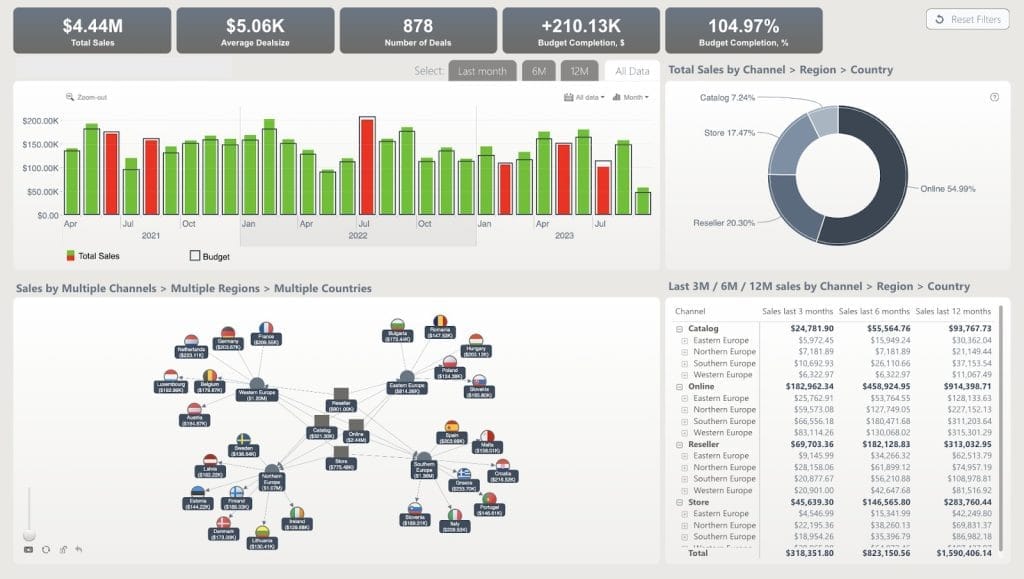
Power BI offers robust data analysis and visualization deeply integrated with the Microsoft ecosystem, with advanced data modeling capabilities that rival Tableau at a more accessible price point.
Key Strengths:
- Deep integration with Microsoft 365, Azure, and Dynamics products
- Advanced data modeling capabilities accessible without SQL knowledge
- AI-powered insights and natural language querying
- Both desktop (free) and web (paid) interfaces
- Regular feature updates keeping pace with analytics trends
Power BI stands out for its integration with the Microsoft ecosystem, making it particularly valuable for agencies already using Microsoft tools. The data modeling capabilities are especially strong, allowing for complex analysis that would require SQL knowledge in other platforms. The free desktop version provides substantial functionality, and the per-user pricing for the web version is more accessible than Tableau for many agencies.
Considerations: Like Tableau, Power BI has a learning curve for advanced features. The web version lacks certain capabilities available in the desktop application. Non-Microsoft data source connections can sometimes be less smooth than native Microsoft integrations.
Ideal for: Agencies working within the Microsoft ecosystem who need powerful data analysis and visualization capabilities.
Want more analytics options? Read our best marketing analytics tools guide.
Swydo – The Client Reporting Automation Expert
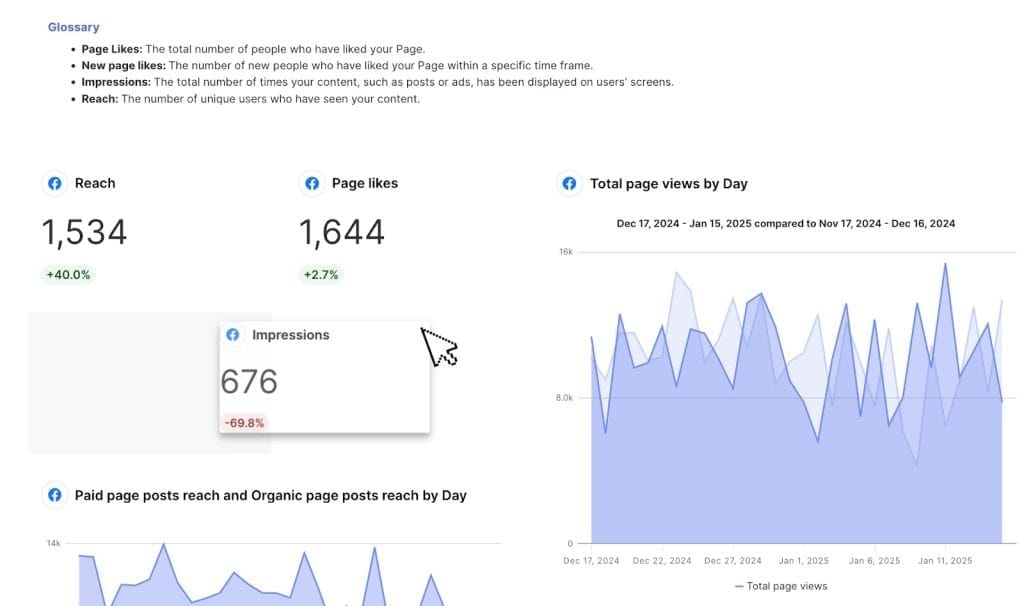
Swydo specializes in marketing report automation rather than direct social media management, consolidating metrics from social media, PPC, SEO, and email into unified branded reports.
Key Strengths:
- Multi-platform automated reporting across all marketing channels
- Live KPI monitoring with single-dashboard overview for all clients
- Customizable report design templates with branding options
- Time-efficient automation that eliminates manual report building
- Cross-channel data integration beyond social platforms
Swydo’s Monitoring Overview makes it easy to track all your clients’ top KPIs in a single dashboard while still allowing granular individual client reports. The platform saves hours of manual report building each month—time that goes directly back into strategy and client service. For full-service agencies needing to demonstrate comprehensive performance across all campaigns, this integration is exceptionally valuable.
Considerations: Requires pairing with other marketing agency tools since it focuses exclusively on reporting. Not a social management platform in itself. The learning curve is minimal, but you’ll need your other tools properly connected for maximum value.
Ideal for: Data-focused agencies managing multiple marketing channels who need streamlined, automated client reporting systems.
Check out our full breakdown of the best social media reporting tools.
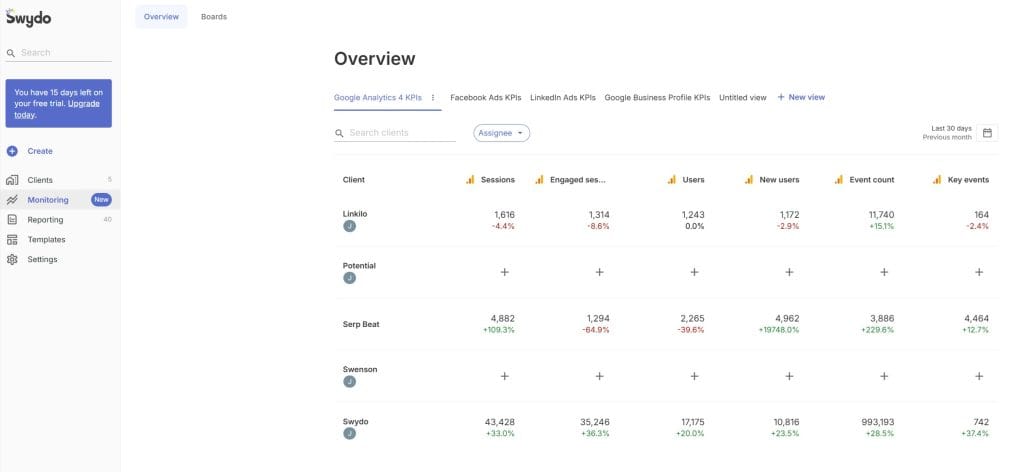
Email Marketing and Automation Tools
Email remains one of the highest-ROI marketing channels, and automation extends its power across the full customer lifecycle. These platforms help agencies deliver campaigns that nurture leads, drive conversions, and retain customers at scale.
Mailchimp – The Email Marketing Standard

Mailchimp has evolved from a simple email platform into a comprehensive marketing automation tool with customer journey mapping, e-commerce integration, and AI-powered content optimization.
Key Strengths:
- User-friendly email builder with drag-and-drop design
- Customer journey mapping for automated multi-step sequences
- Marketing automation capabilities triggered by user behavior
- E-commerce integration with Shopify, WooCommerce, and more
- Content optimization suggestions powered by AI
Mailchimp excels at making email marketing accessible while offering depth for sophisticated campaigns. The journey builder allows for complex automation sequences—welcome series, abandoned cart flows, re-engagement campaigns—while its testing features help optimize content for better performance. The platform’s familiarity also reduces client onboarding friction when agencies hand off email management.
Considerations: Pricing increases significantly as subscriber lists grow, which can create sticker shock for agencies managing large client lists. Some advanced automation features are restricted to higher tiers. Power users sometimes find the automation builder less flexible than dedicated platforms like ActiveCampaign.
Ideal for: Agencies managing email marketing for clients who need a balance of accessibility, automation capabilities, and broad integration support.
ActiveCampaign – The Automation Specialist

ActiveCampaign focuses on sophisticated marketing automation that goes well beyond email, with a powerful rules engine that responds to user behavior across channels.
Key Strengths:
- Advanced automation engine with complex condition-based sequences
- Built-in CRM functionality bridging marketing and sales
- Predictive sending optimizing delivery timing per recipient
- Split testing at the automation level, not just individual emails
- Extensive integration with 900+ apps
ActiveCampaign stands out for its powerful automation engine, which allows for complex, condition-based sequences that respond dynamically to user behavior. If a prospect opens email A but not email B, then visits the pricing page, ActiveCampaign can automatically trigger a personalized follow-up. The CRM functionality bridges the gap between marketing and sales, making it valuable for full-funnel campaigns where the handoff from marketing to sales needs to be seamless.
Considerations: The platform’s depth comes with a steeper learning curve than simpler alternatives. The email builder is less intuitive than Mailchimp’s drag-and-drop interface. Some agencies find the CRM functionality is strong enough to use but not deep enough to replace a dedicated CRM like HubSpot or Pipedrive.
Ideal for: Agencies focused on sophisticated behavioral marketing automation who need complex sequences that go beyond basic drip campaigns.
HubSpot Marketing Hub – The Integrated Marketing Platform

HubSpot Marketing Hub offers email marketing and automation as part of its broader marketing platform, connecting email campaigns with CRM data, content, and multi-channel tools.
Key Strengths:
- Seamless integration with HubSpot CRM for unified customer data
- Content management capabilities including blog, landing pages, and SEO
- Multi-channel campaign tools spanning email, social, and ads
- Comprehensive analytics connecting email performance to revenue
- ABM features for B2B marketing with account-level targeting
HubSpot Marketing Hub excels at connecting email campaigns with broader marketing efforts, providing a unified view of performance and customer interactions across every touchpoint. The content tools are particularly strong, with blogging, social media, and SEO capabilities alongside email marketing. For agencies that want one login to manage a client’s entire digital marketing presence, this integration is the core value proposition.
Considerations: The full platform represents a significant investment, particularly as advanced features are added beyond the starter tier. Some specialized email features lack the depth of dedicated email platforms like ActiveCampaign. The value proposition weakens considerably if you’re only using it for email and ignoring the broader marketing tools.
Ideal for: Agencies looking for an integrated marketing platform that connects email with content, social, CRM, and multi-channel analytics.
Klaviyo – The E-Commerce Email Specialist

Klaviyo focuses specifically on email and SMS marketing for e-commerce, with deep integration into shopping platforms and segmentation capabilities built around purchase behavior and customer value.
Key Strengths:
- E-commerce-specific features, templates, and pre-built flows (welcome, cart abandonment, post-purchase)
- Advanced segmentation based on purchase history, browsing behavior, and predicted lifetime value
- Predictive analytics for customer lifetime value and churn risk
- SMS marketing capabilities alongside email for multi-channel campaigns
- Detailed performance benchmarks comparing results against industry averages
Klaviyo stands out for its focus on driving e-commerce results. The segmentation capabilities allow for highly targeted campaigns based on what customers actually bought, browsed, and are predicted to buy next. Pre-built flows for common e-commerce scenarios (welcome series, cart abandonment, win-back) get agencies up and running quickly, while the predictive analytics help identify which customers are most valuable and which are at risk of churning.
Considerations: The e-commerce focus makes it less suitable for service businesses, B2B, or other industries without online transactions. Some agencies find the learning curve steeper than general email platforms, though the e-commerce-specific capabilities justify the investment. Pricing scales with list size and can get expensive for clients with large customer databases.
Ideal for: Agencies working with e-commerce clients who need sophisticated email and SMS marketing tied directly to purchase behavior and revenue.
SlickText – The SMS Marketing Platform
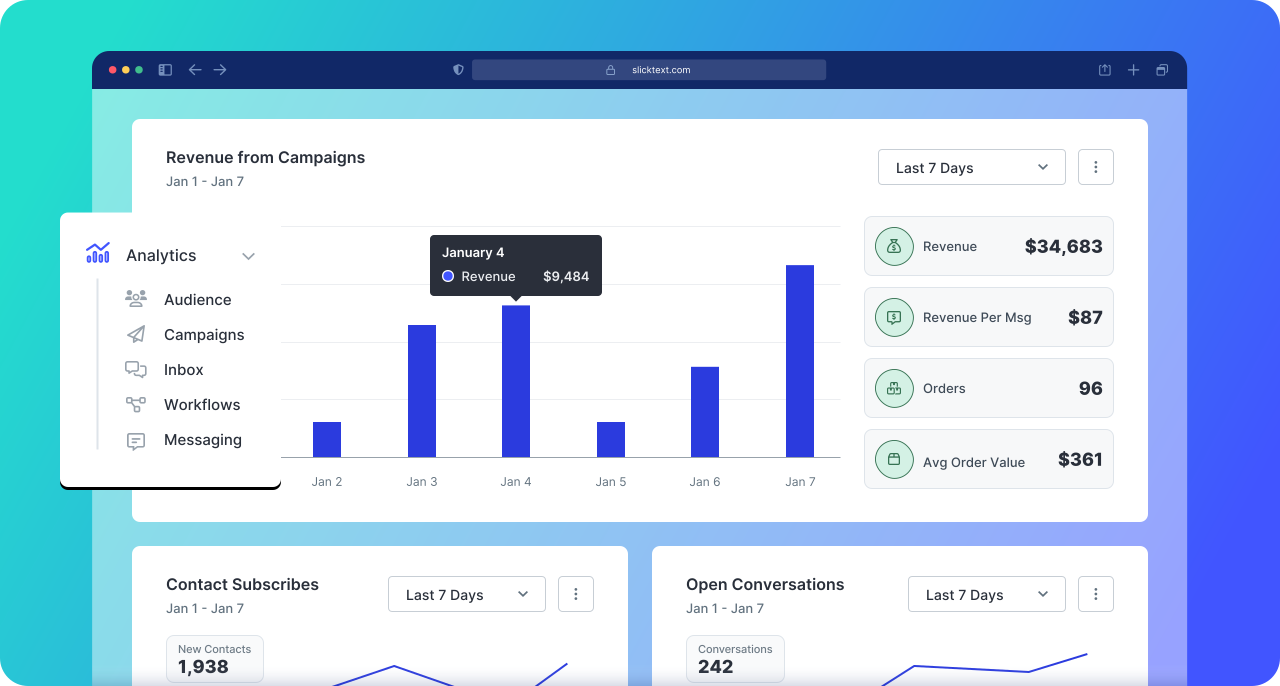
SlickText enables agencies to add SMS marketing to their channel mix with automated text campaigns, audience segmentation, compliance management, and integration with CRMs and marketing platforms.
Key Strengths:
- Automated SMS campaigns with triggers, drips, and scheduled sends
- Audience segmentation for targeted messaging
- Built-in compliance management for TCPA and other regulations
- Integration with major CRMs, email platforms, and Zapier
- Multi-client management with separate workspaces
SMS marketing consistently delivers open rates above 90%, making it one of the highest-engagement channels available. SlickText makes it practical for agencies to add this channel without becoming compliance experts themselves. The platform handles opt-in management, unsubscribe processing, and regulatory compliance—the operational headaches that prevent many agencies from offering SMS. Multi-client workspaces keep each client’s campaigns, contacts, and reporting cleanly separated.
Considerations: SMS costs are based on message volume, adding a variable expense to agency and client budgets. The channel works best for time-sensitive promotions, appointment reminders, and flash sales—not for long-form content marketing. Compliance requirements vary by region and add complexity for agencies with international clients.
Ideal for: Agencies expanding into SMS marketing who need reliable delivery, compliance management, and multi-client organization.
Design and Creative Tools
Visual content drives engagement across every channel. These tools help agencies create compelling assets efficiently—from quick social graphics to professional video production and collaborative UI design.
Canva – The Accessible Design Platform

Canva has democratized design, making it possible for marketing teams without specialized design skills to create professional-looking assets for every channel.
Key Strengths:
- Intuitive drag-and-drop interface accessible to non-designers
- Extensive template library covering social posts, presentations, ads, and print materials
- Brand kit functionality maintaining consistent colors, fonts, and logos across all assets
- Real-time collaboration features for team editing
- Animated content creation for social media and ads
Canva excels at empowering marketing teams to create professional-looking designs without requiring extensive training or a design degree. The template library provides starting points for virtually every content type, from Instagram stories to pitch decks, while the brand kit feature ensures consistency across all client assets. For agencies where speed matters more than pixel-perfect custom design, Canva dramatically reduces the time from concept to published asset.
Considerations: Professional designers will find it limiting compared to Adobe Creative Cloud or Figma. Complex design requirements, particularly for print materials or intricate layouts, push against the platform’s boundaries. The “template look” can become repetitive if teams don’t customize significantly.
Ideal for: Agencies producing high volumes of social media and digital content who need speed and consistency without extensive design resources.
Adobe Creative Cloud – The Professional Creative Suite

Adobe Creative Cloud remains the industry standard for professional design and creative work, with specialized applications covering every aspect of visual production.
Key Strengths:
- Comprehensive suite: Photoshop (image editing), Illustrator (vector graphics), Premiere Pro (video), InDesign (publication design), After Effects (motion graphics)
- Professional-grade capabilities that set the quality ceiling for the industry
- Seamless integration between applications for multi-stage creative workflows
- Regular feature updates including AI-powered tools through Adobe Firefly
- Industry standard file formats ensuring compatibility with clients and vendors
Adobe’s suite covers every creative need an agency faces. The integration between applications streamlines workflows—a designer can create vectors in Illustrator, composite them in Photoshop, animate them in After Effects, and edit the final video in Premiere Pro without ever leaving the ecosystem. The AI-powered features through Adobe Firefly now assist with generative fill, background removal, and content-aware editing, accelerating production without sacrificing quality.
Considerations: Significant subscription investment, with costs adding up across multiple applications ($59.99/month for the full suite per user). Professional-grade tools have steeper learning curves requiring dedicated training. Not every team member needs the full suite—most agencies supplement with Canva for simpler tasks.
Ideal for: Agencies with dedicated design teams who need professional-grade creative capabilities across photography, video, print, and motion graphics.
Figma – The Collaborative Design Platform

Figma has revolutionized design workflows by moving the entire process to the cloud with real-time collaboration that lets multiple designers work on the same file simultaneously.
Key Strengths:
- Real-time collaborative editing with multiple cursors and live updates
- Prototyping capabilities for interactive website and app mockups
- Design system management maintaining component consistency across projects
- Vector editing tools matching professional desktop applications
- Developer handoff features with inspect mode, CSS output, and asset export
Figma excels at streamlining the design process from concept to implementation. Multiple team members can work on designs simultaneously—no more “file is locked by another user” headaches. The prototyping features make it easy to create interactive mockups that clients can click through and experience before development begins, reducing the costly revision cycles that happen when clients first see designs in a built website. Developer handoff tools smooth the transition from design to code.
Considerations: Some specialized features found in desktop applications (advanced photo editing, print layout) are missing or limited. The cloud-based nature requires internet connectivity for full functionality. The free tier is generous for small teams but becomes expensive per-editor at scale.
Ideal for: Agencies with collaborative design workflows who need to streamline the process from concept through client approval to developer implementation.
Loom – The Video Communication Tool

Loom simplifies video communication by making it trivially easy to record your screen and camera, creating shareable video messages that replace lengthy emails and unnecessary meetings.
Key Strengths:
- One-click screen recording with optional webcam overlay
- Automatic cloud hosting with shareable links—no file attachment headaches
- Drawing and annotation tools for visual emphasis during recordings
- Viewer analytics showing who watched and for how long
- Integration with Slack, Notion, and project management tools
Loom has transformed how agencies communicate internally and with clients. Instead of writing a 500-word email explaining a design decision, a 2-minute Loom video shows and tells simultaneously. Client feedback meetings that used to require scheduling can often be replaced with asynchronous video updates. The viewer analytics show who has actually watched, eliminating the “I didn’t see the email” problem. For agencies billing hourly, reducing meeting time directly improves margins.
Considerations: Free plans limit video length and storage capacity. Some users report occasional quality issues with longer recordings or complex screen activities. Not every client or team member prefers video communication—some people genuinely prefer reading.
Ideal for: Agencies looking to improve client communication and internal knowledge sharing through quick, shareable video rather than meetings and long emails.
Plainly Videos – The Video Automation Platform
Plainly lets agencies take one After Effects template and produce hundreds of video variations using a spreadsheet or API—personalized, versioned, or localized videos at scale without manually editing each file.
Key Strengths:
- After Effects template automation for bulk video rendering
- Spreadsheet-driven video generation mapping data from Google Sheets or Excel to video parameters
- API integration for programmatic, trigger-based video creation
- Text, image, color, and audio swapping across unlimited variations
- Batch rendering that handles hundreds of versions in a single workflow
Plainly solves a specific but increasingly important agency problem: the need for video creative volume. Paid social algorithms reward fresh creative, and clients running campaigns across multiple markets need localized versions. Manually editing each variation in After Effects is unsustainable. Plainly automates the variation layer—design the template once, then generate hundreds of versions with different text, images, languages, or product shots from a simple spreadsheet. For agencies doing paid social at scale, this tool directly addresses the creative bottleneck.
Considerations: Requires After Effects templates as the starting point, meaning you need a motion designer for the initial template creation. The output quality depends on template quality. Not designed for one-off video production—the value comes from volume. The learning curve for template setup is moderate.
Ideal for: Agencies doing paid social at scale who need high creative volume without proportional production time and cost.
AI and Automation Tools
AI has moved from a supporting technology into the backbone of modern agency operations. The shift in 2026 is from using AI as a content assistant to deploying AI agents that autonomously execute marketing tasks. Multi-agent systems outperform single-agent approaches by over 90% on complex tasks, and marketing teams using AI agents report 73% faster campaign development. Here are the tools and platforms leading this transformation.
AI Content and Research Assistants
ChatGPT (OpenAI) – The Versatile AI Assistant
ChatGPT remains the most widely used AI tool for marketing teams, offering flexible natural language generation for everything from campaign ideation to client research and draft content creation.
Key Strengths:
- Natural language generation with strong reasoning capabilities
- Research assistance synthesizing information across topics
- Content ideation generating dozens of angles and approaches in minutes
- Draft creation for blogs, emails, social posts, ad copy, and more
- Custom GPTs allowing agencies to build specialized assistants for repeated tasks
ChatGPT excels at accelerating the early stages of content creation—brainstorming, outlining, drafting—where blank-page paralysis costs agencies the most time. The platform’s ability to understand context and respond to specific instructions makes it valuable for agencies juggling multiple client voices and industries. Custom GPTs let teams build specialized assistants (one for each client’s brand voice, for example) that standardize output quality across team members.
Considerations: Output requires human review and refinement for brand voice consistency and factual accuracy. The model occasionally generates plausible-sounding but incorrect information. Content generated without careful prompting can feel generic. Not a replacement for subject matter expertise or original thought.
Ideal for: Agencies looking to accelerate content creation, ideation, and research processes while maintaining human oversight for quality and brand alignment.
Claude (Anthropic) – The Long-Form Content Specialist
Claude has become a popular choice for agencies needing long-form content generation, document analysis, and the ability to work with very large documents, with particularly strong performance on structured, detailed responses.
Key Strengths:
- Excellent long-form content generation with consistent quality across lengthy pieces
- Very large context window for analyzing entire documents, reports, and datasets
- Structured, detailed responses well-suited for reports and strategy documents
- Claude Code for building internal marketing tools and custom workflows
- Strong reasoning capabilities for complex strategy and analysis tasks
Claude excels where other AI tools struggle: maintaining coherence and quality across long-form content. For agencies producing detailed blog posts, whitepapers, strategy documents, and comprehensive reports, the output quality at length is a genuine differentiator. Many agencies also use Claude Code as a coding assistant for building internal tools—content refresh trackers, competitive analysis dashboards, automated reporting scripts—that would otherwise require a developer.
Considerations: Like all AI writing tools, output requires human review. Some agencies find Claude’s responses can be overly cautious or verbose. The platform is less widely integrated into third-party marketing tools compared to OpenAI’s API. Pricing for heavy API usage can add up.
Ideal for: Agencies needing high-quality long-form content, document analysis, strategy work, and internal tool creation.
Jasper – The Marketing AI Agent Workspace

Jasper has pivoted dramatically from a template-based writing tool to what it now calls an agent workspace built for modern marketing teams, offering 100+ specialized AI agents and end-to-end content pipelines.
Key Strengths:
- 100+ purpose-built marketing AI agents for specific tasks and channels
- Content Pipelines connecting data, strategy, and creative into automated production systems
- Brand voice and context hub maintaining quality and authenticity at scale
- Multi-language support for global campaign deployment
- Team collaboration with governance and approval workflows
Jasper’s transformation from writing assistant to agent workspace reflects where marketing AI is heading. Instead of prompting a chatbot to write an ad, agencies can set up Content Pipelines that automatically take a campaign brief, generate variations for each channel, maintain brand voice throughout, and queue content for approval—reducing the operational complexity of multi-channel campaigns. The brand context hub ensures output stays on-brand even as AI handles more of the production workload.
Considerations: The platform’s depth comes with a learning curve for teams used to simpler AI writing tools. Pricing positions Jasper at the premium end of AI content tools. The agent-based workflow represents a fundamentally different way of working that requires team adoption and process change, not just a tool subscription.
Ideal for: Marketing agencies looking to scale content production with agent-based automation while maintaining brand consistency across channels and markets.
Midjourney – The AI Image Generator
Midjourney generates high-quality images from text descriptions, opening possibilities for visual content creation that previously required extensive design resources or stock photo budgets.
Key Strengths:
- High-quality image generation from text prompts with distinctive artistic quality
- Unique artistic styles and approaches not achievable through stock photography
- Rapid iteration with multiple variations per prompt for creative exploration
- Regular model improvements raising output quality and control
- Community resources and shared prompts for learning effective techniques
Midjourney excels at creating distinctive visual content for marketing campaigns, particularly when unique or conceptual images are needed that stock photography can’t provide. The ability to generate multiple variations allows for rapid exploration of visual directions without briefing a photographer or designer. For social media content, blog illustrations, and concept exploration, Midjourney dramatically reduces the time from idea to visual asset.
Considerations: Generated images require refinement in traditional design tools for specific brand requirements like exact color matching or precise layouts. Some styles and concepts work better than others, requiring experimentation with prompt engineering. The ethical and legal landscape around AI-generated images continues to evolve. Not suitable for product photography or anything requiring photographic accuracy of real items.
Ideal for: Agencies expanding visual content capabilities without increasing design headcount, particularly for conceptual, illustrative, and social media content.
AI Agent Platforms
AI agents go beyond basic automation. They reason through problems, adapt to changing conditions, coordinate across tools, and learn from interactions. These platforms let agencies deploy autonomous agents for specific marketing functions—a fundamental shift from tools that assist to tools that execute.
Gumloop – The AI Workflow Automation Platform
Gumloop lets agencies connect any LLM model to internal tools and workflows without writing code, with built-in access to premium AI models, powerful web scraping, and continuous agents that act on new data in real time.
Key Strengths:
- Built-in access to latest AI models (ChatGPT, Claude, Grok) without separate API keys or billing
- Visual workflow builder with more flexibility than traditional if-then automation
- Powerful web and app scraping for automated competitive intelligence
- Continuous AI agents that monitor data and act autonomously in real time
- Integration with Notion, Slack, Google Sheets, and other workspace tools
Gumloop occupies the space between simple Zapier automations and full custom development. For agencies that want AI-powered workflows—automatically monitoring competitor content, generating weekly performance summaries, or routing leads based on AI analysis—Gumloop makes this possible without engineering resources. The built-in LLM access eliminates the hassle of managing API keys and surprise billing from OpenAI or Anthropic. The visual interface makes workflows inspectable and debuggable by non-technical team members.
Considerations: The platform is newer and less established than Zapier or Make, with a smaller user community and fewer pre-built templates. Complex workflows require understanding of how LLM prompting works. The power of continuous agents means mistakes can compound if automations aren’t properly tested before deployment.
Ideal for: Agencies wanting AI-powered automation beyond traditional if-then rules, especially for competitive intelligence, content workflows, and data-driven monitoring.
MindStudio – The No-Code AI Agent Builder
MindStudio lets agencies create, test, and deploy custom AI agents for specific marketing tasks without writing code, then monitor their performance with built-in guardrails and approval workflows.
Key Strengths:
- No-code interface for building AI agents tailored to specific agency workflows
- Pre-built agent templates for common marketing tasks (content, social, lead scoring)
- Built-in guardrails, approvals, and monitoring for safe deployment
- Multi-agent orchestration allowing agents to coordinate on complex tasks
- Performance tracking showing agent accuracy, speed, and output quality
MindStudio addresses a specific gap: agencies want custom AI agents for their unique workflows, but don’t have engineering teams to build them. The platform lets a marketing ops person create an agent that, for example, reviews incoming leads against qualification criteria, drafts personalized follow-up emails, and routes qualified leads to the sales team—all without writing a line of code. The approval workflows ensure agents don’t send anything without human sign-off until the agency is confident in the output quality.
Considerations: The no-code approach means highly complex or unusual agent behaviors may hit platform limitations. Agent quality depends heavily on how well they’re configured—garbage in, garbage out applies doubly to AI agents. The platform is still relatively new, and the AI agent category is evolving rapidly.
Ideal for: Agencies wanting to build custom AI agents for their specific workflows without requiring engineering resources or coding skills.
Workflow Automation Platforms
Zapier – The App Connection Standard

Zapier connects over 5,000 applications with no-code automation, remaining the go-to platform for agencies that need to eliminate repetitive manual tasks across their tech stack.
Key Strengths:
- Connections to 5,000+ applications covering virtually every marketing tool
- No-code automation building accessible to non-technical team members
- Multi-step workflow creation with conditional logic and filtering
- Scheduling and time-based triggers for recurring tasks
- Error handling and notifications preventing silent failures
Zapier excels at eliminating the repetitive manual tasks that eat agency hours—transferring leads from Facebook Lead Ads to the CRM, posting new blog content across social channels, notifying the team in Slack when a client fills out a feedback form. The no-code approach means anyone on the team can build automations, not just the technically inclined. For agencies managing multiple clients with different tech stacks, Zapier is often the glue that holds everything together.
Considerations: Complex automations become expensive on higher-tier plans, with pricing based on the number of tasks executed monthly. Some integrations have limitations in the specific actions and data fields available. Multi-step Zaps with many conditions can become difficult to troubleshoot. Less powerful than Make for data transformation tasks.
Ideal for: Agencies looking to improve efficiency by automating routine tasks and data transfers between marketing platforms without technical resources.
Make (formerly Integromat) – The Advanced Automation Platform

Make offers more powerful and flexible automation than Zapier, with visual workflow building, advanced data transformation, and the ability to handle complex scenarios that simpler tools can’t manage.
Key Strengths:
- Visual workflow builder with clear data flow visualization
- Advanced data transformation—parsing, filtering, calculating, restructuring between apps
- Robust error handling with retry logic and failure notifications
- API access for custom integrations with any platform that has an API
- Detailed execution history for debugging and optimization
- Extensive app library including niche platforms other tools don’t support
Make stands out for its powerful data manipulation capabilities, allowing agencies to build complex automations that transform data between formats, merge information from multiple sources, and handle conditional logic that would break simpler tools. The visual workflow builder makes complex scenarios inspectable—you can see exactly how data flows between applications and where transformations happen. For agencies orchestrating data across multiple client tech stacks with varied platforms, Make handles the edge cases that cause Zapier automations to fail.
Considerations: The platform’s depth comes with a steeper learning curve than Zapier. Some complex scenarios require understanding of data structures and API concepts. While the visual builder is intuitive for simple workflows, highly complex automations can become visually dense and hard to maintain.
Ideal for: Agencies with complex automation needs requiring data transformation, multi-source orchestration, and technical sophistication beyond basic app-to-app connections.
Writing and Proofreading
Grammarly – The Writing Quality Assurance Tool
Grammarly scans every piece of agency content—social posts, blog articles, proposals, client emails—for grammar errors, punctuation issues, fragmented sentences, and tone inconsistency before it reaches clients or the public.
Key Strengths:
- Real-time grammar, spelling, and punctuation correction across all writing
- Tone detection and adjustment ensuring appropriate voice for each context
- Style and clarity suggestions improving readability
- Browser extension, desktop app, and integrations working everywhere your team writes
- Brand tone customization maintaining consistency across team members
Grammarly is the cheapest insurance policy an agency can buy. One typo-filled client proposal can cost you a deal; one embarrassing social media post can damage a client relationship. The tool installs across devices and browsers, catching mistakes in real time whether your team is drafting in Google Docs, composing emails, writing in WordPress, or posting in social media platforms. For agencies with multiple writers producing content for different clients, the tone and style consistency features prevent the jarring voice shifts that undermine quality.
Considerations: Free plan covers basic grammar only—advanced features like tone detection and style guides require the premium subscription. The AI suggestions aren’t always right, particularly with industry jargon, brand-specific terminology, or intentionally informal social media copy. Can occasionally over-correct in ways that strip personality from casual content.
Ideal for: Every agency, regardless of size or specialty. The cost of published errors far exceeds the subscription price.
Client Acquisition and Sales Tools
Sustainable agency growth requires effective tools for lead generation, proposal creation, and closing deals. These platforms address the business development side of agency operations that marketing tools alone can’t cover.
Proposify – The Proposal Management System

Proposify streamlines the creation, delivery, and tracking of client proposals and contracts, turning the proposal process from a time sink into a competitive advantage.
Key Strengths:
- Template-based proposal creation with professional design and layout
- Electronic signature capabilities eliminating the print-sign-scan cycle
- Proposal analytics showing exactly how prospects engage—which sections they read, how long they spend
- Content library for reusable sections, case studies, and pricing tables
- Integration with CRM platforms syncing deal status automatically
Proposify excels at turning proposals into intelligence tools. The analytics show how prospects interact with proposals—did they skip to pricing immediately? Did they spend 10 minutes on the case studies? Did they forward it to someone else? These insights tell your sales team what matters to each prospect, enabling informed follow-up conversations. The template library ensures proposals look professional and consistent, even when produced under tight deadlines by different team members.
Considerations: Some users report limitations in design flexibility compared to creating custom PDF proposals from scratch. The platform represents an additional cost in the business development process. Advanced features like content analytics require higher-tier plans.
Ideal for: Agencies looking to improve proposal conversion rates through professional presentation, prospect engagement insights, and streamlined approval processes.
DocuSign – The Document Management Leader

DocuSign delivers enterprise-grade electronic signature and document management capabilities for client agreements, SOWs, NDAs, and any contract that needs a legally binding signature.
Key Strengths:
- Legally-binding electronic signature technology with global compliance
- Document template library for standardized agreements, SOWs, and contracts
- Advanced workflow automation for multi-party approval processes
- Integration with CRM, accounting, and project management platforms
- Robust security, authentication, and audit trail capabilities
DocuSign transforms agency agreement processes from proposal through signed contract, eliminating paper-based workflows while providing security and compliance features. Real-time tracking shows exactly where clients stand in the review and signature process—no more wondering whether the SOW is sitting in someone’s inbox or has been forwarded to legal. For agencies onboarding multiple new clients per month, the time saved on contract execution alone justifies the investment.
Considerations: The platform focuses primarily on document execution rather than visually impressive proposal design—pair it with Proposify for the full pipeline. Enterprise-level features command premium pricing. Simpler alternatives exist if you only need basic e-signatures without complex workflows.
Ideal for: Agencies requiring legally-compliant document processes and multi-party approval workflows, particularly those dealing with regulated industries or complex agreement structures.
Calendly – The Scheduling Automation Tool

Calendly eliminates the back-and-forth of scheduling by allowing clients and prospects to book time directly on agency calendars based on real-time availability.
Key Strengths:
- Automated scheduling syncing with Google Calendar, Outlook, and iCloud
- Custom booking questions that qualify prospects before the meeting happens
- Automated meeting reminders and follow-up emails reducing no-shows
- Integration with Zoom, Google Meet, and Microsoft Teams for automatic meeting links
- Team scheduling with round-robin and priority assignment
Calendly removes friction from the meeting scheduling process that can stall deals and frustrate clients. Prospects book time without the three-email back-and-forth about availability. Custom qualification questions provide valuable context before meetings—budget range, project timeline, current challenges—so your team arrives prepared. The reminder system significantly reduces no-show rates, protecting the time your team allocated for the conversation.
Considerations: Branding options are limited on lower-tier plans, which can look less professional for client-facing scheduling. Team scheduling features require higher-tier subscriptions. Some prospects perceive scheduling links as impersonal compared to a direct “let’s find a time” email.
Ideal for: Agencies looking to streamline scheduling for sales calls, client meetings, and onboarding sessions while maintaining control over availability and qualifying incoming meetings.
Email Security and Deliverability
As email authentication requirements tighten—Google and Yahoo now require DMARC compliance for bulk senders—agencies managing client email campaigns need tools that ensure deliverability and protect brand reputation. A beautifully crafted email campaign means nothing if it lands in spam.
PowerDMARC – The Email Authentication Platform
PowerDMARC centralizes SPF, DKIM, and DMARC management for agencies handling multiple client domains, providing the authentication infrastructure that modern email deliverability requires.
Key Strengths:
- Centralized SPF, DKIM, and DMARC management across all client domains
- Threat detection identifying phishing, spoofing, and impersonation attempts
- Real-time alerts and detailed reporting on email authentication health
- Multi-domain monitoring from a single dashboard
- White-label capabilities for presenting under agency branding
PowerDMARC addresses a problem most agencies don’t think about until it’s too late: email deliverability. With Google and Yahoo enforcing DMARC requirements for bulk senders, agencies that manage email marketing for clients need to ensure authentication is properly configured across every client domain. The platform makes it manageable to monitor and maintain authentication for dozens of client domains simultaneously, preventing the deliverability disasters that tank campaign performance.
Considerations: Email authentication is a technical domain that requires some learning investment to understand properly. The platform is specialized—it handles authentication and security, not email campaign creation or design. Some agencies may prefer to outsource email authentication management rather than add another tool.
Ideal for: Agencies managing email marketing for multiple clients who need to ensure deliverability, protect against domain spoofing, and maintain compliance with sender authentication requirements.
How to Build the Optimal Agency Tech Stack in 2026
With 75+ tools across a dozen categories, building the right stack requires more than picking the highest-rated option in each category. The agencies thriving in 2026 are building purposeful stacks—not collecting tools.
- Start with data infrastructure. Clean, trustworthy data powers everything else. If your reporting data is messy, every tool downstream suffers. Invest in a data normalization layer (Funnel.io, Supermetrics) before adding more point solutions.
- Prioritize integration over features. Choose tools that work together through native integrations or platforms like Zapier and Make. Siloed data creates inefficiency and undermines the cross-channel insights clients expect.
- Account for AI search visibility. Any tool evaluation in 2026 should include the question: does this help my clients appear in AI-generated answers? From Semrush’s AI Visibility Toolkit to dedicated AEO platforms, this capability is now a stack essential, not a nice-to-have.
- Balance depth and accessibility. The most powerful tool is useless if your team can’t adopt it. A slightly less powerful but more accessible option often delivers better results through broader team usage.
- Build for client visibility. Tools with white-label dashboards, branded reports, and client portals strengthen relationships and demonstrate value. Prioritize platforms that make your work visible in ways clients understand.
- Plan for scalability. Select tools with tiered pricing and modular capabilities. Per-user pricing models (Sprout Social, Hootsuite, Semrush) can get expensive quickly—factor in your three-year team growth when evaluating costs.
- Evaluate total cost of ownership. Look beyond subscription costs to implementation, training, and ongoing management. A more expensive tool that saves significant time or enables new service offerings may deliver better ROI than a cheaper alternative with limited capabilities.
- Deploy AI agents strategically. Start with the area where manual work consumes the most time and where success is easy to measure. For most agencies, this is content generation or social media management. Prove value with one agent, then expand.
Conclusion
The agency tech stack in 2026 is defined by a fundamental shift: from tools that help you do marketing to tools that help you prove marketing works. AI agents are handling execution. AEO platforms are tracking a new kind of visibility. Data infrastructure tools are turning raw metrics into the intelligence clients actually pay for.
The agencies pulling ahead aren’t the ones with the most tools—they’re the ones with the most purposeful stack. Every platform earns its place by contributing to clarity: can you show your clients what’s working, why it’s working, and what to do next?
You’ve got the rundown: 75+ tools across every category, from the foundational platforms you already know to the AI-powered tools rewriting the rules. Keep it strategic, keep it integrated, and build for what’s coming—not just what’s here.
Marketing Agency Tools FAQ
Quick answers to the most common questions about building your agency tech stack
At minimum, every agency needs six core tools: a social media management platform (like Sprout Social or Buffer), an SEO tool (Semrush or Ahrefs), a project management system (ClickUp, Asana, or Teamwork.com), a CRM (HubSpot or Pipedrive), an analytics platform (Google Analytics 4), and a reporting tool (Looker Studio or Swydo). Beyond these, most agencies also need an email marketing platform, a design tool like Canva or Adobe Creative Cloud, and a workflow automation tool like Zapier or Make to connect everything together.
It depends on your size. A freelancer or small agency can build a solid stack for under $500/month using tools with free tiers—Buffer, Google Analytics 4, Looker Studio, Google Search Console, Canva, and Ahrefs Starter ($29/month). A mid-sized agency with 5–10 team members managing 10+ clients should budget $2,000–$5,000/month. The biggest cost driver is per-user pricing: tools like Sprout Social ($199–$399/user/month) and Semrush ($45–$100/month per extra seat) scale fast as teams grow. Always project your team size three years out before committing.
Start by mapping outcomes, not features. Before adding any tool, ask: what specific problem does this solve, and can an existing tool already handle it? Prioritize platforms that cover multiple functions—HubSpot combines CRM, email, and content management; Teamwork.com bundles project management with time tracking and budgeting. Use Zapier or Make to connect tools instead of buying overlapping platforms. Audit your stack quarterly: if a tool hasn’t been used in 30 days, cut it. The best-run agencies typically use 8–12 core tools, not 25.
Integration should come before features. A tool that connects natively with your existing stack will outperform a feature-rich tool that creates data silos. After that, evaluate total cost of ownership (subscription + setup + training + per-user scaling), team adoption likelihood (the most powerful tool is useless if no one uses it), white-label and client-facing options (branded reports and dashboards strengthen relationships), and scalability (will pricing stay reasonable as you grow?). Test with a free trial before committing to an annual contract.
There’s no single best—it depends on your agency size, budget, and client mix. Sprout Social is the top choice for mid-to-large agencies that need deep analytics, social listening, and a unified inbox across all platforms. Hootsuite is best for agencies needing broad integrations (100+ apps) and enterprise-level social listening via Talkwalker. For budget-conscious teams, Buffer offers a free plan and paid tiers starting at $5/channel/month. Later Social wins for visual-first Instagram and TikTok campaigns. Sendible is the standout for white-label branding. Agorapulse is known for strong customer support and built-in ROI tracking.
| Tool | Best For | Starting Price |
|---|---|---|
| Sprout Social | Full-suite analytics, large teams | $199/user/mo |
| Hootsuite | Integrations, social listening | $99/user/mo |
| Buffer | Small agencies, freelancers | Free / $5/channel |
| Later Social | Instagram & TikTok visual content | Free (limited) |
| Sendible | White-label agency branding | Competitive |
| Agorapulse | Customer support & ROI tracking | ~$79/user/mo |
Ahrefs is better for backlink analysis and link building—it has the largest backlink index (35+ trillion links) and excels at competitive link research. It’s also more affordable to start, with a Starter plan at $29/month. Semrush is the better all-in-one choice for full-service agencies—it covers SEO, content, PPC research, social media management, and uniquely offers AI Visibility tracking to show how brands appear in AI-generated search results. Semrush Pro starts around $139.95/month. Pick Ahrefs if link building is your core service. Pick Semrush if you need one platform across multiple marketing disciplines.
Teamwork.com is purpose-built for agencies—it includes native time tracking with billable vs. non-billable hours, resource management, and budgeting tied to project scopes, which general PM tools treat as afterthoughts. ClickUp is the most customizable option with flexible views (list, board, Gantt, calendar) and built-in docs, though it requires more setup time. Asana is the easiest to adopt with strong workflow automation that eliminates manual handoffs. Monday.com is best for visually oriented teams who want at-a-glance status across all client projects. Notion works well for agencies that want to combine project management, documentation, and knowledge bases in one workspace.
HubSpot is the better fit for most small-to-mid agencies. It offers a free CRM tier, an intuitive interface, and built-in marketing tools (email, social, content management) that reduce the need for separate platforms. It’s easier to adopt and less expensive to start. Salesforce is built for larger agencies with complex client relationships, deep customization needs, and enterprise clients. It offers more powerful automation, forecasting, and AI-powered insights through Einstein and Agentforce—but requires significant setup time, often consultant fees, and higher per-user costs. If you need marketing tools bundled with your CRM, go HubSpot. If you need enterprise-grade customization, go Salesforce.
Mailchimp is the most accessible option with an intuitive drag-and-drop builder, customer journey mapping, and broad integrations—ideal for agencies that manage email across varied client types. ActiveCampaign is the better choice for sophisticated behavioral automation, with a powerful rules engine that triggers sequences based on complex user behavior across channels. Klaviyo is purpose-built for e-commerce agencies, with deep Shopify integration, purchase-based segmentation, and predictive analytics for customer lifetime value. For agencies that want email integrated with CRM and content tools, HubSpot Marketing Hub provides the most unified experience.
AEO is the process of optimizing your content so AI systems—ChatGPT, Google AI Overviews, Perplexity, Gemini, and voice assistants—cite your brand when answering user questions. Traditional SEO focuses on ranking in search results. AEO focuses on being the answer itself. This matters because zero-click searches now account for nearly 60% of U.S. queries, meaning users get answers without ever clicking through to a website. Agencies that can track and improve how their clients appear in AI-generated responses have a significant competitive advantage.
Three main options exist. Semrush AI Visibility Toolkit is the most integrated solution—it tracks brand presence in Google AI Overviews alongside traditional rankings in one dashboard, making it ideal for agencies already using Semrush. AtomicAGI is a dedicated AI citation tracker that monitors how brands appear across ChatGPT, Gemini, Claude, and Perplexity, showing which specific prompts trigger brand mentions. Birdeye Search AI focuses on local businesses, optimizing content to appear in AI-driven local search results for “near me” and location-specific queries. Most agencies will want at least one AEO tool paired with their traditional SEO platform.
Traditional automation follows fixed rules: if X happens, do Y. AI agents reason through problems, adapt to changing data, coordinate across tools, and improve over time. For example, a Zapier automation might send a follow-up email three days after a form submission. An AI agent built in MindStudio or Gumloop could analyze the lead’s behavior, score their likelihood to convert, draft a personalized email based on their specific interests, and route it for human approval—all without predefined rules for every scenario. Marketing teams using AI agents report 73% faster campaign development.
ChatGPT is the most versatile for brainstorming, drafting, and research—Custom GPTs let you build specialized assistants for each client’s brand voice. Claude excels at long-form content like whitepapers and strategy documents, maintaining quality across lengthy pieces. Jasper is built specifically for marketing teams with 100+ specialized AI agents, brand voice controls, and automated content pipelines. For content optimization, Clearscope and Surfer SEO analyze top-ranking pages and provide real-time guidance on what terms to include and how to structure your content for search. All AI output should be reviewed by humans for accuracy and brand alignment.
Yes, but the strategy has to evolve. Traditional organic search still drives massive traffic, and the fundamentals—quality content, technical health, authoritative backlinks—remain critical. What’s changed is that these same signals are now what AI systems use to decide which sources to cite in generated answers. A well-optimized site with strong E-E-A-T signals is more likely to be referenced by ChatGPT, Google AI Overviews, and Perplexity. Agencies should treat SEO and AEO as complementary: optimize for both traditional rankings and AI citation eligibility using tools like Semrush (which now tracks both) alongside dedicated AEO platforms.
Start with clean data. Use a normalization tool like Funnel.io or Supermetrics to pull metrics from every platform into a consistent format—without this, cross-channel comparisons are unreliable. Then connect marketing activity to business outcomes, not vanity metrics. For e-commerce, Triple Whale provides first-party attribution that resolves the double-counting problem across ad platforms. Fospha connects awareness spend to actual sales across DTC and marketplace channels. For phone-lead businesses, CallRail and CallTrackingMetrics attribute calls to specific campaigns. Present everything through branded dashboards in Looker Studio or Swydo so clients can see results in real time.
Looker Studio (formerly Google Data Studio) is the best free reporting option. It connects to Google Analytics, Google Ads, Google Search Console, and dozens of third-party sources through connectors. You can build interactive dashboards with filters, date ranges, and custom visualizations, then share live links so clients can check performance anytime without requesting a report. The main limitation is that some non-Google data sources require paid connectors (like Supermetrics), and performance can lag with very large datasets. For agencies that need automated, branded report delivery, Swydo is worth the paid upgrade.
Because every platform defines metrics differently. Facebook calls it “impressions,” Google calls it “views,” LinkedIn uses its own definitions—and each platform takes credit for the same conversions, leading to inflated totals. This is the single biggest data problem agencies face. The fix is a data normalization layer. Funnel.io ingests data from hundreds of sources, standardizes naming conventions and metric definitions, and delivers analysis-ready data to whatever reporting tool you use. Supermetrics does similar extraction and delivery. Without this step, your reports are comparing apples to oranges, and clients lose trust in the numbers.
Looker Studio is free, easy to learn, and ideal for most agency reporting needs—it connects well with Google’s ecosystem and third-party marketing data. Tableau is the most powerful visualization tool with advanced analysis capabilities, but it has a steep learning curve and costs $70+/month per user—best for larger agencies with dedicated data analysts. Power BI offers similar power to Tableau at a more accessible price, with deep Microsoft ecosystem integration and a free desktop version. Most agencies should start with Looker Studio and only move to Tableau or Power BI when standard dashboards no longer meet client expectations.
Zapier is easier to use and connects to 5,000+ apps—it’s the better choice for non-technical teams that need simple automations like pushing leads from Facebook to a CRM or sending Slack alerts when a client fills out a form. Make (formerly Integromat) is more powerful for complex workflows that require data transformation, conditional logic, API calls, and multi-source orchestration. If your automations involve merging data from multiple platforms or reformatting data between systems, Make handles edge cases that break Zapier. Start with Zapier for simplicity; switch to Make when your automations outgrow basic if-then rules.
Slack is the standard for internal team communication with channel-based organization by client and topic. For asynchronous client updates, Loom lets you record quick screen-and-camera videos that replace lengthy emails and unnecessary meetings—viewer analytics show who watched, eliminating “I didn’t see the update” excuses. Calendly automates scheduling for sales calls and client meetings with custom qualifying questions. For proposals and contracts, Proposify provides templates with analytics showing how prospects engage (which sections they read, how long they spent), while DocuSign handles legally binding e-signatures. These tools together cover the full communication lifecycle from prospect to active client.
Three categories are commonly overlooked. First, data infrastructure—fewer than 30% of marketers automate repetitive optimization tasks, and most agencies jump straight to dashboards without normalizing their data, which makes every report downstream unreliable. Tools like Funnel.io solve this. Second, AEO tracking—most agencies still can’t show clients how they appear in AI-generated answers, despite AI Overviews appearing in the vast majority of searches. Third, email authentication—with Google and Yahoo now requiring DMARC compliance for bulk senders, agencies managing client email need tools like PowerDMARC to monitor SPF, DKIM, and DMARC across all client domains, or risk deliverability failures that silently kill campaign performance.
Teamwork.com is the strongest option because it was built by agency founders—it natively tracks billable vs. non-billable hours, ties time to project budgets and retainers, and shows resource allocation so you can see who has capacity and who’s overbooked. ClickUp also includes built-in time tracking, and Asana offers workload visualization to prevent burnout. For agencies that just need simple time logging without switching project management tools, standalone options like Toggl or Harvest integrate with most PM platforms. The key is tracking time consistently across your team—even rough data reveals which clients are profitable and which are quietly eating your margins.
For most day-to-day social media graphics, ad creatives, and presentations, Canva is enough. Its template library, brand kit feature, and real-time collaboration make it fast and consistent for high-volume content. However, agencies with dedicated designers will need Adobe Creative Cloud for professional photo editing (Photoshop), vector graphics (Illustrator), video production (Premiere Pro), and motion graphics (After Effects). Figma is the best choice for collaborative UI/UX design and website mockups with real-time multi-user editing and developer handoff tools. Many agencies use Canva for speed on routine work and Adobe or Figma for complex client deliverables.
See every client’s performance across every channel — in one dashboard, under your brand.
Start Your Free Trial Today