
The most important ChatGPT Ads metrics to track are cost per acquisition (CPA), post-click conversion rate and incremental lift, because those three decide whether the channel deserves more budget. Everything else diagnoses. CTR, cost per click (CPC) and CPM still matter, just for finding problems rather than proving results.
That ranking surprises people. Open Ads Manager for the first time and the number staring back is a click-through rate that looks tiny next to Google Search. It’s supposed to look tiny, and once you see why, every other metric on the list makes sense.
So the plan is simple. First comes what ChatGPT Ads actually measures and where it goes blind. Then all nine metrics ranked with formulas, sourced benchmarks for what “good” looks like, and the tracking setup, GA4 reconciliation and client reporting that keep the numbers honest.
What Are ChatGPT Ads Metrics?
ChatGPT Ads metrics are the numbers that show how your sponsored placements inside ChatGPT perform, from impressions and clicks all the way through to conversions and revenue. Some come straight from OpenAI’s Ads Manager. Others you calculate yourself in GA4 or your CRM, since the platform keeps conversation data private from advertisers.
One analogy does most of the work here. A ChatGPT ad behaves like a business card left on the table after a consultant has already answered your question. You came for advice. You got it. The card sits underneath.
Most people never pick it up. That’s fine, because the ones who do have just read a full answer about their exact problem and are often further along in their decision than a typical search clicker.
That tells you where to look. Judge the channel by what happens after someone picks up the card, and by whether the card changed behavior even when nobody touched it. How many people grab it’s a much weaker signal.
The analogy stops there, though. Ads Manager reports a short, specific list of numbers and hides several you’d expect to see, so both lists are worth knowing before you build a single report.
The Seven Numbers Ads Manager Reports
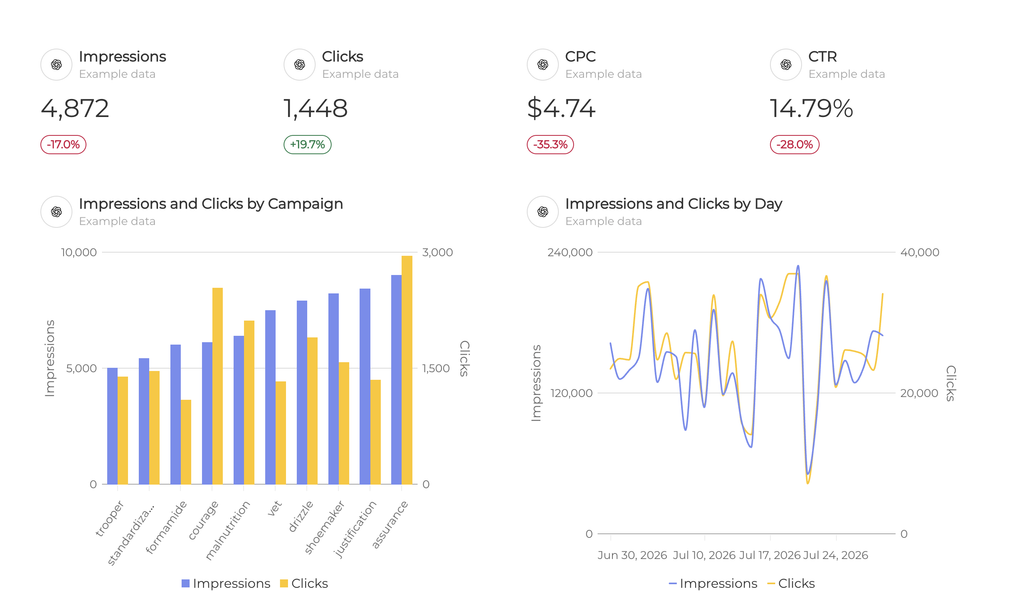
Ads Manager reports seven native metrics at the campaign, ad group and ad level:
| Metric | What it means | Best used for |
|---|---|---|
| Impressions | Times your ad was shown | Delivery and pacing |
| Clicks | Valid clicks on your ad | Traffic volume |
| Spend | Amount spent in your account currency | Budget control |
| CTR | Clicks divided by impressions | Creative and context fit |
| Avg. CPC | Spend divided by clicks | Cost efficiency on Clicks campaigns |
| Avg. CPM | Spend per 1,000 impressions | Cost efficiency on Views campaigns |
| Conversions | Attributed goal conversions within your selected windows | Outcome tracking |
E-commerce advertisers also get Order Created Sales and Order Created ROAS, both calculated from attributed purchase events. You can segment everything by device, country and platform. That’s the full list.
What ChatGPT Ads Won’t Tell You
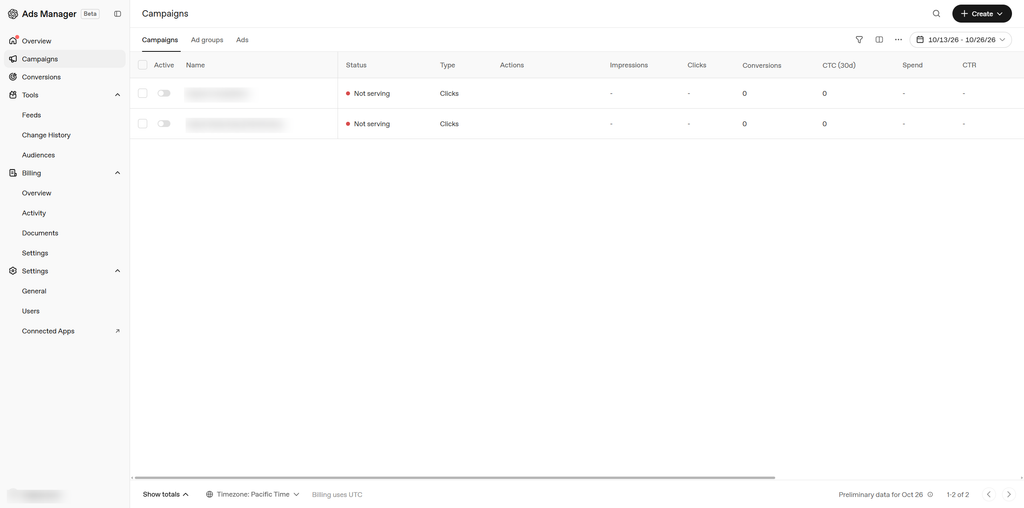
You’ll never see the prompt that triggered your ad. Conversations stay private by design, and ads respond to context hints rather than exact keywords. There’s no query report to pull.
Demographic breakdowns by age or gender don’t exist either. Reach and frequency are missing too, which means impressions count showings rather than people. You can’t tell whether one user saw your ad once or ten times.
Auction insights and impression share are absent as well. Competitors and lost volume stay invisible.
The audience is narrower than it sounds. Ads appear for Free and Go users only, never on Plus, Pro or any Business plan, and never for users identified as under 18. If your buyers sit on paid business seats, they won’t see your ads at all. That shapes every number you read afterward.
Which Metrics Matter Most Depends on Your Campaign Objective
ChatGPT Ads has three campaign objectives (Views, billed per thousand impressions; Clicks, billed per click; and Conversions), and each needs a different primary KPI. Judge a Views campaign on CPA and it looks like a failure. Judge a Conversions campaign on CTR and it looks fine right up until the money runs out.
One billing detail trips people up. Conversions campaigns tune toward conversions, but OpenAI still charges them per valid click, so CPC stays a live cost lever.
The cleanest way to keep it straight is to give every metric one of three jobs, a setup this guide calls the Decide, Diagnose, Verify stack. Decide metrics tell you whether to scale, hold or cut. They’re CPA, post-click conversion rate, incremental lift and ROAS. Diagnose metrics explain why a Decide metric moved: CTR, CPC, CPM and view-through conversions. Verify metrics, meaning click-to-session rate and conversion reconciliation, tell you whether your data can be trusted at all.
The Decide, Diagnose, Verify Stack by Campaign Objective
Make budget calls from the green row. Fix problems with the middle row. Trust nothing until the last row checks out.
| Role | Views (CPM) | Clicks (CPC) | Conversions |
|---|---|---|---|
| Decide | Branded search lift Incremental lift | Post-click conversion rate CPA from GA4 or CRM | CPA ROAS or pipeline value Incremental lift |
| Diagnose | CPM, impressions, CTR | CPC, CTR | CPC, CTR, view-through conversions |
| Verify | Direct and branded traffic in test regions | Click-to-session rate | Click-to-session rate, conversion reconciliation |
Conversions campaigns are optimized for conversions but billed per valid click, so CPC stays a live lever.
Build one habit around it. Make budget decisions from the Decide row, and only after the Verify row checks out. Use the Diagnose row to fix campaigns.
The 9 ChatGPT Ads Metrics Worth Your Attention, Ranked
These nine metrics are ranked by how much weight each deserves in a budget decision. The first four decide. The next four diagnose. The last one checks that the whole stack runs on clean data.
1. Cost per Acquisition (CPA)
CPA comes first. It’s the only native number that ties what you spent to what you got. Every budget conversation eventually lands on it. In the Reporting API, CPA is spend divided by conversions.
It’s also one of the few ChatGPT metrics you can fairly hold up against Google or Meta, provided every platform counts the same conversion event, the same “demo booked,” the same purchase. CTR comparisons across platforms mislead because placements differ so much. CPA comparisons with matched definitions hold up.
Two cautions apply.
Skip yesterday’s CPA. Conversions can take 24 to 48 hours to appear. The most recent day always shows full spend against partial results, and a 7-day rolling window fixes that.
Check which attribution model you’re reading as well. ChatGPT Ads uses last-touch attribution. It credits the final qualifying ad interaction and ignores everything before it. That works for comparing campaigns inside the account but undersells the channel if ChatGPT tends to start buying journeys rather than finish them. A quick refresher on attribution models pays off before your first client conversation about this channel.
2. Post-Click Conversion Rate
Post-click conversion rate tells you whether your landing page keeps the promise the ad made. The Reporting API calculates it as click-through conversions divided by clicks. View-throughs are excluded.
On ChatGPT, this metric carries extra weight. The visitor has just read a complete answer about their problem. Your homepage re-explaining the category wastes their time. They need the next step.
A healthy CTR paired with a weak post-click rate almost always means a mismatch between the context your ad appeared in and the page it sends people to. Build one landing page per ad group theme, written as the natural follow-up to the question that theme covers.
The reverse pattern points to cost. A strong post-click rate with a high CPA means expensive clicks, so check CPC before you touch the page.
3. Incremental Lift
Incremental lift measures the conversions that happened because of your ChatGPT ads, as opposed to alongside them. It’s the only causal metric on this list. It settles the “would they have bought anyway?” argument.
ChatGPT Ads has no native lift study. You run the test yourself or through a partner, and the standard design is a geo holdout: ads on in a matched set of regions, off in a comparable control set, conversion rates compared over a fixed period. Lift is test conversions minus control conversions, divided by control conversions.
Last-touch attribution can undercount badly, which is the reason to bother. A WorkMagic geo-lift test for the brand Dose found 2.3 times more incremental orders than last-click attribution had captured. That’s a single brand in a single study. It still shows how much a click-only view can miss.
Two cheaper signals help when a formal test isn’t in the budget yet. Watch branded search and direct traffic in your test regions, and add a “How did you hear about us?” field that lists ChatGPT as an option. Neither proves causation, but both catch influence that never produces a click.
My take is blunt: don’t scale ChatGPT Ads past the test-budget stage without at least one holdout read, because last-touch numbers alone will mislead you in one direction or the other.
4. Return on Ad Spend (ROAS)
ROAS on ChatGPT Ads is attributed purchase value divided by spend. It counts exactly one event type. Order Created ROAS is built entirely from attributed order-created events, so leads, sign-ups and booked demos never feed into it, however much they’re worth to you.
For e-commerce, that’s a clean number.
Lead generation is different. Ads Manager ROAS will read as zero or close to it even while the campaign fills pipeline. The real return calculation belongs in your CRM, built on closed revenue or weighted pipeline from ChatGPT-sourced leads and reported as the outcome metric. Clients mix these up constantly. This breakdown of ROAS vs ROI makes the distinction easy to explain.
5. View-Through Conversions
View-through conversions count people who saw your ad, didn’t click, and converted within one day. The window is fixed. You either switch it on or turn it off.
The business-card analogy fits almost exactly. Someone reads the answer, notices your brand underneath, opens a new tab and types your URL. In OpenAI’s own data, 52.7% of eligible one-day view-through conversions happen within an hour of the impression, which points to fast intent.
Give view-throughs their own column. A client who sees a CPA partly built on unlabeled non-clicks will eventually ask why it doesn’t match GA4. That conversation gets much harder after the fact.
6. Average Cost per Click (CPC)
Average CPC is spend divided by clicks. It’s your main cost lever on both Clicks and Conversions campaigns, since both bill per click.
OpenAI recommends starting bids between $3 and $5, but advertisers have reported CPCs anywhere from roughly $3 to $22. ChatGPT runs a relevance-weighted second-price auction. Your average usually clears below your max bid.
The more useful number is the CPC you can actually afford. Multiply your target CPA by your post-click conversion rate and you get your maximum affordable CPC.
Say your target CPA is $120 and 2% of clicks convert. You can pay up to $2.40 a click and still hit target. At $5 a click, you’d need a 4.2% conversion rate just to break even, so run that math before you set a bid.
7. Click-Through Rate (CTR)
CTR is clicks divided by impressions. On ChatGPT it measures how well your creative fits the context it appeared in.
It runs low by design, since the ad sits beneath an answer that already satisfied most readers. Putting a ChatGPT CTR next to a Google Search CTR compares business cards picked up after a consultation with flyers handed out at a store entrance. Those happen at very different points in a buying decision.
Keep CTR comparisons inside your own account. Ad group against ad group, creative against creative and country against country all tell you something useful, and a creative that pulls double its sibling’s CTR in the same ad group has earned a bigger share of budget.
8. CPM and Impressions
For Views campaigns, CPM and impressions are the primary metrics. You’re paying for visibility.
The catch is the reach gap. Without reach or frequency data, 100,000 impressions could mean 100,000 people, or 10,000 people who each saw your ad ten times, and Ads Manager can’t tell you which.
Pair every Views campaign with a downstream signal you control, such as branded search volume, direct traffic or the self-reported attribution field from metric 3. CPM on its own is close to a vanity metric.
9. Click-to-Session Rate
Click-to-session rate is ChatGPT-paid sessions in GA4 divided by clicks in Ads Manager. It’s the one metric here that measures your measurement.
Ad clicks won’t match analytics sessions one to one. Consent banners, redirects, in-app browsers and people bouncing before your tag fires all open a gap. Expect it, and watch for sudden changes in its size.
Check the ratio weekly. If it drops while clicks hold steady, something broke, usually a stripped UTM, a new redirect or a consent update. Every conversion metric built on that traffic is suspect until you fix it.
What Is a Good CTR, CPC and Conversion Rate for ChatGPT Ads?
There’s no official answer. OpenAI doesn’t yet publish performance benchmarks across advertisers, industries or campaign types, so every figure below comes from panel data, agency projections or single case studies. Use them as reference points.
| Metric | Figure | Source | How to use it |
|---|---|---|---|
| CTR, United States | 0.73% | Graphite and Similarweb panel data | Rough sense check for U.S. campaigns |
| CTR across nine markets | 0.60% (New Zealand) to 1.91% (Brazil) | Graphite and Similarweb panel data | Expect variation by country; newer markets read higher |
| Starting CPC bid | $3 to $5 | OpenAI recommendation | Opening bid rather than an expected average |
| Observed CPC | About $3 to $22 | Advertisers via Search Engine Journal | Wide spread; your vertical decides where you land |
| Conversion rate by industry | 0.2% (financial services) to 6.3% (higher education) | First Page Sage projections | Directional only, since the figures are modeled |
| CPA vs. paid search | 15.3% lower for one brand | WeightWatchers via DV Rockerbox, published by OpenAI | Evidence the channel can compete on cost |
In Graphite and Similarweb panel data, Brazil, Mexico and Japan led on CTR, while the U.S., UK and Australia all sat below 1%. Markets with fewer weeks of ad data tended to read higher, a pattern common while an audience is still new to seeing ads.
On conversions, First Page Sage’s modeled data projects B2B SaaS at 1.7% and e-commerce at 2.3%. Those projections shift between editions. Use them to sanity-check a forecast rather than grade a campaign.
Why ChatGPT Benchmarks Look So Different From Google Ads
For contrast, average Google and Microsoft search ads run at a 6.64% CTR, an 8.18% conversion rate and a $5.42 CPC, based on WordStream and LocaliQ data. Side by side, ChatGPT looks weak.
The two datasets measure different moments. Search ads catch people mid-query, ChatGPT ads show up after the query has been answered, and each benchmark source defines “conversion” its own way.
Your own first 30 days make the most reliable benchmark. Run a controlled test, record CPA, post-click conversion rate and click-to-session rate, and make that baseline the standard every later month is judged by. No published figure matches your offer, vertical and tracking that closely.
ChatGPT Ads CTR by Market
All-time CTR on ad-bearing responses. Google and Microsoft search ads average 6.64% for comparison.
Brazil
1.91%
Mexico
1.55%
Japan
1.53%
South Korea
1.21%
Canada
0.75%
UK
0.74%
United States
0.73%
Australia
0.67%
New Zealand
0.60%
Source: Graphite and Similarweb panel data, reported by Search Engine Journal. Google comparison from WordStream and LocaliQ benchmark data. Newer markets have fewer weeks of data.
How to Track ChatGPT Ads Conversions Without Losing Data
Accurate conversion tracking needs three layers working together: OpenAI’s Pixel and Conversions API on the platform side, UTM-tagged URLs on the analytics side, and a GA4 channel that keeps paid ChatGPT traffic apart from organic ChatGPT mentions. Skip one and a Decide metric breaks.
- Install the OpenAI Pixel and the Conversions API together. The Pixel catches browser events, and the Conversions API sends server-side events that survive ad blockers and consent gaps. OpenAI deduplicates them with a shared event ID, so send the same ID from both.
- Match event names exactly. If the event your campaign optimizes for and the event your site sends differ by one character, Ads Manager reports zero conversions, and they never backfill. Test with a real conversion before launch.
- Capture the click reference on your server. ChatGPT appends an oppref parameter to landing URLs. The Conversions API won’t grab it for you. Your server has to store it and return it with the conversion event.
- Tag every ad URL with UTM parameters. Untagged clicks land in GA4 as plain chatgpt.com referrals and blend with organic mentions, which inflates your AI visibility numbers and hides your paid results. OpenAI’s URL macros make tagging painless:?utm_source=chatgpt&utm_medium=paid&utm_campaign={campaign_id}&utm_content={ad_id} labels every click automatically. This guide to UTM parameters covers naming conventions if your team hasn’t settled on one.
- Build a dedicated GA4 channel. Add a custom channel group rule where source equals “chatgpt” and medium equals “paid,” and place it above the default referral rules so organic ChatGPT traffic keeps its own bucket. These steps to track AI traffic in GA4 handle the organic side.
- Choose attribution windows on purpose. Click-through windows run 7, 14 or 30 days, and view-through is either off or one day. A click beats a view when both qualify. Windows change reporting and leave bidding and billing alone, so match the window to your sales cycle and keep it fixed.
6 Steps to Track ChatGPT Ads Conversions
Three layers have to agree before CPA and conversion rate can be trusted.
OpenAI platform
Your analytics
Reporting settings
1
Pixel plus Conversions API
Send the same event ID from both so OpenAI removes duplicates.
2
Exact event names
One character off reports zero conversions that never backfill.
3
Store the oppref click ID
Your server saves it on landing and returns it with each conversion.
4
UTM tags on every ad
utm_source=chatgpt and utm_medium=paid keep paid clicks out of organic referrals.
5
A paid ChatGPT channel in GA4
Place the rule above referral rules so paid and organic stay apart.
6
Fixed attribution windows
Pick 7, 14 or 30 days to match your sales cycle, then leave it alone.
Test with one real conversion before launch, and check that it shows up in both Ads Manager and GA4.
Why ChatGPT Ads Numbers Never Match GA4 Exactly
ChatGPT Ads and GA4 will always disagree a little. The reasons come down to timing, dating and counting, and once you know which one applies, you save hours of “the numbers are wrong” back-and-forth with clients.
Timing comes first. Impressions, clicks and CTR update about every 15 minutes, spend can lag 7 to 8 hours, and conversions take 24 to 48. A same-day report so shows near-live clicks against stale spend and partial conversions, which makes CPC and CPA look broken when the data is simply incomplete.
Dating causes the month-end fights. Ads Manager dates a conversion to the day of the ad interaction by default, while GA4 and most CRMs date it to when it happened, so a click on the 30th that converts on the 2nd lands in different months in different tools. Ads Manager does offer a column dated by conversion time. Reconcile with that one.
Counting covers the rest. Clicks are a different unit from sessions, last-touch credit differs from GA4’s data-driven credit, and view-through conversions have no GA4 equivalent at all. A blank value in the Reporting API means the data is unavailable, so read it as unknown rather than zero.
How Fast Each ChatGPT Ads Metric Settles
Same-day reports mix live clicks with stale spend and missing conversions.
~15 min
Impressions, clicks, CTR
Safe for daily creative checks.
7 to 8 hrs
Spend, CPC, CPM
Read cost metrics the next morning.
24 to 48 hrs
Conversions, CPA, ROAS
Use rolling 7-day windows.
Close any reporting period two days late, and reconcile with GA4 using conversions dated by conversion time, not ad-event time.
In practice, report delivery metrics weekly and outcomes monthly, and leave a two-day buffer before closing any period that includes conversions.
How to Report ChatGPT Ads Metrics to Clients
Strong ChatGPT Ads reports lead with outcomes, explain the blind spots once, and place the channel next to the client’s other paid media so the numbers have context. Clients have little use for seven raw columns. They want to know whether the channel earns its budget.
Look at the first page of your current paid media report. Does it show the numbers that are easy to pull. The ones your client actually decides with? With a new channel, that gap shows fast.
What to Put on Page One
Page one should answer “is this working?” in under a minute, which means sticking to the Decide row:
- CPA against target, on a rolling basis
- Post-click conversion rate against your own baseline
- Pipeline value for lead gen, or ROAS for e-commerce
- A one-line note on incrementality: tested, test running, or not yet tested
Diagnostics go on page two. The data-health check goes last. Add a short definitions block explaining that conversions take up to two days to settle and that view-throughs are reported separately, then reuse it every month. For a broader checklist, the guide on what to include in a KPI report pairs well.
How to Build the Report in Swydo
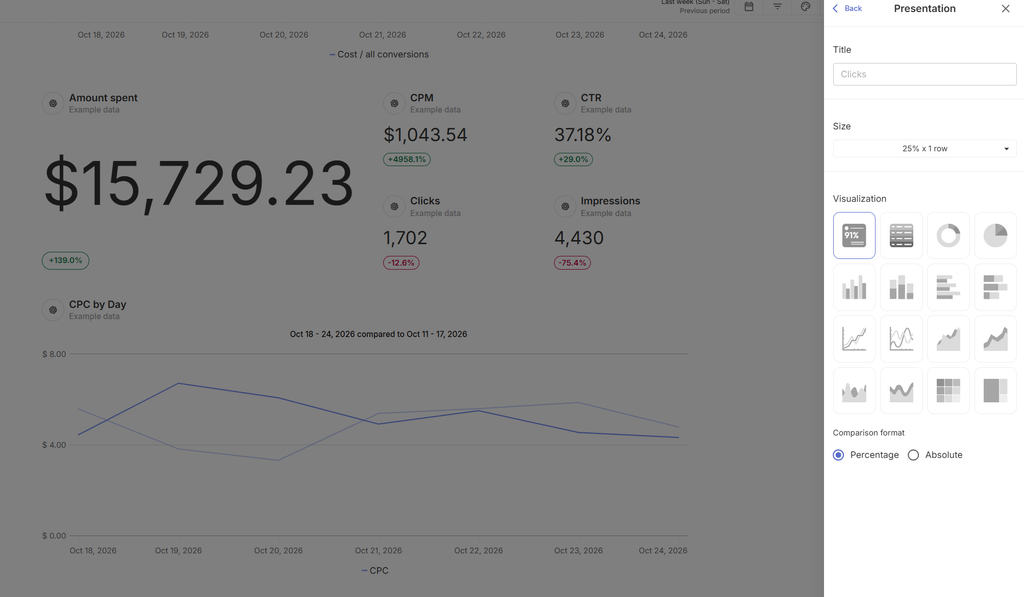
Swydo connects to ChatGPT Ads directly, so the delivery and cost metrics refresh on their own and sit next to Google Ads, Meta Ads, Microsoft Ads and LinkedIn Ads in the same report. Outcomes come from GA4, which gives you the full Decide, Diagnose, Verify stack in one place.
- Connect ChatGPT Ads. In the client’s Data Sources, add OpenAI Advertising and paste an API key from your OpenAI platform account. Swydo pulls impressions, clicks, cost, CPC, CTR and CPM at the campaign, ad group and ad level, along with ad previews. The ChatGPT Ads report template gives you a ready-made starting layout.
- Add GA4 for the outcome side. With the paid ChatGPT channel set up, the GA4 integration shows ChatGPT-paid sessions, conversions and revenue on the same page as spend. Click-to-session rate and a GA4-based CPA come straight from those two sources.
- Add Ads Manager conversions if you want them. If a client wants the platform’s own attributed conversions or Order Created ROAS alongside GA4, schedule a daily export from OpenAI’s Reporting API into Google Sheets with Make or Zapier and connect that sheet.
- Set goals and alerts. In Monitoring, then Goals, set a monthly spend or CPC target for the ChatGPT Ads source and a conversion target for the GA4 channel, so On Track or Off Track shows as the month runs. In Monitoring Alerts, use a 7-day trigger period for CPC spikes or CTR drops so the conversion lag doesn’t fire false alarms, and route alerts to Slack.
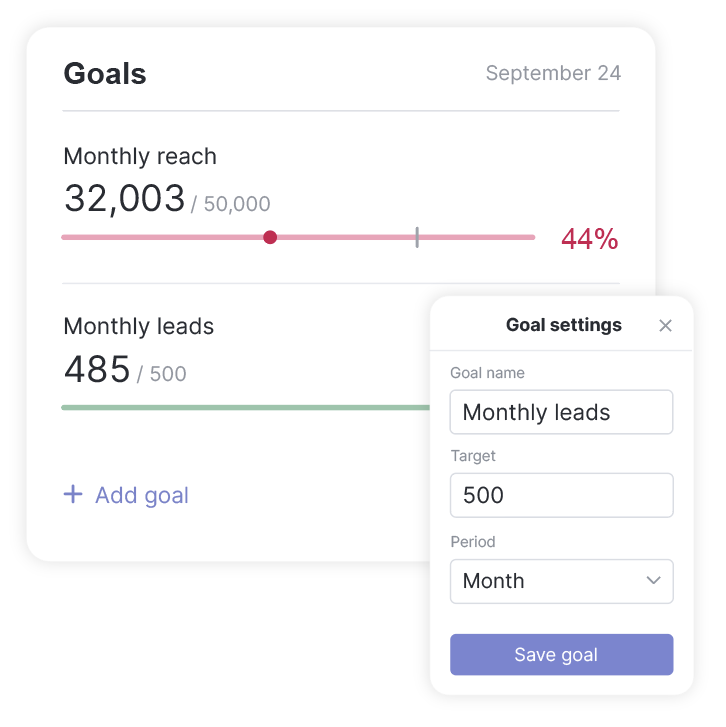
Those last two steps mark the difference between monitoring vs reporting. A monthly report tells the client what happened. Monitoring tells you while there’s still time to change it.
8 ChatGPT Ads Measurement Mistakes to Avoid
Most measurement mistakes on this channel come from carrying search-ads habits into a placement that works differently. These eight cost agencies the most money and credibility.
- Grading CTR against Google Search. The placement under a finished answer guarantees a lower CTR, so judge on CPA and conversion rate.
- Reading same-day CPA. Spend lags hours and conversions lag days.
- Leaving ad URLs untagged. Paid clicks blend into organic ChatGPT referrals in GA4 and skew both channels at once.
- Mismatching the conversion event name. One wrong character means zero reported conversions, and they never come back.
- Expecting ROAS from lead-gen campaigns. Order Created ROAS counts purchases only, so measure lead value in the CRM.
- Calling results too early. A $1,000 test at a $3 CPC buys about 333 clicks, and at a 2% conversion rate that’s roughly seven conversions, far too few to separate signal from noise. Budget for enough conversions to judge, or read post-click conversion trends first.
- Changing attribution windows mid-test. The reported numbers move while actual performance stays the same, and every before-and-after comparison breaks.
- Forgetting who can’t see the ads. Plus, Pro and Business users never see ChatGPT ads, so if your buyers sit on paid workplace seats, weak results may reflect the audience rather than your campaigns.
Final Thoughts
ChatGPT Ads rewards advertisers who measure outcomes. Decide on CPA, post-click conversion rate and incremental lift, and troubleshoot with the rest.
Nobody publishes an official benchmark. So your first clean 30 days become the standard every later month is measured against. Get tracking right before launch, let conversions settle, and keep the channel on the same report as the rest of your paid media.
For the wider picture, these guides on PPC metrics and the marketing KPIs clients care about round out the reporting side.
ChatGPT Ads Metrics FAQ
Quick answers on what to track, what it costs and how to prove it works
Cost per acquisition (CPA), post-click conversion rate and incremental lift. Those three show whether ChatGPT Ads produce customers at a price worth paying.
CTR, CPC and CPM explain why those numbers move, and click-to-session rate confirms your tracking is working. Decide budget on the first group and use the rest to fix campaigns.
Impressions, clicks, spend, CTR, average CPC, average CPM and conversions, at the campaign, ad group and ad level. E-commerce advertisers also get Order Created Sales and Order Created ROAS.
You can split results by device, country and platform. Demographics, reach, frequency and auction insights aren’t available.
It depends on what you pay for. Each objective has one primary metric and a few that explain it.
| Objective | Primary metric | Supporting metrics |
|---|---|---|
| Views (CPM) | Branded search and direct traffic lift | CPM, impressions, CTR |
| Clicks (CPC) | Post-click conversion rate | CPC, CTR, click-to-session rate |
| Conversions | CPA | Post-click conversion rate, CPC, view-through conversions |
No. Conversations stay private from advertisers, and ads match on context hints rather than keywords, so there’s no prompt or query report.
The practical workaround is one landing page per ad group theme. Comparing conversion rates across themes shows which intents bring buyers.
The ad appears below an answer that has already solved most of the user’s question, so fewer people need to click. On Google, the ad shows up while the person is still looking.
That makes CTR a weak success metric on ChatGPT. Use it to compare your own ads against each other, and judge the channel on CPA instead.
Roughly 0.6% to 1.9%, depending on the country, with the U.S. near 0.73% in Graphite and Similarweb panel data. OpenAI doesn’t publish official benchmarks.
| Market | CTR |
|---|---|
| Brazil | 1.91% |
| Japan | 1.53% |
| Canada | 0.75% |
| United States | 0.73% |
| New Zealand | 0.60% |
OpenAI suggests starting bids of $3 to $5, and advertisers have reported CPCs from about $3 to $22. Competition in your vertical decides where you land.
Your real ceiling is target CPA multiplied by conversion rate. A $120 target CPA with a 2% conversion rate supports a CPC of up to $2.40.
Modeled estimates from First Page Sage run from about 0.2% in financial services to 6.3% in higher education, with B2B SaaS near 1.7% and e-commerce near 2.3%.
Treat those as a rough guide. Your own first month of clean data is a better benchmark than any published average.
Any ROAS above your break-even point, which is 1 divided by your gross margin. With a 40% margin, break-even ROAS is 2.5, so anything above that makes money on attributed sales.
No official ROAS benchmark exists, and last-touch reporting can understate the channel. Pair ROAS with a holdout test before scaling.
No. Conversions campaigns optimize toward conversions but are still billed per valid click, so CPC and conversion rate together decide your CPA.
In the U.S., the minimum is $25 per campaign per day, and OpenAI averages that amount over seven days. Daily spend can run above the set budget on busy days as long as the weekly average holds.
The technical minimum isn’t a useful test size, though. Most campaigns need far more to produce enough conversions to judge.
Multiply your target CPA by the number of conversions you need to make a decision. At an $80 target CPA and 30 conversions, that’s about $2,400 in media for one campaign.
Fewer conversions than that and random swings will look like real results. Keep the first test to one or two campaigns so the budget isn’t spread thin.
Plan for at least 30 days, and longer if conversions come in slowly. Conversions take up to two days to report, and early CTR and CPC swings settle once delivery stabilizes.
Agree on the success metric and the end date before launch. Deciding afterward makes it too easy to call any result a win.
Compare them on CPA for the same conversion event, never on CTR. If ChatGPT Ads deliver customers at or below your paid search CPA, the channel is worth more budget.
In one case OpenAI published, WeightWatchers saw an attributed CPA 15.3% below its blended paid search. That’s a single brand, so test against your own numbers.
Install the OpenAI Pixel and the Conversions API, and send the same event ID from both so OpenAI can deduplicate them. Event names must match exactly, or Ads Manager reports zero conversions and never backfills them.
Add UTM parameters to every ad URL so GA4 can see the same traffic.
Tag every ad URL with utm_source=chatgpt and utm_medium=paid, then create a GA4 custom channel group rule for that combination placed above the referral rules.
Untagged ad clicks show up as chatgpt.com referrals, mixed in with organic mentions. That inflates your AI visibility numbers and hides paid results. This guide shows how to track AI traffic in GA4 on the organic side.
oppref is a click reference parameter ChatGPT adds to your landing page URL. It ties a conversion back to the ad click that drove it.
The Conversions API doesn’t capture it automatically. Your site needs to store it when the visitor lands and send it back with the conversion event.
Click-through windows can be 7, 14 or 30 days, and view-through is either off or one day. Attribution is last-touch, and a click wins over a view when both qualify.
Window settings change reporting only, not bidding or billing. Pick the one that matches your sales cycle and leave it unchanged.
Yes, if you turn on the one-day view-through window. It counts people who saw your ad, didn’t click, and converted within a day.
Check which columns your account includes in Conversions, and report view-throughs separately so clients can compare CPA with GA4.
The tools count different things at different times. Ads Manager dates conversions to the ad interaction and reports them up to 48 hours late, while GA4 dates them to when they happened and counts sessions instead of clicks.
Reconcile with the conversion-time column in Ads Manager and wait two days before closing a reporting period.
Impressions, clicks and CTR update about every 15 minutes. Spend lags 7 to 8 hours, and conversions take 24 to 48 hours, so same-day CPA is always incomplete.
Run a geo holdout. Show ads in a set of matched regions, keep them off in a control set, and compare conversion rates over the same period.
OpenAI works with incrementality partners such as Haus, Measured and WorkMagic. A cheaper signal is to watch branded search and direct traffic in the regions where ads run.
Lead with CPA against target, post-click conversion rate, pipeline value or ROAS, and the status of any incrementality test. Put CTR, CPC and CPM on a second page as diagnostics.
Swydo connects to ChatGPT Ads natively for spend, clicks, CPC, CTR and CPM, and GA4 adds the conversions and revenue, so both sides of the story sit in one automated client report.
No. Order Created ROAS only counts attributed purchase events. Lead generation campaigns can fill pipeline and still show little or no ROAS.
For lead gen, measure return in your CRM using closed revenue or weighted pipeline from ChatGPT-sourced leads.
Yes. Ads Manager exports CSV files, and the Reporting API returns campaign data for dashboards and spreadsheets. Hourly data goes back about 30 days, and daily data goes back a full year.
Pull data on a schedule so you aren’t limited by those retention windows.
Free and Go users. Ads don’t appear on Plus, Pro or Business plans, or for users identified as under 18.
If a client’s buyers mostly use paid workplace seats, weak results may reflect who can see the ads rather than how the campaigns are built.
No. OpenAI states that ads don’t influence the answers ChatGPT gives. Paid placements and organic mentions are separate.
Track them separately too. Ad performance belongs in your paid media report, and brand mentions in ChatGPT answers belong in AI visibility reporting.
Self-serve ads are available in dozens of countries, and the list keeps growing. Check OpenAI’s Ads Manager availability page for the current list before planning a campaign.
Results vary a lot by market, so report each country separately.
Put ChatGPT Ads CPA, conversions and GA4 traffic in one client report, with alerts when costs drift.
Start Your Free Trial Today