
TL;DR: A winning PPC proposal contains 11 sections: cover, executive summary, about your agency, audit/research findings, goals, strategy, timeline, investment options, case studies, terms, and signature. Spend 3-5 days on discovery before writing. The industry-average proposal close rate is around 20%, rising to about 36% for agencies using disciplined proposal software. The biggest improvements you can make today: align proposals to the prospect’s business outcomes (not service lists), present 2-3 pricing options instead of one, and address how AI Overviews have changed paid search expectations.
What Is a PPC Proposal?
A PPC proposal is a document that outlines how a marketing agency will manage a prospect’s paid advertising campaigns, including strategy, scope, timeline, pricing, and expected outcomes.
It serves two functions: it’s a sales document used to win the contract, and it becomes the delivery roadmap once signed. A strong PPC proposal demonstrates understanding of the prospect’s business, positions the agency as the strategic solution, sets clear expectations, and justifies pricing against measurable outcomes.
What Should a PPC Proposal Include? (The 11-Section Framework)
Every effective PPC proposal contains these 11 sections, in this order:
- Cover Page — Agency name, prospect name, date, contact details
- Executive Summary — One-page synthesis of the prospect’s problem, your solution, and projected outcome
- About Your Agency — Brief positioning, not a company history
- Audit and Research Findings — What you found in their current account, market, or competitive landscape
- Goals and KPIs — Specific, measurable targets tied to business outcomes
- Strategy — How you’ll achieve the goals, with platform-specific approaches
- Scope of Services — What’s included and explicitly what’s not
- Timeline — 30/60/90-day phases with milestones
- Investment — 2-3 pricing options framed around ROI
- Case Studies — 2-3 relevant examples from similar clients
- Terms and Signature — Contract terms and clear next steps
The remainder of this article explains how to write each section to convert.
The Framework
11 Sections That Turn a Proposal Into a Signed Contract
Cover Page
Executive Summary
About Agency
Audit & Research
Goals & KPIs
Strategy
Scope of Services
Timeline
Investment
Case Studies
Terms & Signature
Setup & Context · Sections 1–3
Discovery & Strategy · Sections 4–7
Commitment & Close · Sections 8–11
How Long Should a PPC Proposal Be?
A PPC proposal should be 8-12 pages. Shorter proposals appear superficial; longer ones rarely get read by busy executives.
Focus on depth per page rather than total length. Each page should deliver specific insights about the prospect’s business, not generic agency capability statements.
How Long Does It Take to Write a PPC Proposal?
Allow 3-5 days from first contact to proposal delivery: 2-3 days for discovery and research, then 1-2 days for writing and customization.
Speed-to-lead research is often misapplied to proposals. The frequently cited finding that companies responding to inquiries within five minutes are 21 times more likely to qualify a lead than those waiting 30 minutes refers to initial outreach, not proposal delivery. Initial response should be fast; the proposal itself benefits from discovery time. A 24-hour proposal turnaround is appropriate only for repeat clients or templated low-tier services.
What Questions Should You Ask Before Writing a PPC Proposal?
Ask these 12 questions before writing a single line of the proposal. They’re a natural extension of your client onboarding workflow, just compressed into the pre-sale window:
Business and Goals
- What does success look like in 6 months? In 12 months?
- What’s your current monthly revenue, and what’s your target?
- What’s your average customer lifetime value?
Current Performance 4. What’s your current monthly ad spend, by platform? 5. What’s your current cost per acquisition and conversion rate? 6. Who currently manages your campaigns, and why are you considering a change?
Attribution and Measurement 7. How do you currently track conversions (GA4, CRM, server-side tagging)? 8. What’s your sales cycle length, and how do leads convert to revenue?
Decision Process 9. Who else is involved in this decision? 10. What’s your budget range for management fees? 11. What’s your timeline for making a decision? 12. What other agencies are you considering, and what’s drawing you to them?
The answers shape every subsequent section of the proposal. If the prospect already has active campaigns, run a PPC audit on their account before writing — the findings give you the quantified opportunity costs you’ll need for the executive summary.
How Do You Write a PPC Proposal Executive Summary?
The executive summary should open with the prospect’s specific pain point in quantified terms, then state your strategic solution and projected outcome in three to four sentences.
Most executives read only this section, so write it last when you have the full picture. The same principles that apply when you write an executive summary for a monthly client report apply here: lead with the conclusion, then support it. Avoid generic openings like “Thank you for the opportunity.” Lead with the problem.
Weak opener: “We’re excited to share our PPC strategy with your team.”
Strong opener: “Your campaigns generate 340 leads monthly, but only 23% convert to sales meetings. Our intent-based restructure typically increases lead quality by 40-60% for similar B2B companies, which would shift your sales-meeting conversion rate above 32% within 90 days.”
The second version names a specific problem, references comparable benchmarks, and projects a measurable outcome.
How Do You Structure the Audit and Research Section?
Present audit findings as opportunity costs, not technical observations. Quantify what the current situation is costing the prospect.
Surface-level (avoid): “Your display campaigns have a low click-through rate of 0.4%.”
Strategic (use): “Your display campaigns are missing an estimated 280-340 potential customers monthly because creative targets browsers rather than buyers. Based on your $45 average cost per lead from search, this represents $12,600-$15,300 in monthly opportunity cost.”
Cover four audit dimensions: account structure, keyword/audience strategy, creative and landing page alignment, and conversion tracking integrity. Layering PPC competitor analysis on top of the account audit shows prospects exactly which keywords and audiences their rivals are winning that they’re missing — which is usually a more persuasive argument than account-level inefficiency alone.
How Should You Present PPC Pricing in a Proposal?
Present 2-3 pricing options framed around business outcomes, not a single number framed around your costs.
Most agencies now use a hybrid model: a base retainer of $250-$3,000 plus 10-20% of ad spend, with productized packages for SMBs under $10K/month and performance-bonus tiers for clients with clean attribution. The choice between these structures depends on your overall agency pricing strategy — value-based pricing supports the performance-bonus tier, while hourly-rooted models tend to default to flat retainers.
Three Pricing Models for PPC Agencies
Pricing Models
Three Ways Agencies Structure PPC Fees
Productized Package
$1,500 – $4,500 / moHow It Works
Flat monthly fee with defined scope. Predictable for both sides; no spend-tied incentive.
Best For
SMBs under $10K/month ad spend, simple single-platform campaigns.
Simplicity-FirstHybrid Retainer
$500 – $3,000 base + 10–20% of spendHow It Works
Base fee covers strategy and account work; percentage scales with campaign size.
Best For
Most mid-market clients spending $10K–$100K/month across multiple platforms.
Most CommonPerformance Bonus
Lower base + ROAS / CPA bonusHow It Works
Reduced retainer offset by bonuses tied to measurable outcome targets.
Best For
Mature accounts with clean attribution and sophisticated client teams.
Outcome-AlignedThree-Tier Option Structure Within a Proposal
Present three tiers labeled by outcome, not by service count:
- Growth tier — Optimize existing campaigns; ideal for stable accounts seeking efficiency
- Scale tier — Expand to new channels; ideal for accounts ready to test Meta, LinkedIn, or CTV
- Dominate tier — Market leadership; includes competitive intelligence, advanced attribution, executive strategy
Most prospects choose the middle tier when three are presented, which is why the middle tier should align with your preferred engagement.
What’s the Average PPC Management Fee?
Most PPC agencies charge 10-20% of total ad spend, with absolute monthly fees ranging from $1,500 to $10,000 depending on account size and complexity.
A typical agency engagement runs approximately $5,800 per month, though independent benchmarks suggest this sits at the high end of mid-market pricing.
For clients spending under $5,000/month on ads, percentage-of-spend pricing doesn’t cover agency costs, so flat productized packages or minimum monthly fees apply.
How Should You Address ROI Expectations in a PPC Proposal?
State a realistic ROAS range with attribution and cite the source, rather than claiming a single guaranteed multiple.
The frequently cited “$2 return for every $1 spent on Google Ads” figure originates from Google’s Economic Impact methodology, based on a 2009 analysis by economist Hal Varian; Google’s broader figure including organic-search lift is $8 for every $1.
Actual industry data shows paid search ROAS averages around 2.26x with wide variance by vertical — financial services average 0.7x, while heavy equipment averages 6.86x.
In a proposal, frame ROI like this: “Industry-average paid search ROAS is approximately 2.26x, with [prospect’s vertical] benchmarks at [X]. Our methodology typically improves campaign efficiency by 30-50% over the first 90 days, which would move your ROAS from [current] to [projected].” Be careful which metric you commit to — ROAS vs ROI is not a semantic difference, and a proposal promising 4x ROAS reads very differently than one promising 4x ROI to the same finance team.
How Do AI Overviews Affect PPC Strategy?
AI Overviews have reduced paid click-through rates on affected queries by approximately 68%, from 19.7% to 6.34%, based on a Seer Interactive longitudinal study of 3,119 queries and 26 million impressions.
The AI Overviews Paradox
Fewer Clicks, Better Leads — What the Seer Interactive Data Actually Shows
▼ Click-Through Rate
−68%
Paid CTR dropped from 19.7% to 6.34% on AI Overview queries
▲ Conversion Rate
65%
of industries saw conversion rates improve as info-seekers filter out
▲ Ad Presence
+394%
Growth in Google Ads appearing on AI Overview results since March 2025
Counter-intuitively, 65% of industries saw improved conversion rates because AI Overviews filter out information-seekers, leaving higher-intent clickers. Google Ads now appears on 25.56% of AI Overview search results pages, up 394% from March 2025.
What to tell clients in a proposal: expect fewer clicks at higher CPCs but higher conversion rates. Judge campaign success on revenue and qualified leads, not click volume. Prioritize being cited within AI Overviews, which lifts paid clicks by approximately 91%.
What Recent Platform Changes Should PPC Proposals Address?
Address these five platform shifts that didn’t exist when most agency proposal templates were written:
Google Ads
- AI Max for Search launched at Google Marketing Live, joining Performance Max and Demand Gen in Google’s “Power Pack” of AI-driven campaign types
- Performance Max controls expanded in January 2025: campaign-level negative keywords (up to 10,000), 50 search themes per asset group, channel-level reporting, brand exclusions on Search. Position these new controls explicitly in your proposal — they’re a meaningful update to Google Ads best practices and prospects with prior PMax experience will want to know you’re using them
Meta
- Advantage+ Shopping renamed to Advantage+ Sales Campaigns in early 2025
- Detailed targeting exclusions retired in March 2025; targeting now relies on creative variety, signal quality, and Meta’s Andromeda retrieval engine
- AI connectors opened to Claude and ChatGPT in April 2026, enabling LLM-driven campaign management
TikTok
- US divestment deal closed January 22, 2026 (TikTok USDS Joint Venture LLC; Oracle, Silver Lake, and MGX hold 45%; ByteDance retains 20%). The platform remains live for US advertisers, but creative performance volatility from algorithm retraining is a real risk to flag.
Microsoft Ads
- Copilot conversational ads report 73% higher CTR than standard placements, with cost 30-70% below Google equivalents. For B2B prospects already paying premium Google CPCs, the Microsoft Ads vs Google Ads comparison usually justifies a Bing test budget in the Scale tier of your proposal.
Retail Media and CTV
- US retail media spend grows 17.9% to $69.33B, with Amazon and Walmart capturing 89%+ of incremental dollars
- Walmart Connect now offers self-service Meta and TikTok campaigns through its platform
- Connected TV via Netflix (94M ad-tier users), Disney+, and YouTube CTV is now mid-market accessible
How Should You Handle Measurement and Attribution in a PPC Proposal?
Specify the measurement stack explicitly because cookie-only attribution is no longer reliable, even after Google reversed its third-party cookie deprecation in April 2025.
Safari and Firefox still block third-party cookies by default, so the modern measurement stack agencies should propose includes:
- Server-side tagging (GTM Server, Stape, or Tracklution) — vendors claim 15-30% improvement in data completeness
- GA4 Enhanced Conversions plus Google Ads Data Manager
- Meta CAPI (Conversions API) with Pixel deduplication
- Customer Match lists — Google’s minimum dropped from 1,000 to 100 users in 2025
- Incrementality testing, MMM, or geo-lift for advanced measurement when budgets support it
Naming these specifically in a proposal signals technical credibility and differentiates from agencies still pitching pixel-only setups. State explicitly which marketing attribution models you’ll use in reporting — data-driven, last-click, position-based — so the client isn’t surprised when month-one numbers don’t match their old last-click dashboard.
What’s the Average Proposal Close Rate for Marketing Agencies?
The industry-average proposal close rate is approximately 20%, rising to about 36% for agencies using dedicated proposal software, based on Proposify’s analysis of 2.6 million proposals across 27 industries.
Loopio puts average RFP win rates at 39%. GetAccept reports an all-industry proposal win rate of 47%.
Agencies that close above 45% on qualified pipeline are performing in the top quartile. Note that the broader 25-40% / 60-70% close-rate ranges that circulate widely in agency content don’t appear in any primary source — Proposify’s benchmark data is the most reliable available.
Benchmark
How Proposal Close Rates Actually Compare Across Sources
Reality Check: The 25–40% / 60–70% close-rate ranges circulating widely in agency content don’t appear in any primary source. Proposify’s benchmark is the most reliable available.
What Are the Most Common PPC Proposal Mistakes?
The five most common mistakes that lose deals:
- Listing every platform you support. Pick 2-3 platforms aligned to the prospect’s business; depth beats breadth.
- Feature-dumping instead of stating outcomes. Replace “we provide conversion tracking” with “you’ll know exactly which campaigns drive revenue.”
- Leading with agency credentials. Open with the prospect’s problem; credentials go in the About section.
- Vague timeline commitments. Specify 30/60/90-day milestones with measurable outcomes.
- Stating price without ROI context. Frame fees as a percentage of ad spend and show payback period.
How Do You Follow Up on a PPC Proposal?
Use a four-touch sequence over 14 days:
14-Day Sequence
A Follow-Up Cadence That Protects Momentum Without Nagging
Send Proposal + Offer 20-Min Walkthrough
Open the presentation opportunity
Share Additional Value
Competitive insight or case study; demonstrates engagement
Confirm Next Steps and Timeline
Maintain decision momentum
Professional Close-Out
Door open for future; preserves the relationship
Each follow-up should deliver value, not just request a decision. When a prospect goes silent after a proposal, a structured re-engagement sequence — not just chasing for an answer — recovers a meaningful share of those deals.
How Do You Present a PPC Proposal Effectively?
Request a 20-25 minute presentation meeting rather than emailing the proposal and waiting.
Spend 75% of the meeting on strategy and projected outcomes, 25% on logistics and process. Address concerns in real time. Close with explicit next steps and a decision timeline.
Most agencies skip presentations, which is exactly why presenting professionally wins disproportionate market share.
How Do You Turn a Signed PPC Proposal Into a Delivery Plan?
Convert the proposal’s promises directly into your reporting setup before the kickoff call. Every commitment you made — projected ROAS, lead-quality improvement, 30/60/90-day milestones — should appear as a tracked metric in the client’s first report.
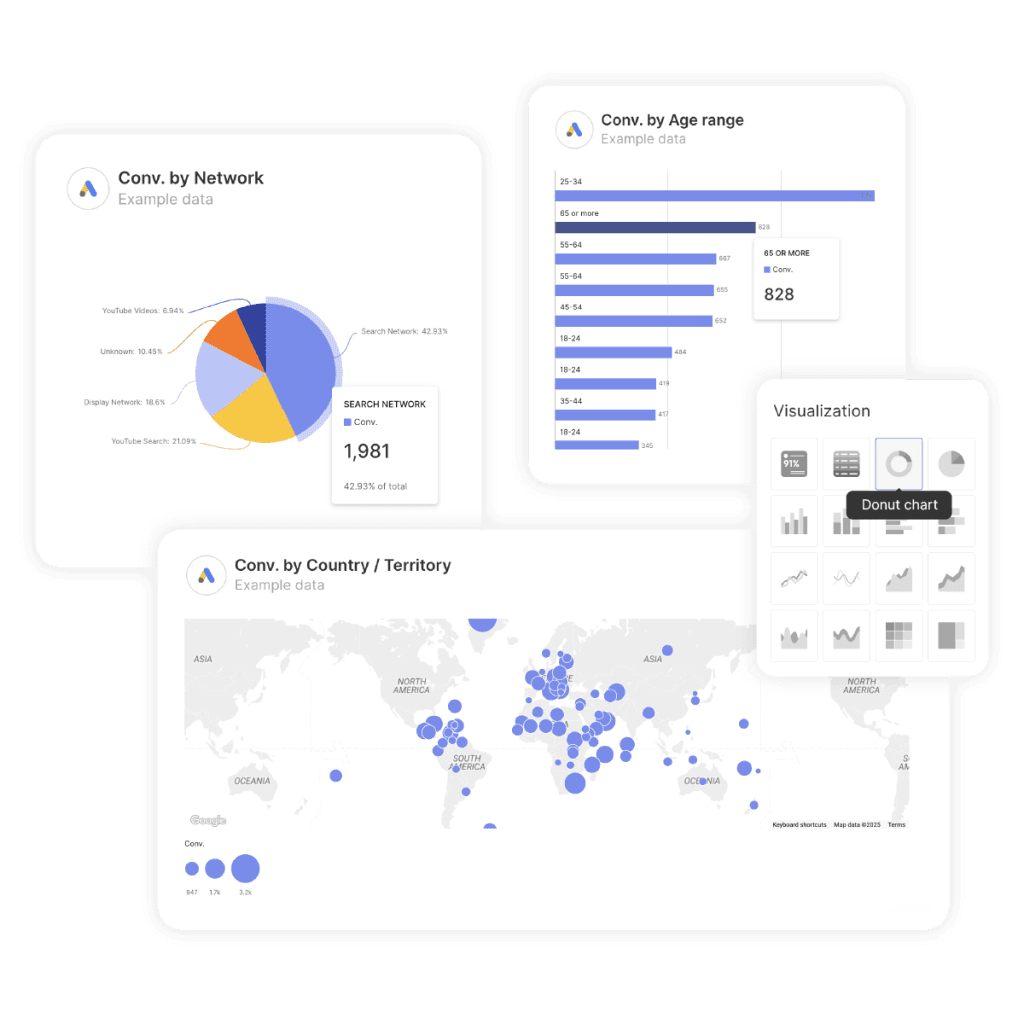
This is where having a dedicated reporting platform matters. Use PPC reporting templates that mirror the exact KPIs you promised in the proposal, so monthly reviews show progress against the original commitments rather than against arbitrary baselines. Clients who watch their proposal goals tracked in real time renew at meaningfully higher rates, which is why most client reporting best practices frameworks start with proposal alignment rather than template selection.
When Should You Walk Away From a PPC Proposal Opportunity?
Walk away when any of these conditions are present:
- Budget is unrealistic for the stated goals (typically under $3,000/month in ad spend with growth targets)
- Prospect won’t invest time in proper discovery
- Decision-making process is unclear or fragmented
- Prospect demands a proposal within 24 hours without allowing research
- Prospect is fishing for free consulting
Disqualifying poor-fit opportunities protects close rate and team capacity.
PPC Proposal FAQ
Quick answers to the questions agencies actually ask when writing PPC proposals
A PPC proposal is a document that outlines how an agency will manage a prospect’s paid advertising campaigns, including strategy, scope, timeline, pricing, and expected outcomes. It serves two purposes: it wins the contract as a sales document, then becomes the delivery roadmap once signed.
A PPC proposal should include 11 sections in this order: cover page, executive summary, about the agency, audit and research findings, goals and KPIs, strategy, scope of services, timeline, investment options, case studies, and terms with signature. The order matters as much as the content — leading with discovery findings before strategy builds credibility, while saving credentials for later keeps the focus on the prospect’s business.
A PPC proposal should be 8 to 12 pages. Shorter proposals appear superficial; longer ones rarely get read by busy executives. Focus on depth per page rather than total length — every page should deliver specific insights about the prospect’s business, not generic agency capability statements.
A PPC proposal is a sales document designed to win the contract; a scope of work (SOW) is a legal attachment that defines exactly what will be delivered once the contract is signed. The proposal sells the outcome and strategy, while the SOW protects both parties by spelling out deliverables, exclusions, and acceptance criteria. Many agencies fold a high-level scope section into the proposal and attach a detailed SOW once terms are agreed.
Free PPC proposal templates are useful as a starting structure but lose deals when used as-is. The sections, headings, and formatting can save hours of setup time, but the content inside every section needs to be customized to the specific prospect’s account, vertical, and goals. Prospects can spot a generic template within seconds, so use templates for structure only — never for pricing, strategy, or projected outcomes.
Proposal software is not required, but agencies using dedicated proposal tools close at around 36% versus the 20% industry average, according to Proposify’s analysis of 2.6 million proposals. The lift comes from electronic signatures, viewing analytics that show which sections prospects spend time on, and reusable content blocks that speed up customization. For agencies sending fewer than five proposals per month, a polished PDF works fine.
Allow 3 to 5 days from first contact to proposal delivery: 2 to 3 days for discovery and research, then 1 to 2 days for writing. A 24-hour turnaround is appropriate only for repeat clients or templated low-tier services. The frequently cited “respond within 5 minutes” rule applies to initial lead response, not proposal delivery.
Ask 12 discovery questions across four areas before writing anything. For business and goals: what does success look like in 6 and 12 months, what’s current monthly revenue and target, and what’s average customer lifetime value. For current performance: monthly ad spend by platform, current cost per acquisition and conversion rate, and who manages campaigns now. For attribution: how conversions are tracked and sales cycle length. For decision process: who else is involved, budget range for management fees, decision timeline, and which other agencies are being considered.
Open with the prospect’s specific pain point in quantified terms, then state your solution and projected outcome in three to four sentences. Most executives read only this section, so write it last when you have the full picture. Avoid generic openings like “Thank you for the opportunity” — lead with the problem instead, such as “Your campaigns generate 340 leads monthly, but only 23% convert to sales meetings.”
Present audit findings as opportunity costs in dollars, not technical observations. “Your display CTR is 0.4%” means nothing to a CFO. The same finding reframed — “your display campaigns are missing 280 to 340 potential customers monthly, representing $12,600 to $15,300 in monthly opportunity cost” — connects a technical problem directly to revenue. Cover four audit dimensions: account structure, keyword and audience strategy, creative and landing page alignment, and conversion tracking integrity.
Five mistakes lose deals consistently: listing every platform the agency supports instead of picking 2 to 3 aligned to the prospect’s business, feature-dumping instead of stating outcomes, leading with agency credentials before the prospect’s problem, giving vague timeline commitments without 30/60/90-day milestones, and stating price without ROI context or payback period. Depth on the right platforms beats breadth on all of them.
Describe the methodology and frameworks without handing over the execution playbook. Say what will be tested, how decisions will be made, and what milestones look like — not the specific keyword lists, bid adjustments, or audience configurations. A prospect should finish the strategy section understanding why the approach will work, not having enough detail to execute it themselves or hand it to a cheaper competitor.
Most PPC agencies charge 10 to 20 percent of total ad spend, with absolute monthly fees ranging from $1,500 to $10,000 depending on account size and complexity. A typical agency engagement runs approximately $5,800 per month. For clients spending under $5,000 monthly on ads, percentage-of-spend pricing doesn’t cover agency costs, so flat productized packages or minimum monthly fees apply instead.
Always present 2 to 3 pricing options framed around business outcomes, not a single number framed around costs. A single price forces a yes-or-no decision; multiple tiers shift the conversation to which option fits best. Label tiers by outcome — Growth, Scale, Dominate — not by service count. Most prospects choose the middle tier when three are presented, which is why the preferred engagement should always be positioned in the middle.
Three pricing models dominate. Productized packages ($1,500 to $4,500 flat) work best for SMBs under $10K monthly ad spend with simple single-platform campaigns. Hybrid retainers ($500 to $3,000 base plus 10 to 20% of spend) are most common for mid-market clients spending $10K to $100K across multiple platforms. Performance-bonus models pair a lower base with ROAS or CPA bonuses, and suit mature accounts with clean attribution.
Industry-average paid search ROAS is approximately 2.26x, with significant variance by vertical — financial services average 0.7x while heavy equipment averages 6.86x. Promise a range with attribution and cite the source, never a single guaranteed multiple. The frequently quoted “$2 for every $1 spent on Google Ads” comes from a 2009 Google-commissioned analysis and shouldn’t be used as a forward-looking commitment.
No — guaranteeing specific PPC results is both technically dishonest and prohibited by major platforms. Google’s advertising policies explicitly forbid guaranteed ranking claims. Replace guarantees with benchmarked projections: cite industry-average performance, reference the prospect’s vertical benchmark, then project a realistic improvement range (typically 30 to 50 percent efficiency gain over the first 90 days). This signals expertise without exposing the agency to legal or reputational risk.
Most agencies set a minimum of $3,000 to $5,000 monthly ad spend below which percentage-based pricing doesn’t cover the work involved. Below this threshold, options are a flat productized package with limited scope, a minimum monthly fee that effectively raises the prospect’s true cost, or walking away. Aggressive growth targets paired with sub-$3,000 ad budgets are one of the clearest disqualification signals.
AI Overviews reduced paid click-through rates on affected queries by approximately 68%, from 19.7% to 6.34%, according to Seer Interactive’s longitudinal study of 3,119 queries and 26 million impressions. Counter-intuitively, 65% of industries saw improved conversion rates because AI Overviews filter out information-seekers, leaving higher-intent clickers. Expect fewer clicks at higher CPCs but better conversion quality.
Tell clients to judge campaign success on revenue and qualified leads, not click volume, and to expect fewer clicks at higher CPCs. Prioritize being cited within AI Overviews, which lifts paid clicks by approximately 91%. Naming AI Overviews specifically in the proposal differentiates the agency from competitors still pitching strategies that assume traditional SERP behavior.
Specify the measurement stack explicitly because pixel-only attribution is no longer reliable — Safari and Firefox block third-party cookies by default. The modern stack includes server-side tagging (GTM Server, Stape, or Tracklution) for 15 to 30% better data completeness, GA4 Enhanced Conversions with Google Ads Data Manager, Meta CAPI with Pixel deduplication, Customer Match lists, and incrementality testing or MMM for clients with budget for advanced measurement.
Pick 2 to 3 platforms aligned to the prospect’s business model, not every platform the agency supports. Google Ads and Microsoft Ads suit high-intent search demand; Meta and TikTok suit visual discovery and consumer brands; LinkedIn suits B2B with long sales cycles; retail media (Amazon, Walmart Connect) suits ecommerce; CTV via Netflix, Disney+, and YouTube CTV is now mid-market accessible for brand-building budgets. Depth on the right platforms always beats breadth across all of them.
Tie every KPI to a business outcome, not a platform metric. CTR, impression share, and quality score are diagnostic — they belong in monthly reports, not in proposal goals. The proposal should commit to outcomes like cost per qualified lead, ROAS, pipeline value, or customer acquisition cost. Pair each KPI with a current baseline, a 90-day target, and a 12-month target so progress is measurable from the first month of the engagement.
Use 30/60/90-day phases with measurable milestones, not vague monthly commitments. Days 1–30 typically cover account audit, tracking implementation, and structural rebuilds. Days 31–60 cover testing new campaigns, audiences, and creative. Days 61–90 cover scaling what’s working and pruning what isn’t. Each phase should name specific deliverables and the metric used to judge success at the end of it.
The industry-average proposal close rate is approximately 20%, rising to about 36% for agencies using dedicated proposal software, based on Proposify’s analysis of 2.6 million proposals. Agencies closing above 45% on qualified pipeline are performing in the top quartile. The 60 to 70% close-rate claims circulating widely in agency content don’t appear in any primary research source.
Always request a 20 to 25 minute presentation meeting rather than emailing the proposal and waiting. Spend 75% of the meeting on strategy and projected outcomes, 25% on logistics and process. Close with explicit next steps and a decision timeline. Most agencies skip the presentation, which is exactly why presenting professionally wins disproportionate market share.
Use a four-touch sequence over 14 days. Day 1: send the proposal and offer a 20-minute walkthrough. Day 3: share additional value such as a competitive insight or relevant case study. Day 7: confirm next steps and timeline. Day 14: send a professional close-out that leaves the door open for future engagement. Every follow-up should deliver value, not just request a decision.
Reframe the conversation around payback period and opportunity cost, not absolute price. If the management fee is $4,000 monthly and the projected efficiency gain returns $12,000 in additional revenue, payback is under two weeks. If the prospect is comparing to a cheaper agency, ask what that agency’s measurement stack and attribution methodology look like — most lower-priced competitors lack the technical infrastructure, and surfacing that gap moves the conversation off price.
Walk away when budget is unrealistic for stated goals (typically under $3,000 monthly ad spend with growth targets), the prospect won’t invest time in proper discovery, the decision process is unclear or fragmented across too many stakeholders, a proposal is demanded within 24 hours without research time, or the prospect is fishing for free consulting. Disqualifying poor-fit opportunities protects close rate and team capacity.
Convert every promise in the proposal directly into the client’s reporting setup before the kickoff call. The projected ROAS, lead-quality improvements, and 30/60/90-day milestones should all appear as tracked metrics in the first monthly report. Clients who can see their original proposal goals tracked in real time renew at meaningfully higher rates than clients whose reports measure arbitrary baselines disconnected from what they actually agreed to.
Turn every PPC proposal promise into a tracked metric your clients can see.
Start Your Free Trial Today